MI5's chief asks for new laws. A bill or order often followed within a month.
MI5 head Sir Ken McCallum wrote on the 25th anniversary of 9/11 that national security is now a shared job for government, business and the public.
What happened
Sir Ken McCallum, Director General of MI5, wrote an article for The Independent on the 25th anniversary of the attacks, arguing that the terrorist threat now sits alongside threats from capable states, that contending with state-backed sabotage, interference and cyber attacks demands new laws as well as new tradecraft, and that government, business, academia and the public must treat national security as a shared national endeavour.
The article broke with MI5’s habit of speaking in public once a year. Sir Ken McCallum wrote that terrorists still want to kill large numbers of people. He named the state threats he meant: sabotage, secret interference and attacks on power stations. He said countering them needs new laws as well as new spy methods.
Broadcasters called it a call to arms and a rare public move by a serving spy chief. McCallum warned that the next shock may be being planned somewhere nobody is watching. MI5 normally speaks in public through one annual threat update, given every October since 2023.
The UK rewrote its security law only this summer. The National Security (State Threats) Act 2026 was introduced on and became law on . It lets the government name organisations that work for hostile states. The Home Office named the first groups under it on .
Sources: The Independent, Sky News, Reuters, GOV.UK (2)
The Pattern
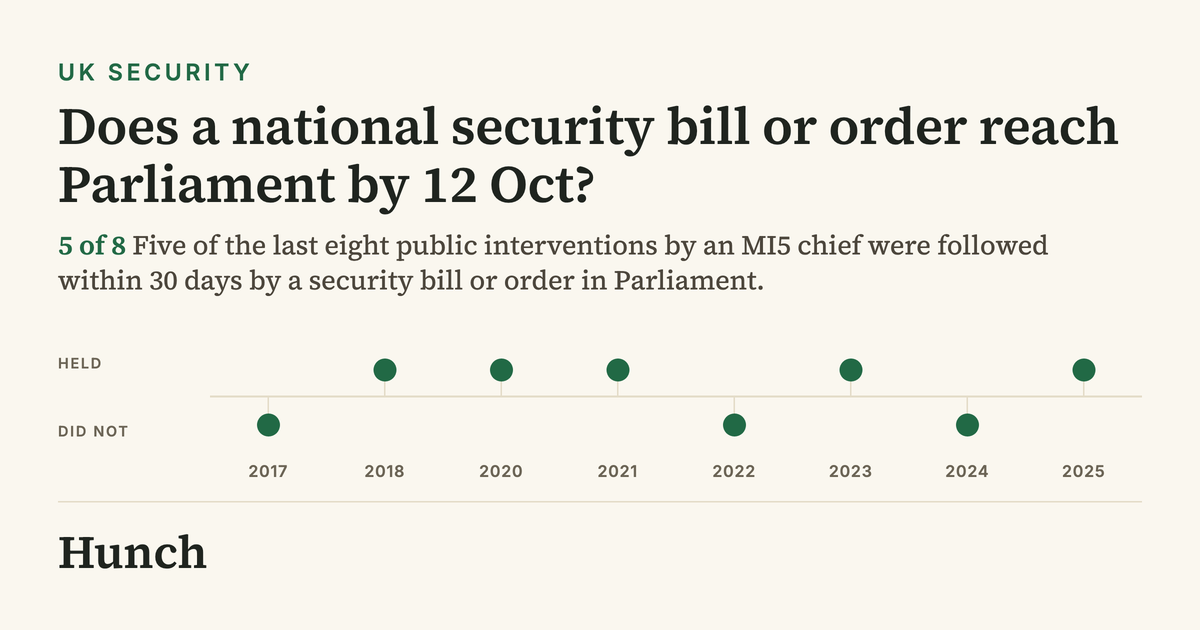
We looked at every public speech or statement by the head of MI5 published on the MI5 website since 2017, eight in all. For each one we checked the next 30 days. Was a national security bill put before Parliament for the first time, or did the government make an order that bans, renames or names a group? The newest come first.
Show the other 6 cases
The Read
History leans towards a new security bill or order by . Five of the eight past MI5 interventions were followed by one within 30 days. The machinery is also already running. The power to name groups under the State Threats Act is ten weeks old, the first groups were named in July, and naming more needs only an order, with no new bill.
There are two weak spots. Four of the five interventions that were followed by a bill or order fell in October or November, when the year in Parliament starts again, and this article came in September. The pattern may also be following the calendar of Parliament more than the spy chief. MI5 updates come mostly in October, which is also when bills arrive after a King’s Speech, the government’s list of planned laws.
The answer would be no if the government treats the article as support for the Act it passed in July and puts forward nothing new. The question on a threat update would be answered no if MI5 decides the September article was this year’s public appearance.
Disclaimer
Hunch works only from sources that are publicly available, and publishes on the basis of analysis of that material. We do not form an editorial opinion or take sides, we give a simpler and wider view of news that already exists. If information in a source we used was inaccurate, distorted, or later disputed but had already entered our analysis, Hunch accepts no liability for that. Predictions are not advice. Phase 1 markets use Hunch Points, not money.
Published by Hunch under the Editorial Code. Complaints and corrections: /contact/.