Abdul El-Sayed beat his party's pick in Michigan. Most who did that then lost.
Barack Obama will rally for Abdul El-Sayed in Detroit on 24 October. Party leaders backed his rival in the Senate primary in August.
What happened
Barack Obama will head to Detroit this month to rally with Abdul El-Sayed, a show of establishment support for a progressive insurgent in Michigan, one of the most consequential Senate races in the country.
Former US President Barack Obama will hold a rally in Detroit on . He will appear with Abdul El-Sayed, the Democratic candidate for the US Senate in Michigan, and Jocelyn Benson, the Democratic candidate for governor. The rally is on the first day of in-person early voting, 10 days before the election on .
In August El-Sayed won the Democratic primary, the vote that picks the party’s candidate, by less than one point. His rival, Congresswoman Haley Stevens, had the support of Senate Democratic leader Chuck Schumer and Senator Gary Peters. Her side spent nearly nine times more on advertising, and the pro-Israel group AIPAC and its allies spent a record $30m against him.
Detroit is where the rally matters most. Stevens won Wayne County, which includes the city, with about 51% of the primary vote to El-Sayed’s 45%. More than three-quarters of Detroit’s people are Black, and Obama is still highly popular there.
The seat is open because Peters, a Democrat, is retiring. El-Sayed faces Republican Mike Rogers, a former congressman who lost a Senate race in Michigan in 2024 to Elissa Slotkin, although Donald Trump won the state. A Marist poll of registered voters in late September put El-Sayed ahead by 51% to 44%. The race is one of a handful that will decide which party controls the Senate.
Sources: The Guardian
The Pattern
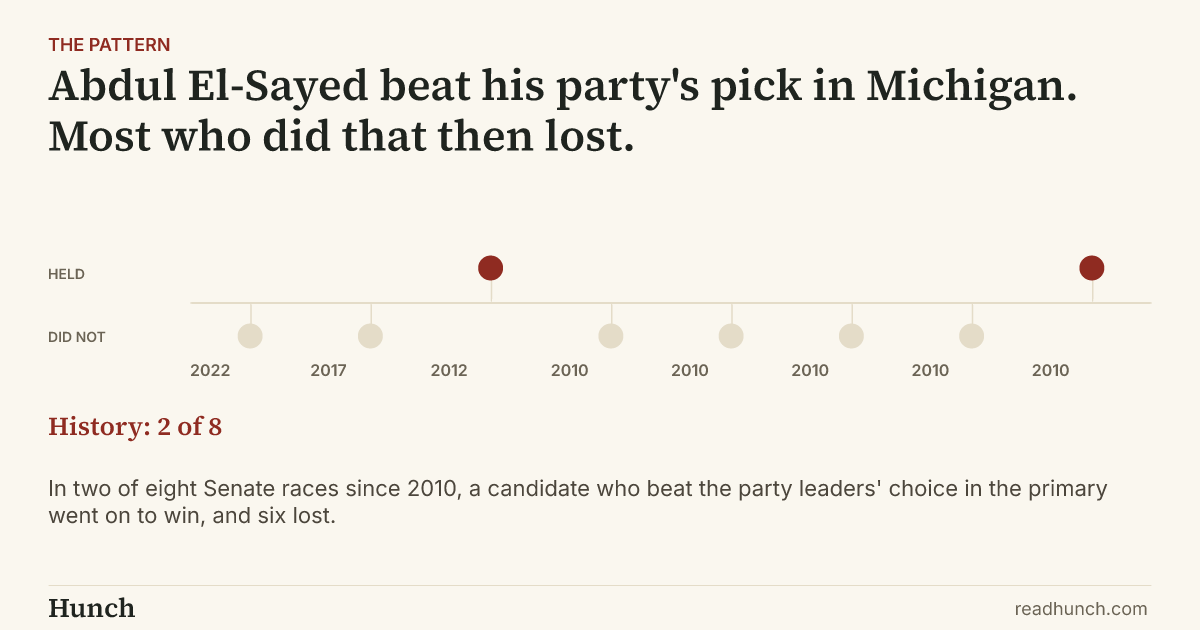
We looked for cases where a candidate won a party primary for the US Senate against the person the party’s leaders backed, and then faced the general election. We found eight since 2010, seven of them Republicans. In two, the seat was open and it belonged to the candidate’s own party, as in Michigan now.
Show the other 6 cases
The Read
Six of the eight candidates lost in November. The two winners, Rand Paul in Kentucky in 2010 and Ted Cruz in Texas in 2012, both ran for open seats their own party already had. That is the situation in Michigan now: the seat is open and it belongs to a Democrat. Of the five who ran from the party out of power in the middle of a president’s term, as El-Sayed does, one won.
There are reasons to read this with care. Seven of the eight were Republicans and five ran in the same year, 2010, so the Democratic side has only one example: Joe Sestak, who lost in Pennsylvania by two points. Four of the six losses were by less than five points, and in Texas in 2012 Cruz won but got fewer votes than his party’s candidate for president. The Marist poll in late September and the result on will show whether Michigan follows the open-seat winners or the others.
Disclaimer
Hunch works only from sources that are publicly available, and publishes on the basis of analysis of that material. We do not form an editorial opinion or take sides, we give a simpler and wider view of news that already exists. If information in a source we used was inaccurate, distorted, or later disputed but had already entered our analysis, Hunch accepts no liability for that. Predictions are not advice. Phase 1 markets use Hunch Points, not money.
Published by Hunch under the Editorial Code. Complaints and corrections: /contact/.