Mike Johnson loses the top job in the US House. Will he quit his seat by January?
Republicans lost the US House on 3 November, and Speaker Mike Johnson will not lead them next year. He has not said if he will serve the full term.
What happened
House Speaker Mike Johnson is stepping down from leadership and has been noncommittal in recent days about his long-term future in Congress.
Republicans lost more than 40 seats in the US House on . Democrats will run the House from January with a wide majority. The next day Speaker Mike Johnson, who won his own seat in Louisiana again, told his staff he would not stay on as Republican leader. On House Republicans chose Jim Jordan as their new leader by 106 votes to 73.
The terms of the President and Vice President shall end at noon on the 20th day of January, and the terms of Senators and Representatives at noon on the 3d day of January … and the terms of their successors shall then begin.
US Constitution, 20th Amendment, Section 1
Johnson stays Speaker until noon on . That day the old Congress ends and his new two-year term begins. He has not said if he will serve all of it. On he said “I’m still in charge here till early January”, and after that “we’ll see how all that develops”. On he said he would “take the oath in January” and had not thought much beyond that. If he says nothing, he takes his seat as an ordinary member when the new Congress meets.
In October Johnson talked about a life outside politics. On he told Fox News he could go back to his hometown of Shreveport and start a lawn business if his party lost. On he said the remark was “tongue in cheek”. On NBC News wrote that it is unclear if he will serve his full term “or leave early as other former speakers have done”.
Sources: CBS News (2, 3, 4), NBC News, US National Archives, The Guardian, PBS NewsHour
The Pattern
We looked for cases where a party leader in a lower house lost power at an election, won their own seat again and then gave up the party leadership. We searched US Speakers and leaders in Britain, Canada, Australia and New Zealand, where an empty seat goes to a local vote, as in the US. We found ten such leaders from 1972 to 2024: two US Speakers and eight former prime ministers.
Show the other 8 cases
The Read
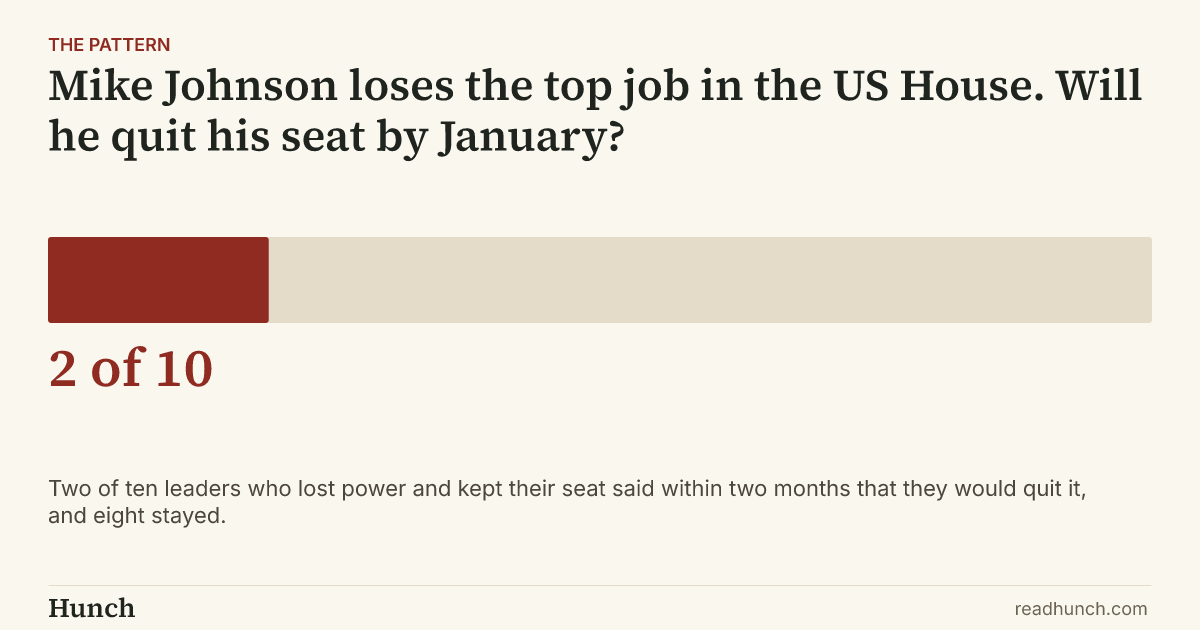
Two of the ten leaders quit within two months, and both were Australian prime ministers before 2000. Both left government with the defeat. A US Speaker is different: Johnson still runs the House until the new term starts on . The two US Speakers among the ten, Dennis Hastert in 2006 and Nancy Pelosi in 2022, both stayed in the House well past two months. Johnson’s own words on also point to January in the House.
There are reasons for doubt. Five of the ten leaders were Australian, and US Speakers have their own habits: NBC News notes that other former Speakers left early. Johnson has also refused to promise that he will serve the full term. Kevin Rudd shows how close the timing can be: he quit on day 67, about a week after the two-month mark.
Sources: Parliament of Australia (2), CBS News (2, 3), BBC, US National Archives, NBC News, The Guardian
Disclaimer
Hunch works only from sources that are publicly available, and publishes on the basis of analysis of that material. We do not form an editorial opinion or take sides, we give a simpler and wider view of news that already exists. If information in a source we used was inaccurate, distorted, or later disputed but had already entered our analysis, Hunch accepts no liability for that. Predictions are not advice. Phase 1 markets use Hunch Points, not money.
Published by Hunch under the Editorial Code. Complaints and corrections: /contact/.