"In the new year": will the UK's youth jobs plan cut disability help for under-25s?
On 17 November the UK government backed a review by Alan Milburn on young people out of work and study. It promised a plan in the new year.
What happened
In the new year, the Government will publish a White Paper and, following that, legislation.
Almost one million people aged 16 to 24 in the UK are not in work, education or training. That is 13% of the age group. On Alan Milburn, a former Labour health secretary, published a review ordered by the government on how to bring that down to around 5% within ten years.
To help pay for it, the review would change benefits for people under 25. They would no longer get the health top-up of Universal Credit, which is extra money when health limits work. They would also lose Personal Independence Payment (Pip), which helps with the extra costs of a disability. A new Youth Allowance at the basic Universal Credit rate and a new Additional Cost Allowance would replace them.
The government agreed with the review’s core ideas the same day. Work and Pensions Secretary Pat McFadden told MPs it supports a guarantee of a route into work or training, set in law, and help run by local areas. The benefit changes will be weighed together with a separate review of Pip led by Sir Stephen Timms, whose final report is not out yet.
We will have the Timms Review reporting soon. In the new year, the Government will publish a White Paper and, following that, legislation.
Pat McFadden, Work and Pensions Secretary, 17 November 2026
Last year Labour MPs refused to back £5bn of benefit cuts. That reform, under Sir Keir Starmer, failed over its effect on disabled people. Prime Minister Andy Burnham said on that he wants to “get stuck into it right now”. Some Labour MPs and the Unison union say the benefit changes could push young people into poverty.
Sources: GOV.UK (2, 3), BBC (2)
The Pattern
We looked for cases where a review ordered by the UK government advised cutting a benefit for a group of people, and the government had to decide whether to make it law. We found four such reviews since 2005, all about the age when the pension starts. None was about disability payments, and none came a year after the government’s own MPs blocked a cut.
Show the other 2 cases
The Read
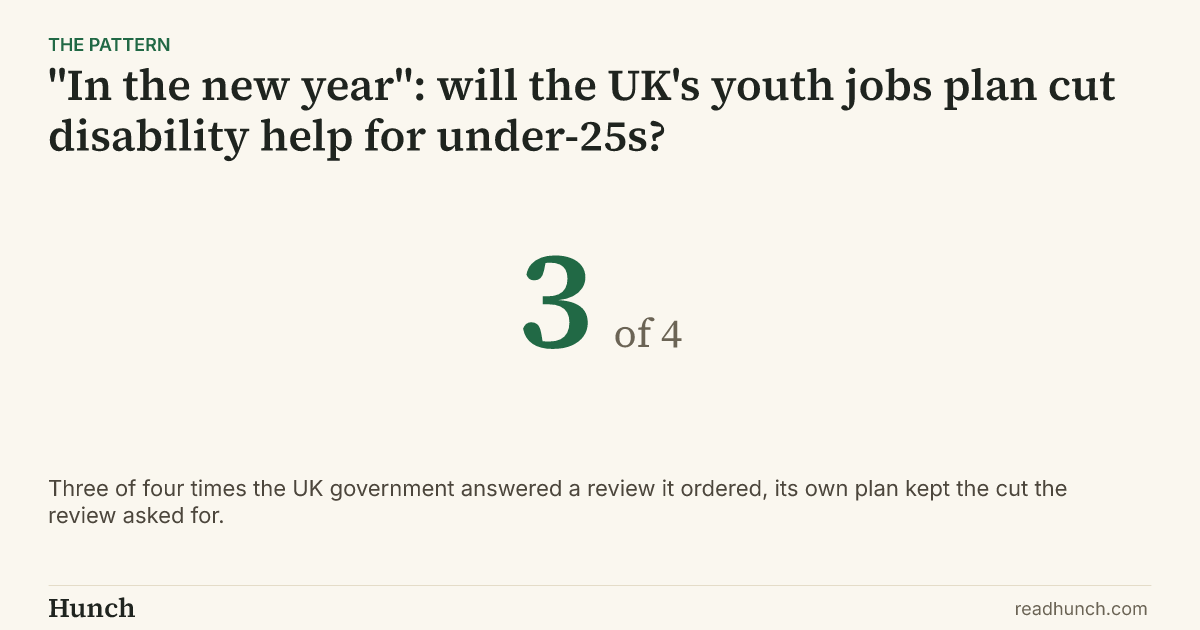
In three of the four reviews, the government’s own plan kept the cut. The plans came 99, 118, 176 and 195 days after the review; this review came out on , so is 134 days later and is 195. The cut became law twice, after 603 and 777 days. We will return on to see whether the benefit changes have become law. In 2017 and 2022 the government put the decision off until after an election, and the pension age in law has not changed.
There are reasons for doubt. All four reviews were about the pension age, not disability payments. In 2011 the government’s first answer was a speech taking the review as the basis for talks, not a full plan. This time the government has tied its answer to the Timms review of Pip, which has no publication date, and named Labour MPs say they cannot back cuts to Pip for young people.
Sources: GOV.UK (2, 3), The Guardian (2), legislation.gov.uk (2), BBC, BBC
Disclaimer
Hunch works only from sources that are publicly available, and publishes on the basis of analysis of that material. We do not form an editorial opinion or take sides, we give a simpler and wider view of news that already exists. If information in a source we used was inaccurate, distorted, or later disputed but had already entered our analysis, Hunch accepts no liability for that. Predictions are not advice. Phase 1 markets use Hunch Points, not money.
Published by Hunch under the Editorial Code. Complaints and corrections: /contact/.