Mongolia's ruling party v a bribery scandal: who wins the early election?
Mongolia's President Ukhnaa Khurelsukh said on 17 November he will resign over bribery claims he denies. The law then calls an early election.
What happened
falsely accused and defamed with allegations of extremely serious crimes
In Mongolia a president’s resignation takes effect only when parliament accepts it. After that the law says an early election must be held within four months. Parliament sets the date within 20 working days, and voting day must be at least 70 days away.
On President Ukhnaa Khurelsukh said he will resign. The opposition Democratic Party had accused him of corruption and threatened to remove him through parliament. He is accused of taking $25m over a railway contract given to the company Bodi International without a tender. He and Bodi deny it.
The claim first came from inside his own party. Nyambaatar Khishgee, a former mayor of the capital Ulaanbaatar, belongs to the ruling Mongolian People’s Party (MPP), but to another group within it. Until the election, the speaker of parliament, Sandag Byambatsogt of the MPP, takes on the president’s duties.
Khurelsukh cannot run again. Since 2019 Mongolia’s constitution allows one six-year term, and he was elected in . In March parliament appointed the country’s third prime minister in under 12 months, after weeks of protests against corruption.
Sources: The Straits Times, DW, Parliament of Mongolia, Legalinfo Mongolia, Al Jazeera
The Pattern
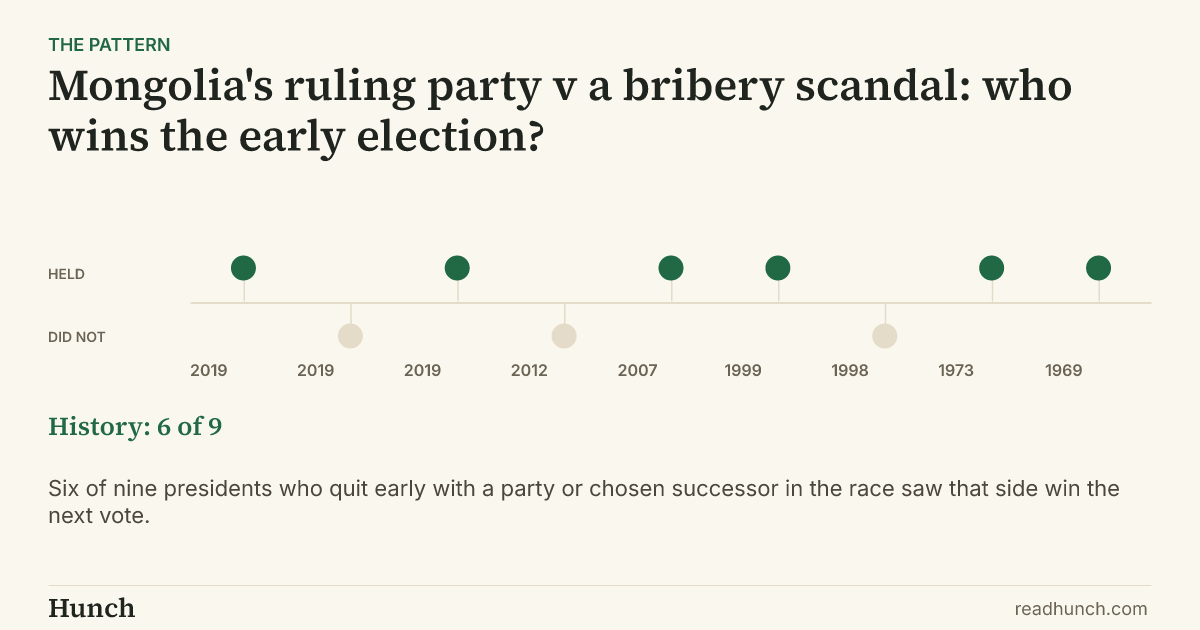
We looked for cases where an elected head of state chose to resign before the end of the term, and the resignation took effect. We found nine such resignations since 1969 where the leader, his party or his chosen successor stood in the next vote. In two of them, Russia and Kazakhstan, the leader handed power to a successor he picked, while in Mongolia the speaker takes over by law.
Show the other 7 cases
The Read
In six of the nine, the party or chosen successor of the leader who left won: France 1969, Argentina 1973, Russia 2000, Georgia 2008, Kazakhstan 2019 and Bolivia 2020. Seven of the nine votes came within 86 days, and Mongolia’s law allows four months.
There are reasons for doubt. In three of the six wins the leader ran again himself, in Georgia, or gave the job to a successor he picked, in Russia and Kazakhstan, and Khurelsukh can do neither. In three more resignations, in Georgia in 2003 and Kyrgyzstan in 2005 and 2020, the people who pushed the leader out won the next vote.
Sources: Conseil constitutionnel, The Guardian, DW, BBC, Al Jazeera, BBC
Disclaimer
Hunch works only from sources that are publicly available, and publishes on the basis of analysis of that material. We do not form an editorial opinion or take sides, we give a simpler and wider view of news that already exists. If information in a source we used was inaccurate, distorted, or later disputed but had already entered our analysis, Hunch accepts no liability for that. Predictions are not advice. Phase 1 markets use Hunch Points, not money.
Published by Hunch under the Editorial Code. Complaints and corrections: /contact/.