Montenegro nears the end of EU entry talks. Will Croatia let it finish this year?
Montenegro has closed 23 of the 33 chapters of its EU entry talks. The EU aims to close the rest by 31 December, but every member must agree.
What happened
The EU and Montenegro provisionally closed chapters 1 and 12 of the entry talks, bringing the total closed to 23 of 33.
Montenegro has closed 23 of the 33 chapters of its EU entry talks. The talks are split into chapters, one for each area of EU law, such as food safety or courts. On EU ministers and Montenegro closed two more, on the free movement of goods and on food safety. Thomas Byrne, Ireland’s minister for European affairs, chaired the meeting and said Montenegro “remains on track to close all negotiating chapters by the end of the year”. Ireland leads the Council of the EU until .
Each of the 27 EU countries can hold up a chapter. No chapter closes until every EU government is satisfied, and the talks end only when all chapters are closed. After that, all 27 countries must also approve an entry treaty.
On the European Commission, which guides the talks for the EU, said in its yearly report that the talks could realistically close by the end of 2026, and an entry treaty could be signed by . Montenegro wants to become the 28th member in 2028.
Subject to Member States’ agreement, Montenegro could provisionally close the remaining chapters by the end of this year.
European Commission, 2026 enlargement package
Croatia, Montenegro’s neighbour and the newest EU member, has set eight demands first. In a paper reported on , it tied six of them to chapter 23, on courts and basic rights, and two to chapter 31, on foreign and security policy. Most go back to the wars of the 1990s, when Yugoslavia broke up. They include payment to Croatians held at the Morinj camp in 1991 and 1992, the fate of 14 missing people, and the Jadran, a training ship that both countries claim.
On Montenegro’s government met two of the demands: it renamed a swimming pool in Kotor and approved a memorial plaque at Morinj. On Croatian Prime Minister Andrej Plenković said four of the six demands left are for the government alone, but two touch the courts or records of missing people. Diplomats from many EU countries told RFE/RL they find Zagreb’s position “unhelpful”. From Lithuania leads the Council.
Sources: ANSA, European Commission (2), GOV.IE, Irish presidency of the Council of the EU, The Independent, Balkan Insight (2), RFE/RL, Vijesti (2)
The Pattern
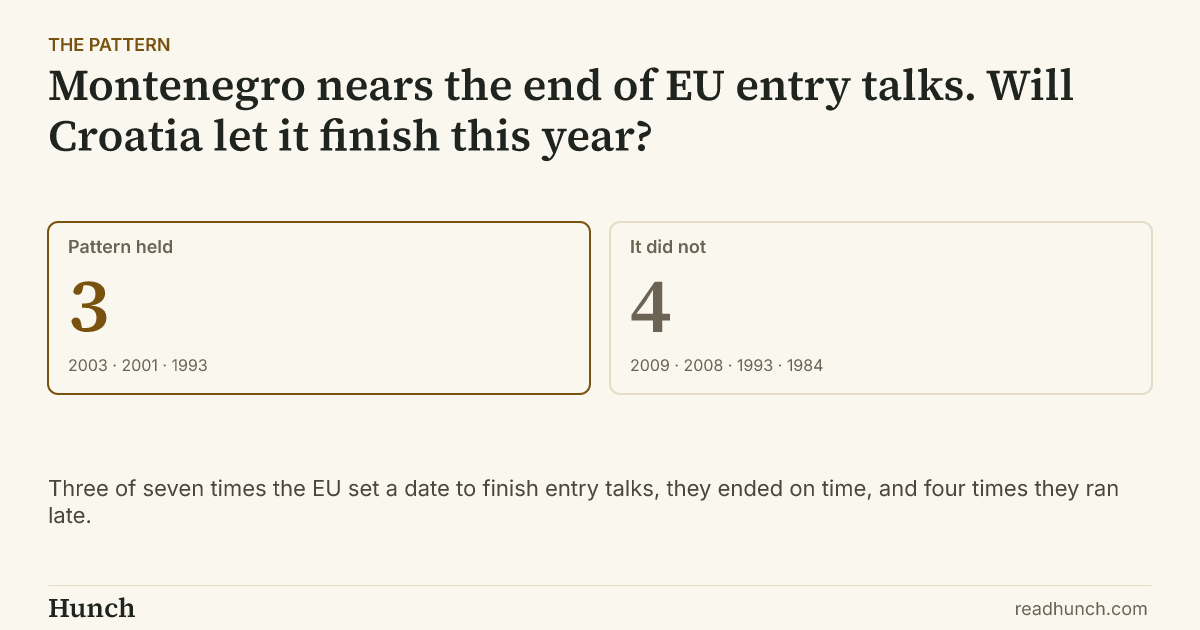
We looked for cases where the EU, or the European Economic Community before it, named a date in an official text by which entry talks with a country should or could end. We found seven such times since 1984, and talks ended on time in three. The four late ones ran over by two weeks, six months, six months and 18 months. (UK Parliament; European Parliament; European Parliament; European Parliament; EUR-Lex; UK Parliament)
Show the other 5 cases
The Read
Among those seven times, only once did a neighbour already inside the EU hold up chapters over a dispute of its own. In 2009 Slovenia blocked nine chapters with Croatia over their border, and the talks ended a year and a half after the Commission’s date. When the talks ran late at other times, they were done within about half a year. EU countries take turns to lead the Council for six months each. Six of the seven times, talks were done by the end of the next turn after the date. For Montenegro that next turn is Lithuania’s, from January to .
There are reasons for doubt. Each time it was the EU that decided, and two of the seven dates were for one country, Croatia. Only once, in 2008, did the Commission alone set the date, and that date was missed. The time left is also shorter now: 57 days from the Commission’s report to , against four months to a year and a half before. And the courts chapter, where most of Croatia’s demands sit, got its own tests for closing for the first time in the talks with Croatia, so the older talks had nothing like it.
Sources: UK Parliament (2, 3, 4), UK Parliament, European Parliament, RFE/RL, EUR-Lex, European Commission, Balkan Insight
Disclaimer
Hunch works only from sources that are publicly available, and publishes on the basis of analysis of that material. We do not form an editorial opinion or take sides, we give a simpler and wider view of news that already exists. If information in a source we used was inaccurate, distorted, or later disputed but had already entered our analysis, Hunch accepts no liability for that. Predictions are not advice. Phase 1 markets use Hunch Points, not money.
Published by Hunch under the Editorial Code. Complaints and corrections: /contact/.