UK air traffic fails a third time in three years. Will its chief last a month?
The transport secretary gave Nats a week to explain the failure and asked the regulator to review it. Downing Street still backs chief Martin Rolfe.
What happened
Heidi Alexander told the Commons on that she had commissioned an independent Civil Aviation Authority review into the Nats flight processing failure of and had given the operator’s chief executive, Martin Rolfe, one week to report back on what went wrong, as cancellations passed 2,000 and Downing Street said the government retained confidence in him.
Nats is the monopoly provider of air traffic control at 15 UK airports. It lost its flight processing system at about 1pm on Tuesday and did not confirm a fix for almost four hours. Departures were held at Heathrow, Gatwick, Manchester and Stansted.
It is the third failure of this kind in just over three years. The analysts Cirium counted about 2,100 cancellations across two days, 1,750 of them on the Tuesday, out of 5,800 flights planned. Industry estimates put the number of passengers affected at about 330,000.
Transport Secretary Heidi Alexander told MPs on Wednesday that the fault was at the Swanwick centre and that a cyber-attack had been ruled out. She said she did not accept that it could not have been avoided. Downing Street said chief executive Martin Rolfe had been given the investigation to run.
Two things a reader might expect are already settled. A review has been ordered. The Civil Aviation Authority (CAA), the regulator, has also said passengers are unlikely to get compensation, because the failure counts as an extraordinary circumstance.
What is not settled is who leads Nats. Ryanair and Wizz Air both called for Rolfe to resign or be removed. Ryanair’s chief executive said his position could not hold, and Wizz Air’s UK managing director said a third failure was one too many.
Rolfe has run Nats since and was paid £1.4m for the year to , including a £343,000 bonus. The same airlines made the same demand after the failures of and . The Department for Transport said then that the transport secretary has no powers over staffing decisions at Nats.
The Pattern
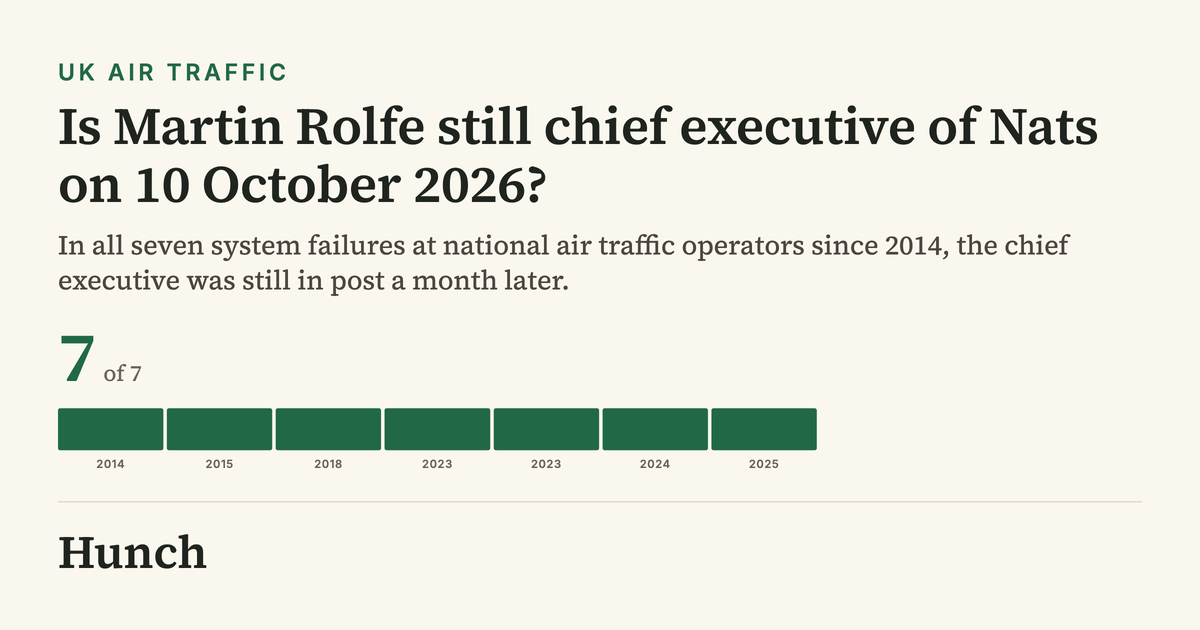
We looked for system failures at air traffic control operators in the UK, Europe and the US since 2014 that cancelled or delayed flights at scale. We checked whether the head of the operator was still in the job 30 days later. We found seven, and in all seven the head stayed. Three of them were at Nats itself.
Show the other 5 cases
The Read
History says Martin Rolfe is likely to still be in charge on . In all seven past failures the head of the operator was still in the job a month later. Downing Street backed him within 24 hours, and the department has already said in writing that the transport secretary has no direct power over Nats staff. Nats is also part public and part private, and its owners include the airlines now calling for him to go. So removing him would take a decision by the Nats board.
The weak spot is that this is the third failure under the same chief, and the first that the government has called avoidable. Ministers took a softer line in 2023 and 2025. Rolfe’s own predecessor, Richard Deakin, left in 2015, five months after a failure, when the board moved first.
The picture would change if the report due on points to a known weakness that was never fixed, if the CAA review finds Nats broke its licence, or if the board acts first to protect its deal with the regulator. A late or thin report is the most likely way this question moves from 80% towards 50%.
Disclaimer
Hunch works only from sources that are publicly available, and publishes on the basis of analysis of that material. We do not form an editorial opinion or take sides, we give a simpler and wider view of news that already exists. If information in a source we used was inaccurate, distorted, or later disputed but had already entered our analysis, Hunch accepts no liability for that. Predictions are not advice. Phase 1 markets use Hunch Points, not money.
Published by Hunch under the Editorial Code. Complaints and corrections: /contact/.