Republicans are spending $29m in New Hampshire. Will Chris Pappas hold the seat?
Senator Jeanne Shaheen is retiring. Democrat Chris Pappas faces former Republican senator John E. Sununu on 3 November.
What happened
Republicans see New Hampshire as their best chance to take a Senate seat from the Democrats, with John E. Sununu against Chris Pappas for the seat of retiring senator Jeanne Shaheen.
Republicans see New Hampshire as their best chance to take a Senate seat from the Democrats. Senator Jeanne Shaheen, a Democrat, said in March that she would not run again. Former Republican senator John E. Sununu faces Democratic congressman Chris Pappas on .
A New York Times poll at the end of September put Sununu 5 points behind. In the same poll 60% of New Hampshire voters disapproved of President Donald Trump, and 65% of voters outside both parties. Among those voters Sununu led Pappas by 10 points on good character.
Outside groups have spent more than $50m in a state with fewer than one million registered voters. The Senate Leadership Fund put $17m behind Sununu, No Going Back PAC $10m and AFP Action more than $2m. Senate Majority PAC put $10m behind Pappas.
Sources: TIME
The Pattern
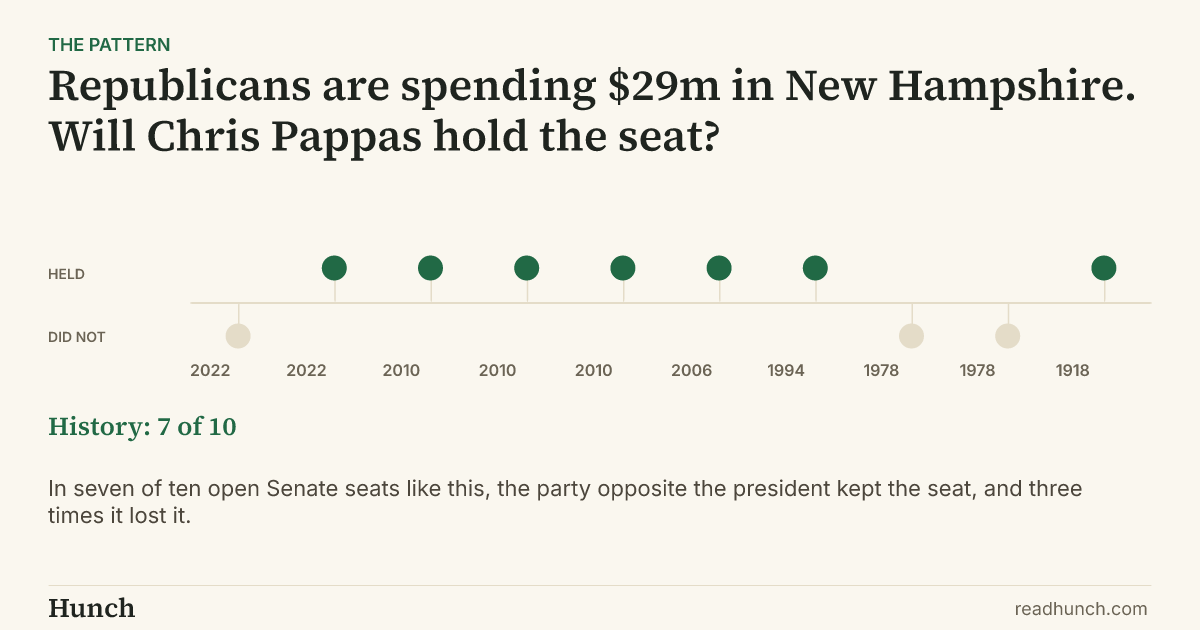
We looked for cases where a midterm Senate seat came open on the side of the party opposite the president, and the president’s party ran someone who had already won a statewide post. In each, the governor came from the other party to the senator leaving. We found ten since 1918, all in years when the president’s approval was under 50% or not yet measured.
Show the other 8 cases
The Read
Past races favour Pappas. In seven of ten open seats like this one, the party opposite the president kept the seat. The president’s party won three times: with sitting governors in Nebraska and Oklahoma in 1978, by 35 and 33 points, and with Fetterman in Pennsylvania in 2022. A former senator ran only once, in West Virginia in 1918, and lost.
Three of the ten races took place on the same day in 2010, and two each in 1978 and 2022, so one national mood often moved several of them together. The losing margins of the president’s party ran from 3.2 to 19.6 points. A 5-point poll gap sits near the narrow end, which is why the margin question is closer than the winner question.
Polls in October and the result on will settle both questions.
Disclaimer
Hunch works only from sources that are publicly available, and publishes on the basis of analysis of that material. We do not form an editorial opinion or take sides, we give a simpler and wider view of news that already exists. If information in a source we used was inaccurate, distorted, or later disputed but had already entered our analysis, Hunch accepts no liability for that. Predictions are not advice. Phase 1 markets use Hunch Points, not money.
Published by Hunch under the Editorial Code. Complaints and corrections: /contact/.