A Democrat leads the Ohio governor race. Parties in this spot usually kept the job.
A New York Times and Siena poll puts Democrat Amy Acton ahead of Republican Vivek Ramaswamy in Ohio, 49% to 45%. Ohio votes on 3 November.
What happened
In Ohio, Democratic candidate Amy Acton drew support from 49 percent of likely voters, while 45 percent backed Republican Vivek Ramaswamy, a New York Times and Siena poll found.
Democrat Amy Acton leads Republican Vivek Ramaswamy by 49% to 45% in the race for governor of Ohio, according to a New York Times and Siena poll taken from late September to early October. A Times poll in June found the race close to a tie.
Ohio has not elected a Democratic governor for at least two decades. Republican Mike DeWine has been governor since and is not on the ballot. President Donald Trump’s approval rating is near historic lows, as voters are unhappy about the cost of living and the war in Iran.
The vote is on . If the race stays as it is, the result will be known on election night from the state’s count.
Sources: The Independent, National Governors Association
The Pattern
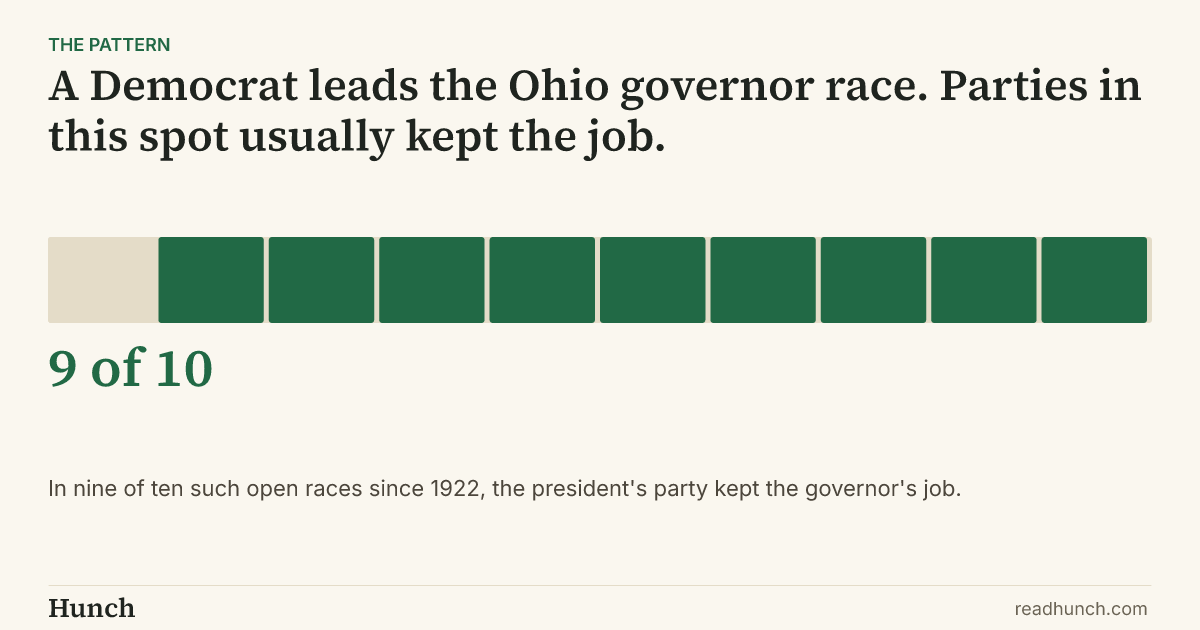
We looked for cases where the president’s party defended an open governor’s seat in the middle of the president’s term, with a candidate who had never won an election, in a state where the other party had not won the job for at least 20 years. We found ten, from 1922 to 1982. Eight of them were in the South and Oklahoma, where one party ruled for decades. Ohio has two strong parties.
Show the other 8 cases
The Read
The past points to Ramaswamy. In nine of ten open races like this one, the president’s party kept the governor’s job, and every result but one was known on election night. In all nine of those wins the other party had not won the job for at least 32 years, or had never won it. The one loss, Michigan in 1982, came 22 years after the other party’s last win. In Ohio it has been at least 20.
There are reasons for doubt. Eight of the ten races were in the South and Oklahoma, where for decades one party won almost every vote, while Ohio has two strong parties. The poll has moved from a tie in June to a four-point lead for Acton. None of the past races came with a poll like this to compare.
Disclaimer
Hunch works only from sources that are publicly available, and publishes on the basis of analysis of that material. We do not form an editorial opinion or take sides, we give a simpler and wider view of news that already exists. If information in a source we used was inaccurate, distorted, or later disputed but had already entered our analysis, Hunch accepts no liability for that. Predictions are not advice. Phase 1 markets use Hunch Points, not money.
Published by Hunch under the Editorial Code. Complaints and corrections: /contact/.