A minister says parents could be jailed for a child's crime. Will it be in writing?
Youth Justice Minister Jake Richards told The Times that parents in England and Wales could lose benefits or go to prison for a child's crime.
What happened
Youth Justice Minister Jake Richards told The Times that parents could lose benefits or be sent to prison for their children’s offences, under a planned reform of Parenting Orders in England and Wales.
Jake Richards, the minister for sentencing and youth justice, gave the interview to The Times. He said the youth justice system should hold parents to account for their part in keeping communities safe. The punishment could go as far as cutting benefits or a prison term, with a judge deciding. He said prison would apply only in the most extreme cases.
No government paper contains this punishment. The Youth Justice White Paper of promised to make Parenting Orders stronger and use them more, and named fines as the penalty. It does not mention prison for parents or taking away their benefits.
The same white paper set out what the Ministry of Justice has promised to publish and when. Proposals on out-of-court resolutions for children, ways to deal with an offence without a court case, come in autumn 2026. A consultation on childhood criminal records comes by the end of the year. Neither is about parents.
Two days before the interview the department published a press notice on preventing youth crime. It says nothing about parents losing money or their freedom.
There is also no bill ready to carry the change. Parenting Orders are set in Acts of Parliament, and no sentencing or youth justice bill is before Parliament. The Commons is away for the party conferences and returns on .
Sources: BBC, GOV.UK (2), UK Parliament, oral questions rota, read
The Pattern
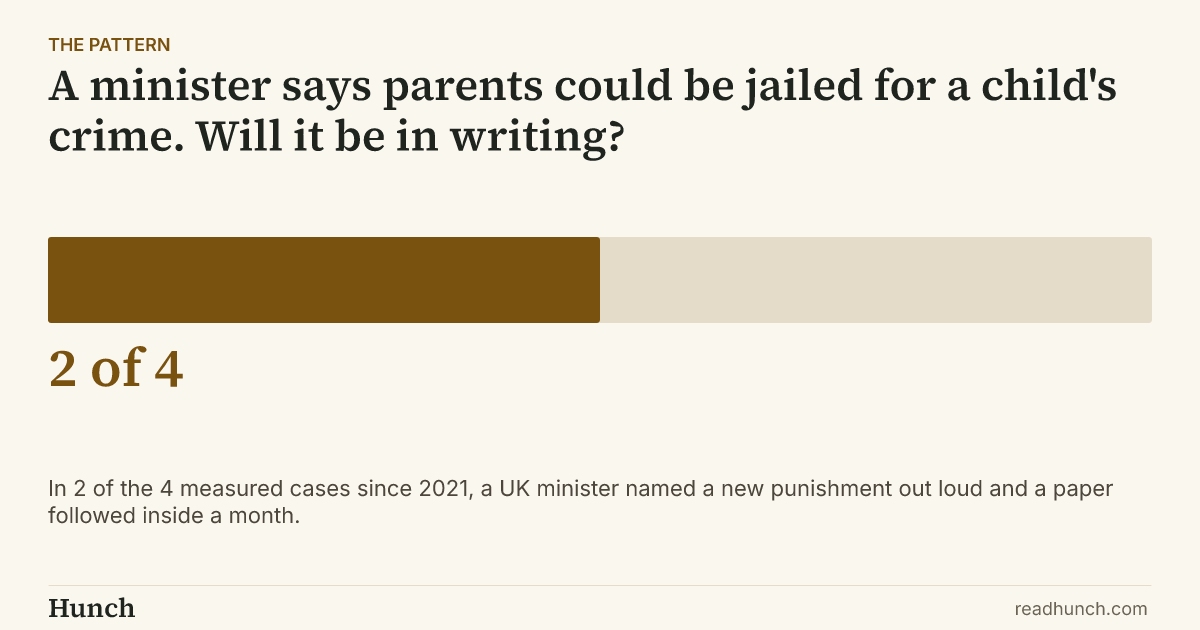
We looked for UK ministers who announced a new punishment in an interview or a speech before it was in any published government bill or consultation. Then we measured how long it took for a consultation, a white paper or bill text to set it out. We found five since 2021, five separate decisions by five ministers. One warning: plans that ended in a document are easier to find, so the list may lean towards them. The newest come first.
Show the other 3 cases
The Read
History says the gap between words and paper usually closes, and it closes fastest when the department already holds the paper. Liz Kendall spoke two days before her white paper, and Rishi Sunak eight days before his consultation. Priti Patel and Shabana Mahmood took 42 and 52 days, and both had somewhere to put the plan: a bill already in the Lords, and a consultation promised in the same speech.
None of that is in place here. Jake Richards named two punishments, prison and loss of benefits, that no government paper contains. No sentencing or youth justice bill is before Parliament, the Commons does not return until , and the two papers the Ministry of Justice has promised for this autumn are about other things. Andy Burnham’s plan of shows the other outcome so far: three weeks on, nothing has been published. The list is also small, and plans that quietly died are harder to find than plans that became a document.
A written statement from a minister naming a consultation date, or the Ministry of Justice adding Parenting Orders to a bill already under way, would make a paper more likely. The department repeating that the May white paper is the plan, with the detail left to a later sentencing bill, would make it less likely.
Disclaimer
Hunch works only from sources that are publicly available, and publishes on the basis of analysis of that material. We do not form an editorial opinion or take sides, we give a simpler and wider view of news that already exists. If information in a source we used was inaccurate, distorted, or later disputed but had already entered our analysis, Hunch accepts no liability for that. Predictions are not advice. Phase 1 markets use Hunch Points, not money.
Published by Hunch under the Editorial Code. Complaints and corrections: /contact/.