Delay adds £420m a year to fixing Parliament. Will the MPs' vote wait until 2027?
MPs on the Commons spending committee say Parliament can vote on its repairs this year. The government, which sets the date, has named none.
What happened
The Commons Speaker, Sir Lindsay Hoyle, said the law on Parliament’s repairs means ‘putting ourselves in handcuffs’. The BBC understands government whips have discussed a debate and vote by the new year, but no date has been set.
£420m: the cost of each extra year of delay. That is the figure the Commons public accounts committee, which checks public spending, gave on for the repairs to the Palace of Westminster, the home of the UK Parliament. The work could cost up to £40bn and take 61 years. The committee said it was “crunch time” and that MPs and peers have enough information to vote on a way forward before the end of this year.
£3bn: the first step the vote would decide. The vote would decide whether to approve up to £3bn of first works over seven years and cut four options to two, before a final choice by 2030. One option moves MPs and peers out for up to 24 years from 2032, at up to £15.6bn. Another moves only the House of Lords out, at £39bn over 61 years. More than 1,650 pieces of asbestos are known in the building, 500 more than in 2021.
This includes the recommendation to both Houses to agree initial phase one works over seven years, capped at £3bn.
Restoration and Renewal Client Board, 5 February 2026
Only the government can put the vote on the Commons agenda. On a government spokesperson said a debate would come “in due course”. On Sir Alan Campbell, the Leader of the House of Commons, the minister who plans its business, hoped to bring a motion “shortly”. On he said: “On timing, all I would say is that we need to get on with this work, so watch this space.” The BBC reported on 5 and that government whips, who organise MPs’ votes, have discussed a vote by the new year. No date is set.
Others are pushing, but they cannot set the date. On the Speaker, Sir Lindsay Hoyle, said the law that holds back the main works means “putting ourselves in handcuffs”, and that timing is for the government. The Conservatives, the main opposition, say they will vote against the current plan. The Commons sits for the last time this year on and returns on .
Sources: BBC (2, 3, 4), UK Parliament Restoration and Renewal, Hansard (2), UK Parliament
The Pattern
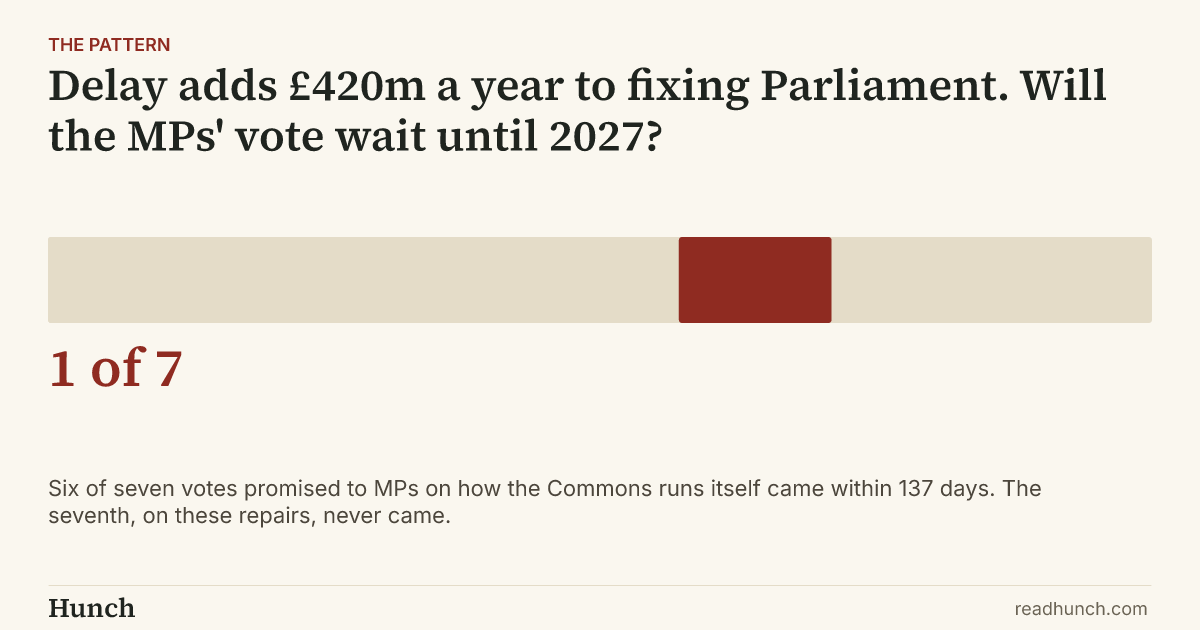
We looked for cases where a UK government promised the House of Commons a vote on how it runs itself, from MPs’ conduct to its own building, without giving a date. We found seven such promises since 1995, two of them about these same repairs.
shortly. Set for , it was pulled. MPs passed it with changes on , 109 days later.
as soon as possible. MPs passed it with changes on , 137 days later.
Show the other 5 cases
promptly. MPs passed most of it on , 74 days later, and the rest, with changes, on .
The Read
263 days have passed since the first promise, on . That is longer than any past wait that ended in a vote. The 2016 promise on these same repairs never got one: ministers missed both dates they named, later that autumn and before Easter 2017, and Parliament closed for an election after 224 days. This year Parliament also ended one session on and opened a new one. Counted from , when Campbell first promised a motion in the new session, the wait is 128 days, inside the 20 to 137 days of past waits that ended in a vote.
There are reasons for doubt. All seven promises came from the same job, Leader of the House, and Andrea Leadsom made three of them. Promises that came to nothing are harder to find in Parliament’s records than votes that took place. The law has also changed: since 2019 the main works need a vote of each House. In 2018 MPs voted freely, and now the Conservatives are told by their party to vote against. In five of the six promised votes that took place, MPs changed the government’s text before passing it, and in 2024 a change passed by one vote, 170 to 169.
Sources: BBC (2), Hansard (2, 3, 4), legislation.gov.uk, UK Parliament (2)
Disclaimer
Hunch works only from sources that are publicly available, and publishes on the basis of analysis of that material. We do not form an editorial opinion or take sides, we give a simpler and wider view of news that already exists. If information in a source we used was inaccurate, distorted, or later disputed but had already entered our analysis, Hunch accepts no liability for that. Predictions are not advice. Phase 1 markets use Hunch Points, not money.
Published by Hunch under the Editorial Code. Complaints and corrections: /contact/.