Disability benefit review reports in autumn. Most past welfare savings fell short.
The Timms Review published a progress update on 8 June. The redesign of the disability benefit PIP test is still due to report in autumn 2026.
What happened
Timms Review co-chairs publish a progress update on the PIP assessment review, which aims to report to the Work and Pensions Secretary in autumn 2026.
The review of PIP is due to report in autumn 2026. PIP, or Personal Independence Payment, is a disability benefit. The review looks at what PIP is for, the test people take to get it and the rules on who qualifies. It will report to the Work and Pensions Secretary.
Sir Stephen Timms, the minister for social security and disability, chairs the review with Sharon Brennan and Dr Clenton Farquharson. It is written together with disabled people. The co-chairs published a progress update on , the review’s main public step of the summer.
The review exists because the government’s first plan failed in the Commons. In Labour MPs rebelled, and ministers took the tighter PIP rules out of the welfare bill. Most of the planned savings went with them, and the question of how PIP should work passed to the review.
A smaller package survived, meant to save £1.9 billion. In the Department for Work and Pensions announced changes to how PIP is run. Awards are reviewed less often, and face-to-face assessments rise to 30%. The changes took effect from , and the savings are counted to the end of 2030/31.
The autumn date falls close to the Budget. The Treasury is preparing it while borrowing runs above forecast, and any change to the PIP test changes the welfare spending that the Office for Budget Responsibility (OBR) counts. The June update keeps the review on time. It does not say what the review will find, and ministers have not promised to accept all of it.
The Pattern
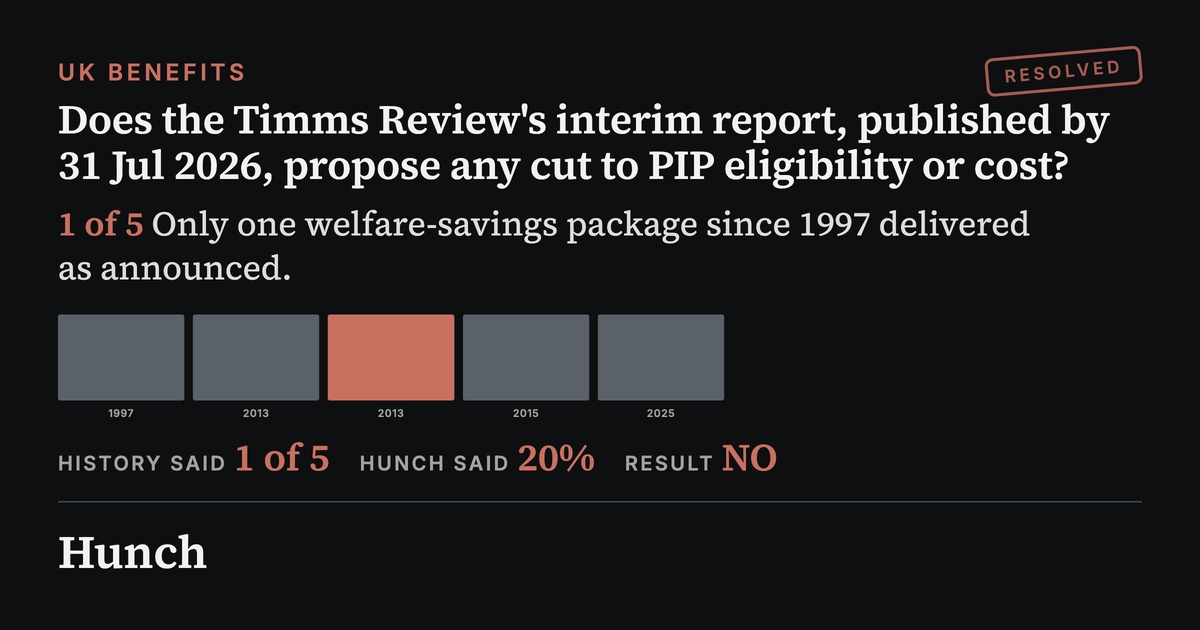
One of five big welfare savings plans since 1997 worked as planned. Governments of both parties have promised welfare savings worth billions of pounds. We looked at what happened to five of the biggest. The other four were reversed, cut back, or overtaken as more people claimed.
Show the other 3 cases
The Read
The 7% forecast for an early final report rests on the timetable. The review’s own June update points to autumn. It is written with groups of disabled people, which takes time, and government reviews this large almost never report early. Publishing in August would also hand the Treasury a disputed welfare paper weeks before a hard Budget, with Parliament away and unable to respond. Everything points to a report after Parliament returns.
The case the other way is money. Borrowing is £7.7 billion above forecast, and the OBR’s July report lists long-term pressure on welfare spending. The Treasury needs savings it can count in the autumn, which could push the review to speed up or to signal its direction early. A government that has already lost one welfare vote may prefer to share hard news early. Even so, that points to a report in September or October, and still not in August.
The bigger question is whether any savings the review suggests will survive. The five past plans above show how often they do not, and that answer will take several months.
Disclaimer
Hunch works only from sources that are publicly available, and publishes on the basis of analysis of that material. We do not form an editorial opinion or take sides, we give a simpler and wider view of news that already exists. If information in a source we used was inaccurate, distorted, or later disputed but had already entered our analysis, Hunch accepts no liability for that. Predictions are not advice. Phase 1 markets use Hunch Points, not money.
Published by Hunch under the Editorial Code. Complaints and corrections: /contact/.