Downing Street bars more crimes from early release. Will the 1 October start hold?
The Prime Minister barred manslaughter, dangerous driving deaths and child sex offences from early release on 30 August, the second cut in a month.
What happened
The Prime Minister blocks further offence categories from the progression model, including all forms of manslaughter, death by dangerous or drunk driving, historic child sex offences and the killing of emergency workers.
Wider early release from prison is due to start on . On Downing Street barred more crimes from it: all forms of manslaughter, death by dangerous or drunk driving, historic child sex offences, the unlawful killing of emergency workers, and causing or allowing the death of a child.
It was the second cut in a month. On the government barred rape, serious child sex offences and grooming offences. In the same announcement it moved the wider releases under the Sentencing Act from September to .
The scheme being cut is the progression model in the Sentencing Act 2026, which became law in January. The Ministry of Justice says the Act was needed to stop prisons running out of places by June.
The August changes do not touch the new release points, the share of a sentence served before release. They change who can pass through them. The announcement put the offenders already left out at 18,000, and the one adds hundreds more.
On the day of the second cut, the Ministry published its estimate of how many will be released in each stage from to .
Adult male prisons are 98 per cent full. More than 3,200 places have been built since 2024 and 14,000 are promised by 2031. On both occasions the Prime Minister said he wanted to go further but could not without the system collapsing.
The pressure has been public since . Andy Burnham said then that he had asked the Justice Secretary, Alex Norris, to find ways of exempting more serious offenders, with the killers of PC Andrew Harper as the named test. Proposals were expected in Parliament in early September.
Sources: GOV.UK (2, 3, 4), PoliticsHome
The Pattern
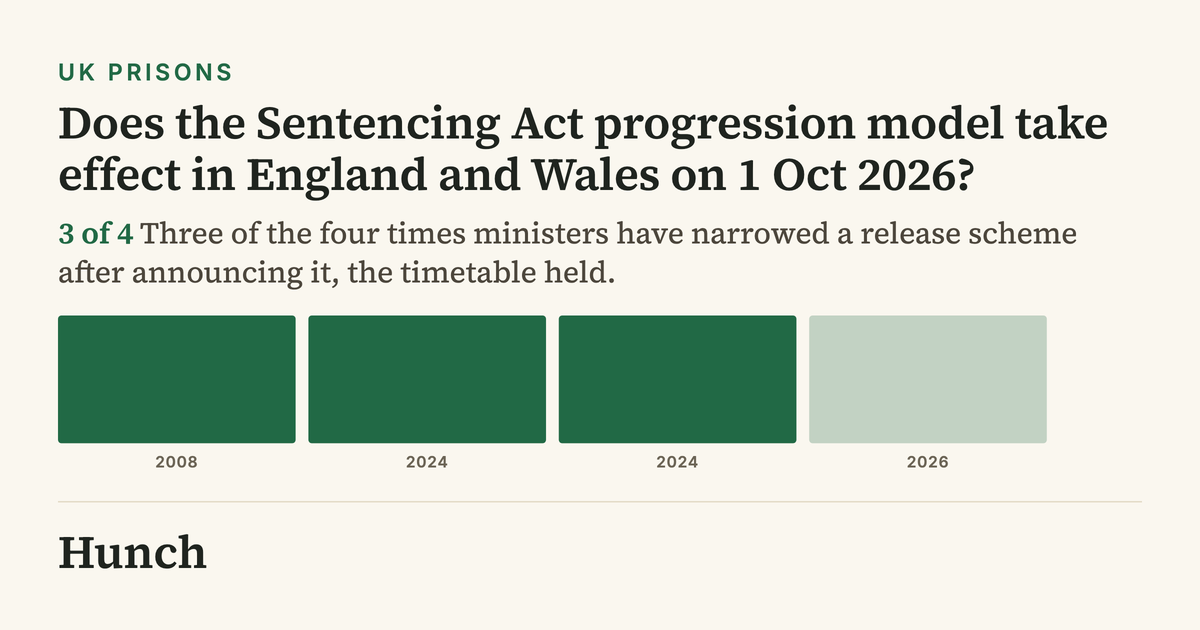
We looked for every time since 2007 that ministers in England and Wales or Scotland cut more crimes or groups of offenders out of an early-release scheme after they had already announced it. Exclusions written in at the start do not count. We found four such cuts, and three kept their release dates. In those three, no delay came with the cut or within 30 days. Four cases is two short of the six we need before we show a History figure.
Show the other 2 cases
The Read
History leans towards the date staying. Ministers who narrowed a release scheme under pressure have kept its dates. Jack Straw left terror offences out of the End of Custody Licence and releases went on. Angela Constance widened her exclusions on and released prisoners on as planned. The Labour government added six offences to SDS40 and kept its 40 per cent release point. Leaving out a few crimes costs a few hundred places, while a delay costs every place the scheme was built to free. The announcement follows the one, with the date left at , and that puts the first market above evens.
The weak point is this scheme itself. The cut came with a delay from September to , the only delay among the four cases. So this government has already moved the date once when the list of exclusions alone did not end the argument. A third round of exclusions before would suggest the list is still being shaped by the news. Each round also frees fewer places, which weakens the case that the date cannot move.
A commencement order, the legal step that switches the scheme on, published on legislation.gov.uk before mid-September would settle the first market early. A new pause announced together with new exclusions would settle it the other way.
Disclaimer
Hunch works only from sources that are publicly available, and publishes on the basis of analysis of that material. We do not form an editorial opinion or take sides, we give a simpler and wider view of news that already exists. If information in a source we used was inaccurate, distorted, or later disputed but had already entered our analysis, Hunch accepts no liability for that. Predictions are not advice. Phase 1 markets use Hunch Points, not money.
Published by Hunch under the Editorial Code. Complaints and corrections: /contact/.