Quebec votes on 5 October. The party that wants independence leads the polls.
The Parti Québécois, which wants Quebec to leave Canada, is first in the last polls before Monday's vote, while the votes against it are split.
What happened
Leger’s last poll before Quebec’s election, taken on and , puts the Parti Québécois at 29%, the Liberals at 25% and the Conservatives at 20%.
Quebec elects all 127 members of its National Assembly on Monday . The Parti Québécois (PQ), which wants Quebec to become an independent country, has led the polls through the campaign. In Leger’s last poll, taken on and among 1,000 voters, the PQ has 29%, the Liberals 25% and the Conservatives 20%.
The party now in power, the Coalition Avenir Québec (CAQ), has fallen behind. A Leger poll of 25 to put it fourth with 16%, behind the Conservatives at 18%. One seat projection site said the CAQ could win no seats at all. Liberal leader Charles Milliard said the CAQ had “disqualified itself”, and Conservative leader Éric Duhaime said his party was “the only ones who can stop the Parti Québécois”.
Most voters want a new government, but not independence. In the last Leger poll 77% want a change of government. Other polls put opposition to independence at 69%. PQ leader Paul St-Pierre Plamondon has said he would not hold a referendum on leaving Canada while Donald Trump is in the White House, and talks of 2029.
Votes are counted on the night. Élections Québec says the deadline to ask for a judicial recount is in most areas, and most winners are formally declared on .
Sources: Leger (2), Global News, Policy Magazine, Élections Québec
The Pattern
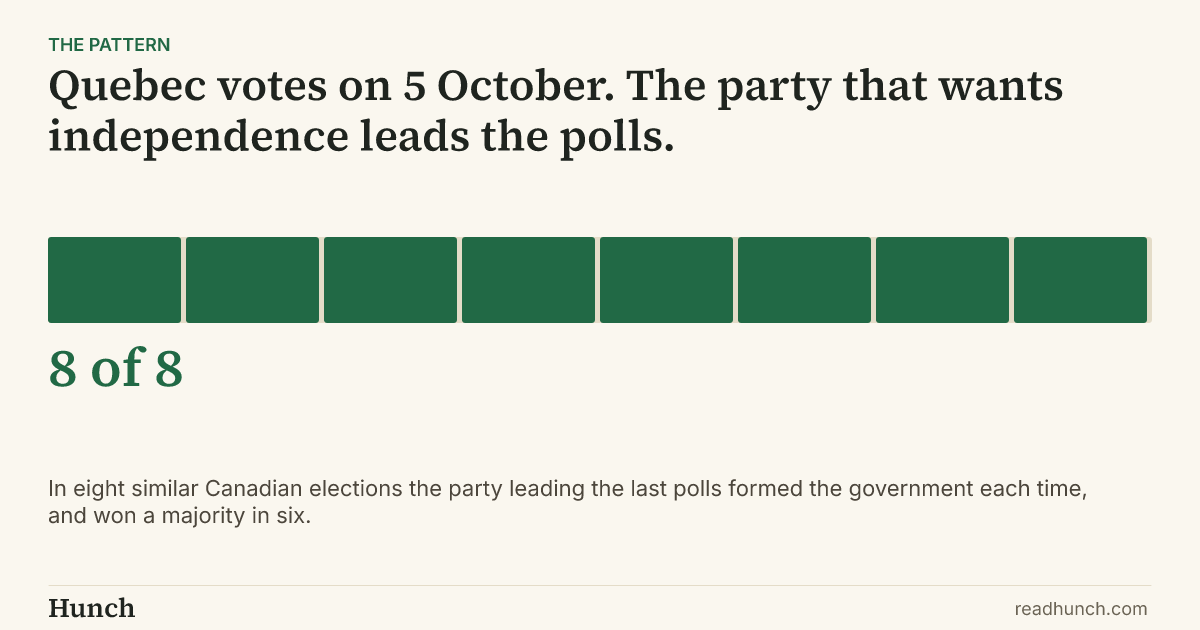
We looked for cases where, in a Canadian federal or provincial election, one party was first in the last polls with less than half the vote, while at least two rivals each had 15% or more, and the party in power was not first. We found eight, from 2006 to 2018. In all eight the leading party formed the government.
Show the other 6 cases
The Read
History points to a PQ government. In all eight elections the party leading the last polls, with its rivals split, formed the government. In six it won a majority of seats. Its vote share always stayed within 2.5 points of its last poll, and the split turned votes into a larger share of seats.
The record is thin and the PQ is weaker than any of the eight. Its 29% to 30% is below every leader in the cases, where the lowest was 32%. The cases only run from 2006 to 2018, and only two are from Quebec. One of those two, the PQ in 2012, was the leader on 33% and ended with a minority, 54 of 125 seats.
The majority is the open question. The two minorities came with 33% and 38% in the last poll, yet the CAQ won a majority in 2018 from 32%. This time the vote is split five ways, with the Conservatives rising and the CAQ falling, and seat projections put the PQ near a majority.
Disclaimer
Hunch works only from sources that are publicly available, and publishes on the basis of analysis of that material. We do not form an editorial opinion or take sides, we give a simpler and wider view of news that already exists. If information in a source we used was inaccurate, distorted, or later disputed but had already entered our analysis, Hunch accepts no liability for that. Predictions are not advice. Phase 1 markets use Hunch Points, not money.
Published by Hunch under the Editorial Code. Complaints and corrections: /contact/.