Will Britain's new railway law miss Christmas? Lords rules leave just two days.
Minister Peter Hendy gives the Railways Bill a fair chance of becoming law by Christmas. The last Lords report day is 15 December.
What happened
Rail minister Peter Hendy told an industry conference this week that the Railways Bill has a fair chance of getting royal assent before Parliament’s winter break.
Britain’s Railways Bill is in its last weeks in the House of Lords. The law creates Great British Railways, one public body to run both the track and the trains. This week rail minister Peter Hendy told a rail industry conference in London that the bill has “a fair chance of getting royal assent” before Parliament’s winter break. Royal Assent is the King’s formal approval that turns a bill into law.
The Lords will debate changes to the bill on , and . This is the report stage, the first point where the whole House of Lords can vote on changes. The earlier committee debates took place in a room where no votes are allowed. After report stage comes Third Reading, the last big Lords debate on the bill. Both Houses of Parliament then stop sitting from to . After , that leaves two sitting days, 16 and .
What is required in our Companion to the Standing Orders is three sitting days between Report and Third Reading.
House of Lords, Hansard, 29 June 1988
Most of the changes come from the opposition. So far, 25 changes have been put forward for the report stage: Conservative peers wrote 21, Liberal Democrats 3 and the government 1. The Labour government has no majority in the Lords: there are 247 Conservative peers, 232 Labour, 154 crossbench peers who belong to no party, and 79 Liberal Democrats. Conservative peer Lord Moylan said in October: “We will return to these matters on Report”. Shadow transport secretary Richard Holden fears rail will wait behind other spending: “Will a new train win out over a new hospital? I doubt it.”
On the House of Commons gave the bill more time, until . Without that vote it would have fallen 12 months after it was first read in the Commons. Conservative MPs voted against, and the vote was 279 to 139. The Liberal Democrats like the idea of the bill, but voted against it as it stands.
Sources: The Guardian, UK Parliament (2, 3), Hansard (2), UK Parliament, BBC, UK Parliament, UK Parliament
The Pattern
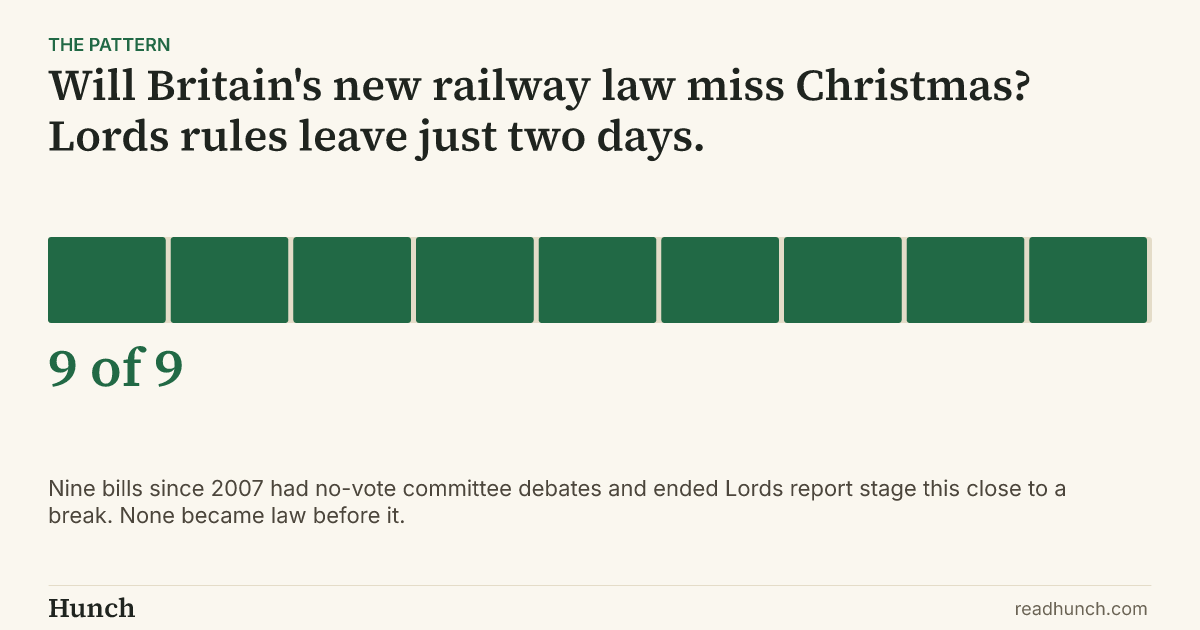
We looked for cases where a UK government bill from the House of Commons had its last report day in the Lords at most seven days before a Lords break, with three or fewer sitting days left and no votes allowed at the committee stage before. We found nine such bills from 2007 to 2023. None became law before the break. All nine became law later, from 29 to 171 days after the last report day.
Show the other 7 cases
The Read
The Lords normally wait three sitting days between the last report day and the last big Lords debate, called Third Reading, and the day of Third Reading itself does not count. Peers can shorten that wait, but only when the parties agree. In all nine bills the gap before the break was three days or fewer, and Third Reading always came after the break. Now there are two days. A law before Christmas needs the Lords to shorten the wait, and the Commons to accept any Lords changes by . The government has also given itself until .
This government has moved fast before. In and Lords Third Reading of a government bill came two days after the last report day. In the Employment Rights Bill went from the Commons on to the Lords on and became law on , the last day before the break. This time a minister has named a target date in public. Twelve other bills since 2007 did become law before a nearby break, but in each the last report day and Third Reading came on the same day, as with urgent laws.
Sources: Hansard (2, 3, 4, 5), UK Parliament (2, 3, 4), The Guardian
Disclaimer
Hunch works only from sources that are publicly available, and publishes on the basis of analysis of that material. We do not form an editorial opinion or take sides, we give a simpler and wider view of news that already exists. If information in a source we used was inaccurate, distorted, or later disputed but had already entered our analysis, Hunch accepts no liability for that. Predictions are not advice. Phase 1 markets use Hunch Points, not money.
Published by Hunch under the Editorial Code. Complaints and corrections: /contact/.