Reform's Ryan Coogan is on police bail to 22 December. Will police decide by then?
Police arrested Reform UK councillor Ryan Coogan on 24 September over his election papers. He is on bail and must return on 22 December.
What happened
A Reform UK council group leader has been arrested by police on suspicion of making false statements in nomination papers.
Cambridgeshire Police arrested Ryan Coogan on on suspicion of making false statements in his nomination papers, the forms a person fills in to stand at an election. He was released on bail and must return to Milton Police Station on .
Coogan was elected to Huntingdonshire District Council for Ramsey ward on and leads the Reform UK group there. In 2025 he was Reform’s candidate for mayor of Cambridgeshire and Peterborough and came second. He has not been charged with any crime.
He has since been released on bail to return to Milton Police Station on .
Cambridgeshire Police, statement to BBC News,
Coogan said he is happy to help the police but has still not been told what the problem is. Police said in September that they were looking at “an allegation of false statements on a candidate nomination paper at May’s HDC elections”. Reform did not answer the BBC, and the council would not comment.
Under the law on elections, a prosecution like this must start within one year of the offence, unless a court allows more time. The Electoral Commission says the penalty can be an unlimited fine or up to a year in prison.
Sources: BBC, legislation.gov.uk
The Pattern
We looked for cases where police in the UK arrested an elected politician on suspicion of a crime and let them go on bail without charge. We found nine since 2008. None of them was about election papers: the arrests were over sexual offences, bribery, leaks and online posts.
Show the other 7 cases
The Read
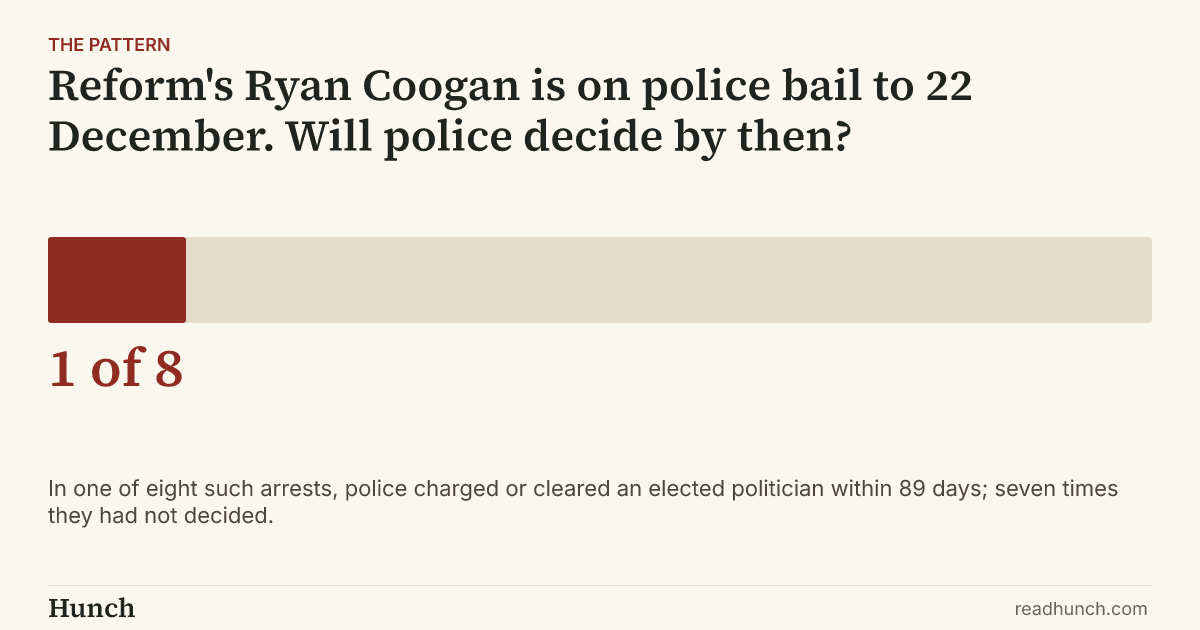
Police rarely decided by the first bail date. In seven of the eight past arrests old enough to count, there was no charge and no dropped inquiry within 89 days. The only quick decision, after 35 days in 2014, was to drop the inquiry. Charges came after 129 days at the earliest, which for Coogan would mean .
There are reasons for doubt. None of the nine past arrests was about election papers, and most were about sexual offences, bribery or leaks, which can take longer to look into. Election law also sets a one-year limit to start a prosecution, while the past arrests had no such limit.
Disclaimer
Hunch works only from sources that are publicly available, and publishes on the basis of analysis of that material. We do not form an editorial opinion or take sides, we give a simpler and wider view of news that already exists. If information in a source we used was inaccurate, distorted, or later disputed but had already entered our analysis, Hunch accepts no liability for that. Predictions are not advice. Phase 1 markets use Hunch Points, not money.
Published by Hunch under the Editorial Code. Complaints and corrections: /contact/.