Teddy Riner needs 500 signatures to run for France. Will he get them?
Teddy Riner, a five-time Olympic judo champion, says he will run for president of France in April 2027. He has no party behind him.
What happened
The Guadeloupe-born 37-year-old may have no experience of public office, no party behind him, and as yet no manifesto.
To get on the ballot for French president, a candidate needs 500 signatures from elected officials. Each official can sign for only one candidate, and the names of those who sign are published at least twice a week. In 2022 the signatures had to arrive by , and the Constitutional Council, which checks the signatures, published the list of candidates on . The first round in 2027 is on ; the other dates are not yet set.
Teddy Riner announced on that he will run. He has won five Olympic gold medals in judo. He says he is neither left nor right and wants to “bring people together”. He has no party, no experience in public office and no programme yet.
As Riner prepared to attempt to gather 500 sponsorship signatures from elected officials, as required by French law, he said some of his motivation to run came from those young and old who were finding it difficult to envision a future for themselves.
The Guardian, 9 November 2026
More than 28 million people watched his video. In an Ifop poll within 24 hours, 22% said they “could” vote for him, but a Cluster17 poll reported by Politico on gave him 2% in the first round. President Emmanuel Macron called him a “great champion”. Riner answered that he is “not the president’s envoy, I’m not a Macronist”.
Sources: BBC, The Guardian, Conseil constitutionnel (2), Service Public, France 24, Politico Europe
The Pattern
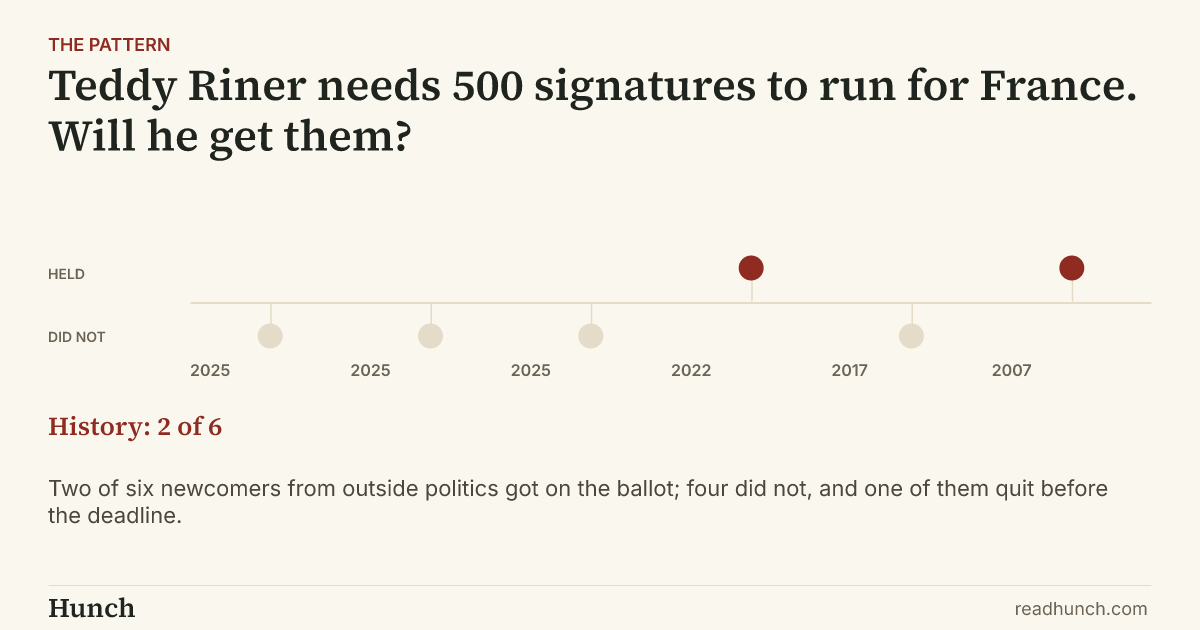
We looked for cases where someone with no party career or elected office announced a run for president in a country where elected officials must sign for a candidate to get on the ballot. We found six such runs since 2007, three in France and three in Ireland’s 2025 race. In Ireland a candidate needs 20 members of parliament or four local councils. The three Irish runs were decided in the same round.
Show the other 4 cases
straitjacket.
The Read
Both French newcomers who made the ballot had less time than Riner has now. José Bové was on the list 47 days after he announced in 2007, with under 3% in the polls. Éric Zemmour made it 97 days after he announced, with 741 signatures. Alexandre Jardin had 105 days in 2017 and gathered 165 of the 500 signatures. If 2027 follows the 2022 calendar, Riner has about four months.
There are reasons for doubt. Only three of the six runs were in France; the three Irish runs in 2025 faced a different rule and ended in the same round. In 2022 two more newcomers, Gaspard Koenig and Clara Egger, got 107 and 36 signatures and were not on the list. Bové had a petition with 30,000 names behind him, and Zemmour was a well-known TV commentator.
Sources: The Guardian (2, 3, 4), Conseil constitutionnel (2), Conseil constitutionnel
Disclaimer
Hunch works only from sources that are publicly available, and publishes on the basis of analysis of that material. We do not form an editorial opinion or take sides, we give a simpler and wider view of news that already exists. If information in a source we used was inaccurate, distorted, or later disputed but had already entered our analysis, Hunch accepts no liability for that. Predictions are not advice. Phase 1 markets use Hunch Points, not money.
Published by Hunch under the Editorial Code. Complaints and corrections: /contact/.