London rough sleeping fell 11% to 3,944. Most past pledges to cut it fell short.
London's official count, CHAIN, found 3,944 people sleeping rough from January to March, 11% fewer than a year before. The next count is due soon.
What happened
CHAIN data showed 3,944 people slept rough in London between January and March, down 11% year on year — the fall Khan promised would begin in 2026.
London’s rough sleeping count fell 11% to 3,944 between January and March, compared with the same months a year earlier. The count comes from CHAIN, London’s official record of people sleeping on the streets, kept by several agencies together. It was also 18% lower than in October to .
People sleeping rough for the first time fell 15% to 1,762 compared with a year earlier. People who have slept rough for a long time fell 9% to 641.
The numbers came when Sadiq Khan said they would. In he launched a plan to end rough sleeping in London by 2030, and he said the improvement would not show until 2026.
The plan has £17m of government money, up to 500 empty homes repaired for use, a centre called the Ending Homelessness Hub and a phone line to help people before they lose their home.
The wider problem is still severe. London Councils estimates that 210,000 Londoners are homeless and living in temporary housing, and boroughs together spend £5m a day on it.
The next CHAIN report, for April to June, is expected from the Greater London Authority in late July. It is the first test of whether the fall lasts into the warmer months, when street counts often behave differently.
Sources: LabourList, CHAIN quarterly report, London City Hall
The Pattern
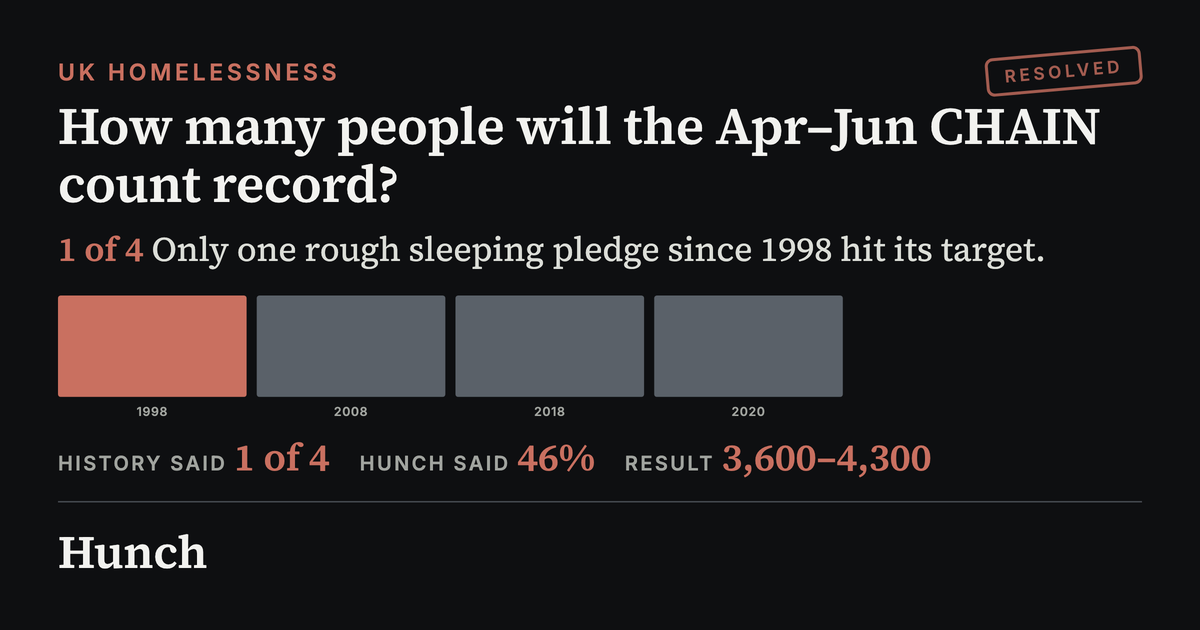
Only one of four big promises since 1998 hit its target. We looked at the major political promises to end or cut rough sleeping since then. The Blair government’s cut was reached in 2001. The other three were missed, or the fall they brought did not last.
Show the other 2 cases
The Read
History and the latest numbers point different ways. The count has fallen in both quarters reported in 2026. The number of people sleeping rough for the first time fell 15%, and that is usually the first number a prevention plan moves. The plan has money and is still being rolled out. The Blair years show that when a dedicated unit, central money and political attention come together, falls can keep going.
There are reasons for doubt. Spring numbers can look better than they are. In warmer months people sleep out in different places and outreach teams find them in different ways, so a strong January to March count can come before a flat or rising April to June one. Last spring’s figure, from before the plan, was not especially high either.
The pressure underneath has not eased. 210,000 Londoners live in temporary housing, and many of the people counted on the streets come from that group. Housing benefit rates are frozen for a second year. Every promise since 2001 was in the end overtaken by these pressures, and the April to June count will show whether this fall lasts.
Disclaimer
Hunch works only from sources that are publicly available, and publishes on the basis of analysis of that material. We do not form an editorial opinion or take sides, we give a simpler and wider view of news that already exists. If information in a source we used was inaccurate, distorted, or later disputed but had already entered our analysis, Hunch accepts no liability for that. Predictions are not advice. Phase 1 markets use Hunch Points, not money.
Published by Hunch under the Editorial Code. Complaints and corrections: /contact/.