Far-right AfD won Saxony-Anhalt with 43.8%. Will its candidate lead the state?
The far-right AfD won the German state of Saxony-Anhalt on 6 September with 43.8% against 17.2% for the CDU, after leading final polls by 20 points.
What happened
Germany’s far-right AfD is eyeing an election breakthrough in Saxony-Anhalt on Sunday, poised to win more than 40% of the vote, roughly twenty points ahead of the CDU that leads the state government.
Saxony-Anhalt, a German state, elected its parliament on Sunday . The far-right AfD led every poll of the campaign, and Al Jazeera’s final preview showed it twenty points ahead.
The last Infratest dimap poll, taken on 24 and , put the AfD on 42% and the CDU of Minister-President Sven Schulze, the head of the state government, on 22%. Die Linke had 11% and the SPD 8% (Infratest dimap, 26 Aug 2026).
The AfD won 43.8%, and the CDU fell to 17.2%. The SPD had 9.3%, the Greens 8.9%, Die Linke 8.6% and the BSW 5.3%, on a turnout of 77.8%. These are provisional results (Landeswahlleiterin Sachsen-Anhalt, 8 Sep 2026).
That gives the AfD 39 of 83 seats, three short of a majority. Its lead over the CDU was 26.6 points, wider than the twenty in the polls. The CDU’s share halved from 37.1% in 2021, and the AfD’s more than doubled from 20.8%.
The result opens a question about who will govern, with no timetable. Under the state constitution the new parliament must first meet by , the thirtieth day after the vote. Until a new government takes office, Schulze’s government stays on as caretaker (Landtag von Sachsen-Anhalt, Landesverfassung).
The constitution sets no date for the first vote to choose a Minister-President. That vote needs a majority of all members, and a second vote follows within seven days. If that fails, the parliament has fourteen days to end its term early or hold a further vote, in which a simple majority of votes cast is enough (Landtag von Sachsen-Anhalt, Landesverfassung).
Every other party has ruled out putting the AfD into office. The BSW has hinted it could cooperate without a formal deal, and Ulrich Siegmund has said he will spend the coming weeks testing the firewall, the other parties’ refusal to work with the AfD.
Sources: Al Jazeera (2), Guardian
The Pattern
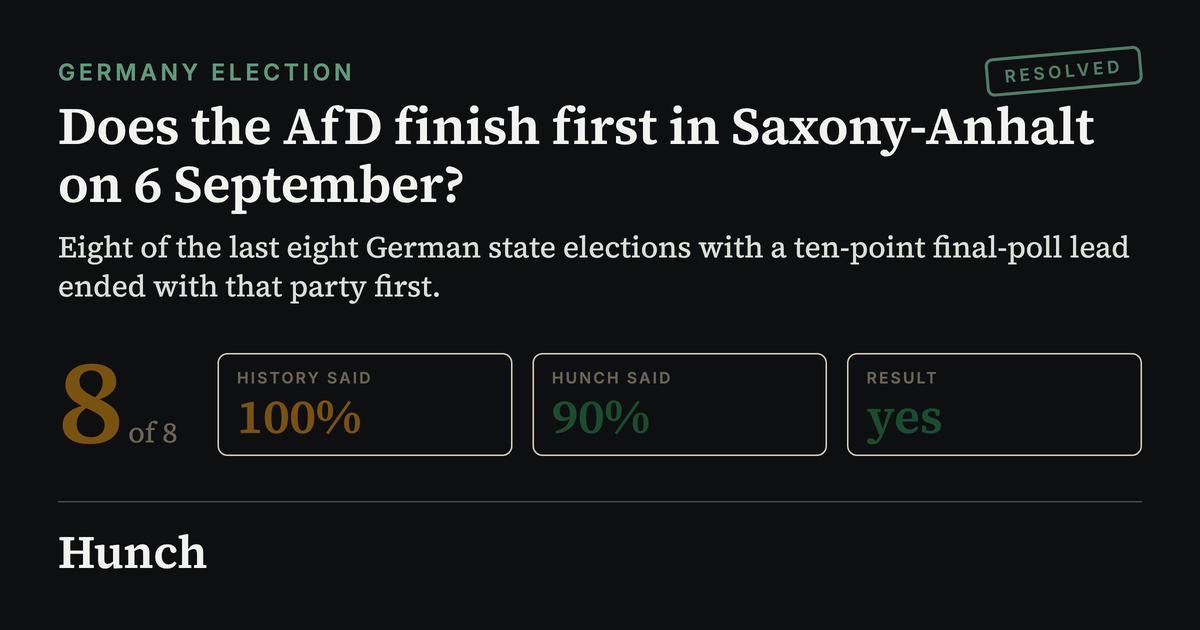
A ten-point lead in the final poll has not been lost since 2016. We looked at every German state election since 2016 where a party went in ten or more points ahead in the last Infratest dimap poll. There were eight, and the leader came first each time. The closest was Saxony-Anhalt in 2016, when a ten-point CDU lead shrank to 5.5 as the AfD overtook Die Linke for second.
Show the other 6 cases
The Read
The record and the result agree. Before Sunday, all eight parties with a ten-point final poll lead had come first, and the AfD turned a twenty-point lead into a 26.6-point win, as the 90% price on the first-place market suggested. In six of the eight cases the leader did better than its final poll, and its gap over second place never fell below 5.5 points. The one sharp narrowing, Saxony-Anhalt 2016, came because the AfD beat its own poll by five points. So far these polls have tended to understate the leader.
The record says nothing about the third market. In none of the eight cases had every other party refused to govern with the winner. Here the constitution decides. No date is set for the first vote, a majority of members is 42 votes, the AfD has 39 and the BSW five. If a first vote fails, within three weeks the constitution moves to a vote decided by a simple majority of votes cast.
The market puts at 35% the chance of an AfD Minister-President by . That could come if the other parties’ refusal breaks and the BSW lends its votes, or if a simple-majority vote is reached. It fails if the other parties gather 42 votes or if no vote takes place at all.
Disclaimer
Hunch works only from sources that are publicly available, and publishes on the basis of analysis of that material. We do not form an editorial opinion or take sides, we give a simpler and wider view of news that already exists. If information in a source we used was inaccurate, distorted, or later disputed but had already entered our analysis, Hunch accepts no liability for that. Predictions are not advice. Phase 1 markets use Hunch Points, not money.
Published by Hunch under the Editorial Code. Complaints and corrections: /contact/.