Chris Van Hollen takes on Chuck Schumer. Will Schumer still lead Senate Democrats?
Senator Chris Van Hollen is running against Chuck Schumer to lead the Democrats in the US Senate. They vote in secret on 1 December.
What happened
Chris Van Hollen, the Democratic senator of Maryland, announced on Thursday that he is challenging Chuck Schumer for the role of Senate majority leader when Democrats regain the chamber’s majority in January.
Chris Van Hollen said on that he will run for Senate majority leader. The senator from Maryland is challenging Chuck Schumer, who has led Senate Democrats since 2017. Democrats won the midterm elections and take control of the Senate in January. Less than a minute after Van Hollen’s statement, Schumer wrote that he has the votes to stay.
I have the votes to continue serving as Democratic Leader. I look forward to leading our new Democratic majority and delivering for the American people.
Chuck Schumer on social media, as reported by The Guardian, 12 November 2026
Democratic senators choose their leader in a secret vote on . The winner needs a simple majority. The Guardian calls it the first contested election for Democratic leader in decades. Van Hollen says more than 10 senators back him, and calls himself the underdog. Bernie Sanders and senator-elect Abdul El-Sayed support him.
On Al Jazeera counted 12 Democratic senators who have promised to vote for Schumer. At least 10, including Sanders, said they will not back him, but only half of those have backed Van Hollen. The winner leads the new Democratic majority when Congress meets on .
Sources: The Guardian (2), NBC News, Al Jazeera, US National Archives
The Pattern
We looked for cases where a member of one party in the US Congress ran in public against that party’s sitting leader in the party’s own vote for leader. We found ten since 1964, four of them in the Senate. We counted the days from the challenge to the vote, or to the leader giving up. Schumer was challenged on , and is day 19.
Show the other 8 cases
The Read
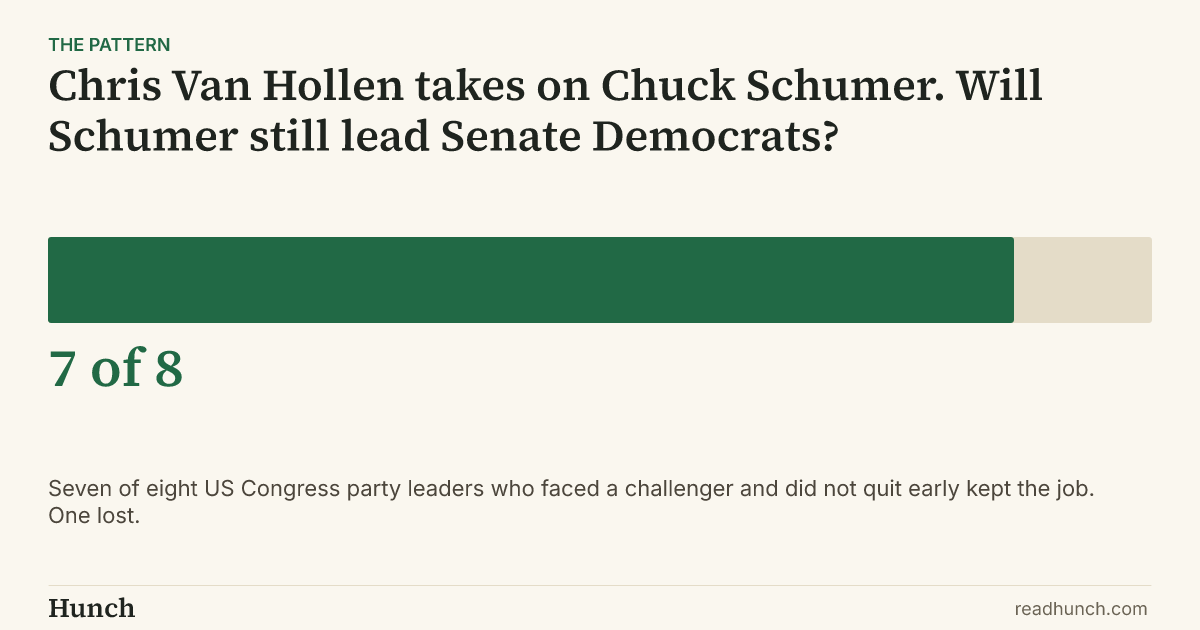
Seven of the eight leaders who stayed in the race kept the job. Two of the three who lost gave up within a day, when pressure had already built: Newt Gingrich after a poor election in 1998, Trent Lott after his own remarks in 2002. Schumer did not give up and answered within a minute. In 1984 Robert Byrd, then the Senate Democratic leader, won a secret vote, and in 1986 he kept the job when his rival gave up.
There are reasons for doubt. All ten fights were in the US Congress, and the same leaders faced two each: Nancy Pelosi in the House and Byrd in the Senate. Only once did a leader lose a vote, Charles Halleck in 1965, and that fight lasted 17 days. This one lasts at least 19 days, longer than any other fight that ended in a vote between the two. Where the count was made public, the challenger got more than 18% of the votes five times in six.
Sources: CBS News, PBS, The Guardian (2, 3), Christian Science Monitor, TIME, Gerald R. Ford Presidential Library, NBC News
Disclaimer
Hunch works only from sources that are publicly available, and publishes on the basis of analysis of that material. We do not form an editorial opinion or take sides, we give a simpler and wider view of news that already exists. If information in a source we used was inaccurate, distorted, or later disputed but had already entered our analysis, Hunch accepts no liability for that. Predictions are not advice. Phase 1 markets use Hunch Points, not money.
Published by Hunch under the Editorial Code. Complaints and corrections: /contact/.