Donald Trump's approval is at 31%. Will Republicans still keep the US Senate?
Americans vote on 3 November. Republicans hold the Senate 53 to 47, and Democrats need a net gain of four seats to take it.
What happened
A month before the midterms, Democrats need a net gain of at least four seats to win the Senate, while approval of President Donald Trump stands at 31%.
Americans vote on , and 35 of the 100 Senate seats are up. Republicans hold the Senate 53 to 47. Democrats need a net gain of at least four seats to take control.
An AP-NORC poll puts approval of President Donald Trump at 31%, the lowest of either of his terms, and 26% for his handling of the economy. Kyle Kondik of Sabato’s Crystal Ball says polls have turned worse for Republicans since Labor Day, though the Midwest is hard to poll.
Republicans are spending millions on races they once saw as safe. Republicans and their allies have booked $888m of ads from mid-September to election day, against $666m for Democrats, according to AdImpact.
At a gathering in Dallas, Trump asked supporters to vote “like I’m on the ballot”. Some Republican candidates in Iowa, Ohio and Michigan have broken with him over the war with Iran.
Sources: Al Jazeera
The Pattern
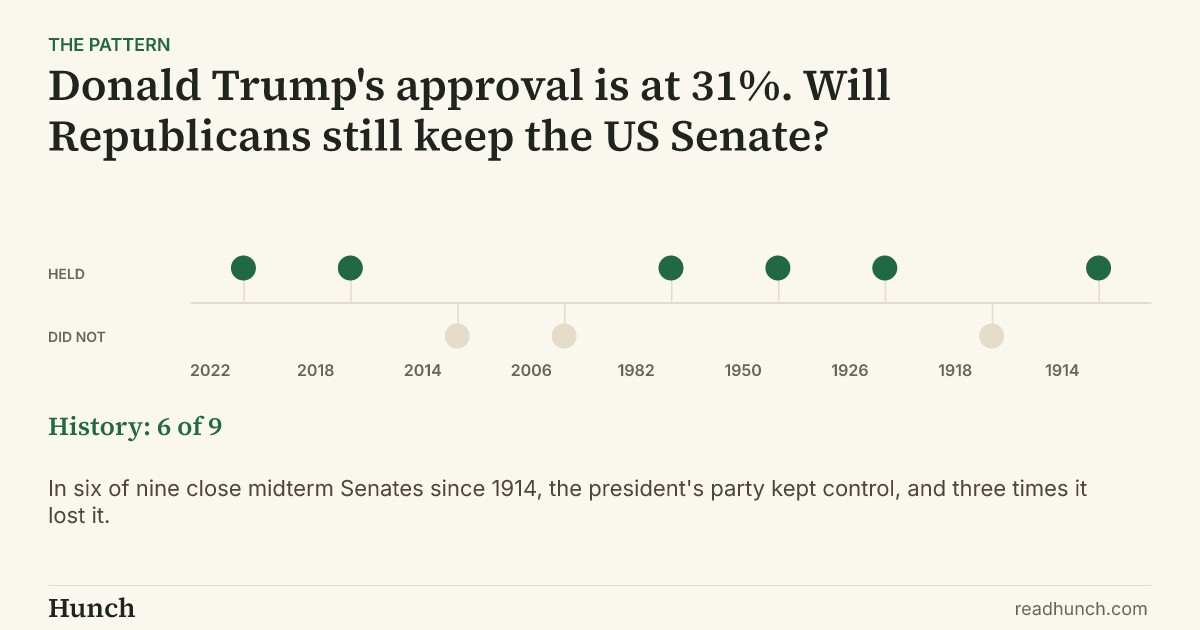
We looked for cases where the president’s party ran the Senate going into a midterm, with a lead of 12 seats or fewer and the president’s approval under 50% or not yet measured. We found nine since 1914. The party kept control six times and lost it three times.
Show the other 7 cases
The Read
Past midterms lean toward Republicans keeping control. In six of nine close midterm Senates, the president’s party kept it. Yet its results came in two groups: it gained one to five seats, or it lost five to nine. With a lead of six today, a net loss of four already ends Republican control, so in this set the party kept control only by gaining seats or by starting with a bigger lead.
Trump’s 31% comes from AP-NORC. Gallup, which measured the earlier presidents, never found one lower than 38% before these midterms. Three of the nine elections, from 1914 to 1926, came before anyone measured approval, and the Senate then had 96 seats.
The two questions point in different directions. With a six-seat lead, losing five seats would end Republican control, and a loss of exactly four would end it too while the seats question resolves no.
Disclaimer
Hunch works only from sources that are publicly available, and publishes on the basis of analysis of that material. We do not form an editorial opinion or take sides, we give a simpler and wider view of news that already exists. If information in a source we used was inaccurate, distorted, or later disputed but had already entered our analysis, Hunch accepts no liability for that. Predictions are not advice. Phase 1 markets use Hunch Points, not money.
Published by Hunch under the Editorial Code. Complaints and corrections: /contact/.