Serbia votes on 25 October. Can Vučić's list win a majority of seats on its own?
Serbia's parliament needs 126 of 250 votes to elect a government. Aleksandar Vučić's list faces a list built by protesting students.
What happened
President Aleksandar Vučić dissolved Serbia’s parliament and called an early election for , after almost two years of student-led protests.
Serbia holds an early parliamentary election on . President Aleksandar Vučić dissolved parliament on . Students have led protests for almost two years, since a railway station canopy fell in Novi Sad in and killed 16 people.
Vučić’s Serbian Progressive Party has been in power since 2012. His second and last term as president ends in 2027. The party has named him as its candidate for prime minister, and in June he said he would step down as president.
The election commission has accepted the list “Aleksandar Vučić – United Serbia” and, on , the students’ “Student List – Students Win”. Other opposition parties run on at least two more lists.
The Government shall be elected if the majority of the total number of deputies votes for it.
Constitution of Serbia, Article 127
Coming first is not enough on its own. The president proposes a prime minister after hearing every list that won seats. If parliament does not elect a government within 90 days of its first sitting, there is a new election. In 2023 Vučić’s list won 47% of the vote and 129 seats.
Sources: Politico Europe, Al Jazeera, Republic Electoral Commission (2, 3), Constitution of Serbia, Articles 109 and 127, The Guardian, IPU Parline
The Pattern
We looked for elections where a party that had won at least two elections in a row still ran the government, after months of protests against it, and a new party or list born of those protests was on the ballot. We kept only countries where parliament elects the government. We found seven such elections, two of them in Serbia.
Show the other 5 cases
The Read
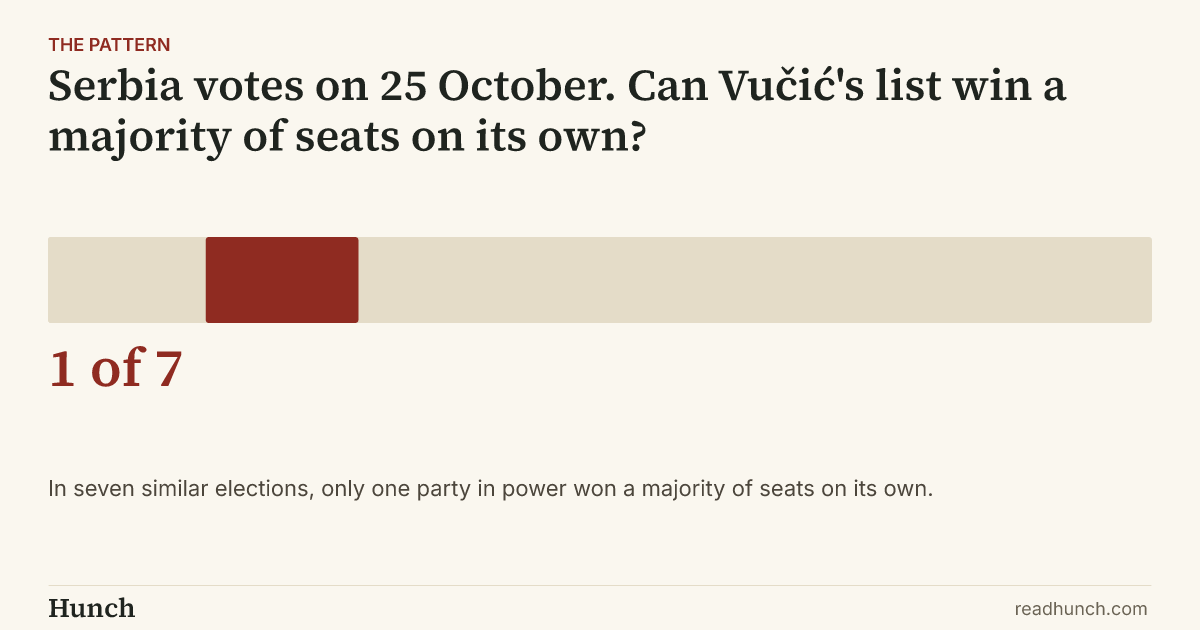
History points against a majority for one list. In seven similar elections, the party in power won enough seats to govern alone only once, and that was Vučić’s own list in 2023. Four times it came first, but only in Serbia did coming first keep it in power. In Montenegro and Bulgaria the list with the most seats did not form the next government.
The record is weak in places. Two of the seven cases are Serbia under the same party, and the others come from different countries and years. Serbia’s seat count also helps the biggest list: in 2023 Vučić’s list won 47% of the vote but more than half the seats. The count on answers the first two questions. The third depends on how fast the new parliament meets and on who the president proposes as prime minister.
Disclaimer
Hunch works only from sources that are publicly available, and publishes on the basis of analysis of that material. We do not form an editorial opinion or take sides, we give a simpler and wider view of news that already exists. If information in a source we used was inaccurate, distorted, or later disputed but had already entered our analysis, Hunch accepts no liability for that. Predictions are not advice. Phase 1 markets use Hunch Points, not money.
Published by Hunch under the Editorial Code. Complaints and corrections: /contact/.