Vučić quit as Serbia's president to be prime minister. Leaders like him got there.
Aleksandar Vučić has quit as Serbia's president. If his party wins a majority on 25 October, parliament is expected to make him prime minister.
What happened
Former Serbian President Aleksandar Vučić launched his campaign for prime minister ahead of the election. If his party wins a majority of seats, parliament is expected to elect him prime minister.
Aleksandar Vučić resigned as Serbia’s president on , more than seven months before his second term was due to end. The constitution barred him from a third term. He is now on the ballot for his Serbian Progressive Party (SNS) in a snap parliamentary election on .
If the SNS wins a majority of seats, parliament is expected to elect Vučić prime minister. Polls suggest a close race with the Student List, the election arm of a protest movement that has marched against the government for almost two years.
At a rally in Belgrade on , Vučić promised a “comprehensive” victory and said, without giving evidence, that foreign agents back the movement. He has led Serbian politics as president or prime minister since 2014.
Serbia’s parliament has 250 seats, so a majority needs 126. At the last election, in , Vučić’s party won a majority on its own, but parliament elected the new government only on .
Sources: Al Jazeera, The Guardian, Government of Serbia
The Pattern
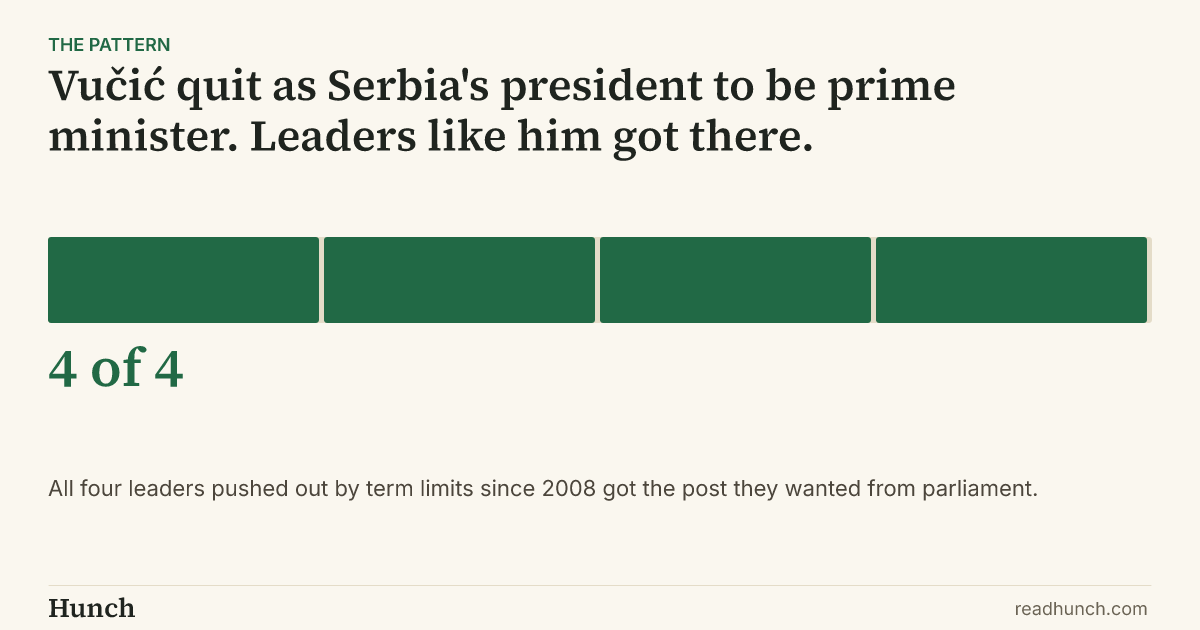
We looked for cases where a term limit forced a leader out of the top job and he then sought another post that parliament gives. We found four since 2008, in Russia, Moldova, Armenia and Bulgaria.
Show the other 2 cases
The Read
The past points to Vučić getting the job. All four leaders pushed out by term limits got the post they wanted from parliament, each within 40 days of the vote or of leaving office. Bulgaria’s Rumen Radev took 18 days this spring, after his party won a majority.
The vote and the date are the weak points. Polls suggest a close race with the Student List, and Vučić needs his party to win first. In Serbia itself, his party won a majority in and parliament still took until to elect a government. In Armenia, Serzh Sargsyan got the job and resigned six days later after street protests.
Disclaimer
Hunch works only from sources that are publicly available, and publishes on the basis of analysis of that material. We do not form an editorial opinion or take sides, we give a simpler and wider view of news that already exists. If information in a source we used was inaccurate, distorted, or later disputed but had already entered our analysis, Hunch accepts no liability for that. Predictions are not advice. Phase 1 markets use Hunch Points, not money.
Published by Hunch under the Editorial Code. Complaints and corrections: /contact/.