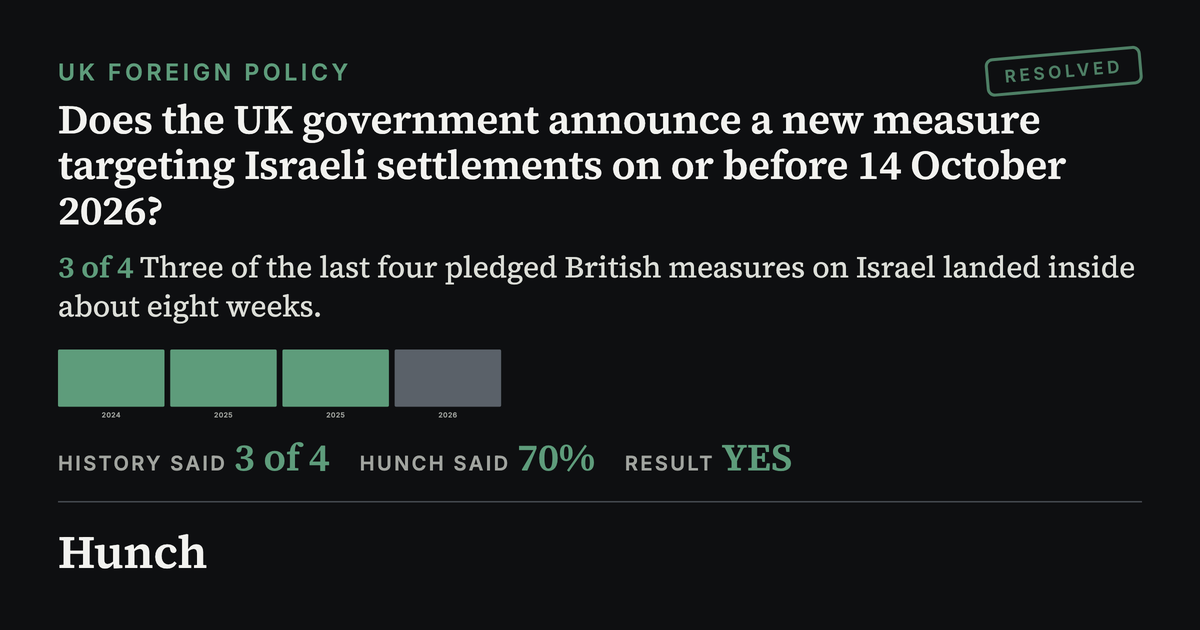
UK may ban Israeli settlement goods. Past UK pledges on Israel were mostly kept.
Israel invited bids for over 1,200 settlement homes in the E1 area of the West Bank. Prime Minister Andy Burnham is expected to ban settlement goods.
What happened
Al Jazeera reports that Prime Minister Andy Burnham is expected to approve a ban on goods linked to Israeli settlements, after Israel issued tenders for more than 1,200 homes in the E1 area of the occupied West Bank.
On the UK called Israel’s E1 building plan unacceptable. It signed a joint statement by national leaders against Israel’s decision to invite bids to build in E1, an area of the occupied West Bank. The statement warned that the plan would cut the West Bank in two.
More governments signed between 20 and , until 22 governments and the European Commission had put their names to it. The statement warned companies that bidding for the contracts could bring legal trouble and harm to their reputation. It set no deadline and imposed nothing.
Al Jazeera reported on that Prime Minister Andy Burnham is expected to approve a ban on goods made in Israeli settlements. On the Foreign Secretary had said the government would set out a full set of measures in the coming weeks. Officials said they do not comment on speculation.
A YouGov poll cited in the same report found 50% of people support a ban and 16% oppose it. More than 140 Labour MPs back a trade ban.
Britain has already taken steps that stop short of trade. It suspended around 30 of 350 arms export licences in , sanctioned two serving Israeli ministers in and formally recognised the State of Palestine in . A trade ban would be the first British measure to touch trade with the settlements themselves.
Sources: Al Jazeera, GOV.UK (2)
The Pattern
Three of four British promises on Israel since 2024 led to action. We looked at every time since 2024 that a prime minister or foreign secretary said measures on Israel were coming, and checked whether a named measure followed within about eight weeks. Arms licences, sanctions on ministers and recognition of Palestine all came. A ban on trade with the settlements, demanded since 2024, never has.
Show the other 2 cases
The Read
History says something will come, but smaller than a full ban on imports. Each of the three measures that did come was a tool the Foreign Office already had, used against a named list. Sanctions and licence suspensions can be signed off inside the department. A ban on imports needs trade law, customs rules and an agreed definition of what counts as settlement produce. Public support of 50% and 140 Labour MPs give political cover, and the machinery is the limit.
There are reasons for doubt. The E1 statement was a warning to business and set no policy, and warnings have been as far as Britain went before. The government has declined to comment on the reports, and Labour Friends of Israel has argued a ban would be impossible to carry out. The Foreign Secretary spoke of a set of measures in the coming weeks and did not promise a ban.
If the package brings more sanctions plus guidance on public contracts, the trade market resolves NO while the pattern still stands. The reading fails outright if Israel withdraws the E1 tenders and the pressure fades.
Disclaimer
Hunch works only from sources that are publicly available, and publishes on the basis of analysis of that material. We do not form an editorial opinion or take sides, we give a simpler and wider view of news that already exists. If information in a source we used was inaccurate, distorted, or later disputed but had already entered our analysis, Hunch accepts no liability for that. Predictions are not advice. Phase 1 markets use Hunch Points, not money.
Published by Hunch under the Editorial Code. Complaints and corrections: /contact/.