Republicans pulled ad money from Trump's pick in North Carolina. Will it come back?
The Senate Leadership Fund pulled its ads from Michael Whatley's North Carolina race on 2 October. Whatley trails Roy Cooper by 11 points.
What happened
The Senate Leadership Fund withdrew its ad spending from Michael Whatley’s North Carolina Senate race on to support other Republican candidates.
The Senate Leadership Fund pulled its ads from North Carolina’s Senate race on . The fund is the campaign group of John Thune, the Republican leader in the Senate. It is moving the money to other races, among them Kansas, where Senator Roger Marshall faces a hard fight. The New York Times and CNN confirmed the move.
The Republican candidate, Michael Whatley, was handpicked by Donald Trump. He is a former chair of the Republican National Committee. The seat opened when Senator Thom Tillis retired. The fund had promised $71 million to hold it and had planned to spend $30 million more for Whatley.
Whatley trails the Democrat Roy Cooper by 11 points in an AARP poll published on . Cooper, a former governor, has led by at least four points in every poll this year. The Cook Political Report rates the race as leaning Democratic. In-person early voting starts on .
Republicans hold the Senate 53 to 47 and can lose no more than three seats. Seven other races are rated toss-ups, and five of them are seats Republicans hold.
Trump has money of his own in the fight. In September his political group said it was sending $49 million to key midterm races.
Sources: The Guardian, The New York Times (2)
The Pattern
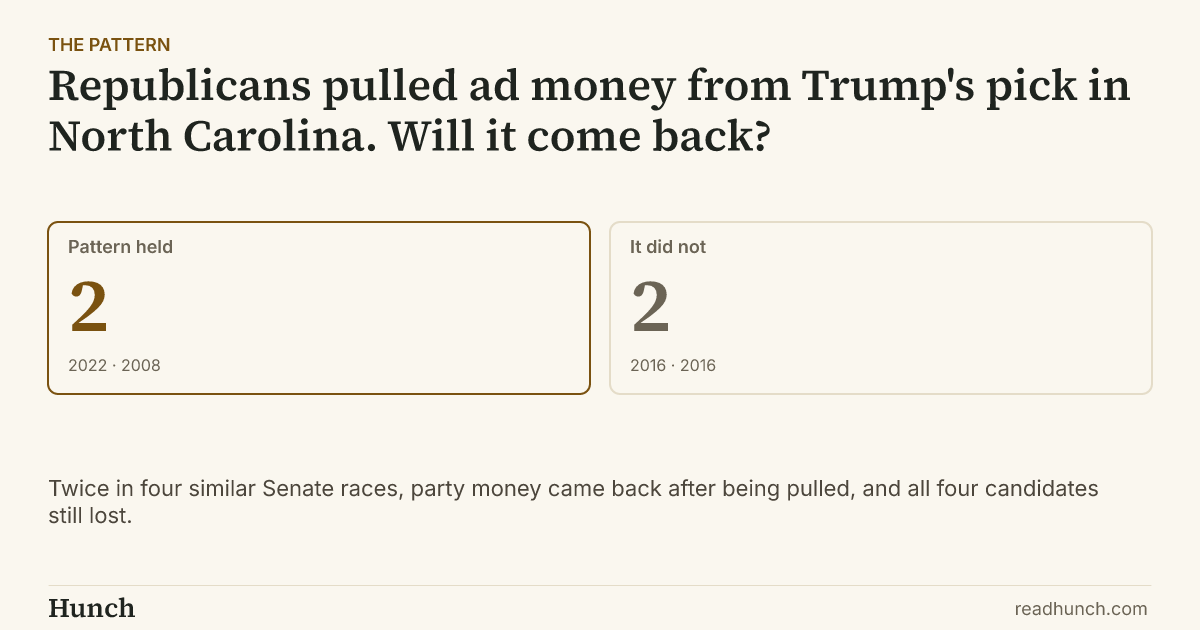
We looked for cases where a party’s central money group pulled its ads from a race a few weeks before polling day because of bad polls, and moved the money to other races, while the candidate had the backing of the party’s leader, who does not run that group. We found four since 2008, all US Senate races. All four candidates lost, but that mostly shows the funds read the polls well. So we ask whether the money came back.
Show the other 2 cases
The Read
History is split. In two of four races the party’s money came back before polling day: in Louisiana in 2008 within days, when the gap narrowed, and in Arizona in 2022 from a different party group. In Florida and Ohio in 2016 it stayed away.
The record has limits. All four cases are US Senate races, and two come from the same 2016 cycle and the same Democratic groups. Every candidate lost, but that mostly says the funds judged the polls well, not that pulling the money caused the loss.
A poll showing Cooper’s lead shrinking would look like Louisiana in 2008. Money from Trump’s own group would answer a different question: the cases did not track whether the party’s leader filled the gap himself.
Disclaimer
Hunch works only from sources that are publicly available, and publishes on the basis of analysis of that material. We do not form an editorial opinion or take sides, we give a simpler and wider view of news that already exists. If information in a source we used was inaccurate, distorted, or later disputed but had already entered our analysis, Hunch accepts no liability for that. Predictions are not advice. Phase 1 markets use Hunch Points, not money.
Published by Hunch under the Editorial Code. Complaints and corrections: /contact/.