Judge sends Spanish PM's wife to trial. Most such trials took over a year to start.
A judge in Madrid has sent Begoña Gómez, wife of Spain's prime minister Pedro Sánchez, to trial. No date is set yet.
What happened
Judge Juan Carlos Peinado sent Begoña Gómez, wife of Spain’s prime minister Pedro Sánchez, and her aide Cristina Álvarez to trial on charges of influence peddling and embezzlement. A higher court must now set the date.
On Monday , Judge Juan Carlos Peinado in Madrid issued the order that sends Begoña Gómez to trial. She is charged with influence peddling, which means using a link to people in power to win a favour, and with embezzlement of public funds. Her aide at the prime minister’s office, Cristina Álvarez, is charged with embezzlement only.
The case is about a university programme Gómez co-directed at Madrid’s Complutense University and the use of a state-paid assistant for private work. Gómez denies wrongdoing. The public prosecutor says the evidence shows no crime and wants her acquitted. Hazte Oír, a private group acting as prosecutor, wants 13 years in prison.
No trial date is set yet. The case goes to the Madrid Provincial Court, where a jury will hear it, and that court must now set the date. In June the judge took her passport, and in July the provincial court confirmed the jury trial.
Pedro Sánchez made no statement on the day in our sources. He has long called the case a politically motivated campaign against his family. The latest legal date for Spain’s next general election is .
Sources: Politico Europe (2), Financial Times, The Guardian, Reuters
The Pattern
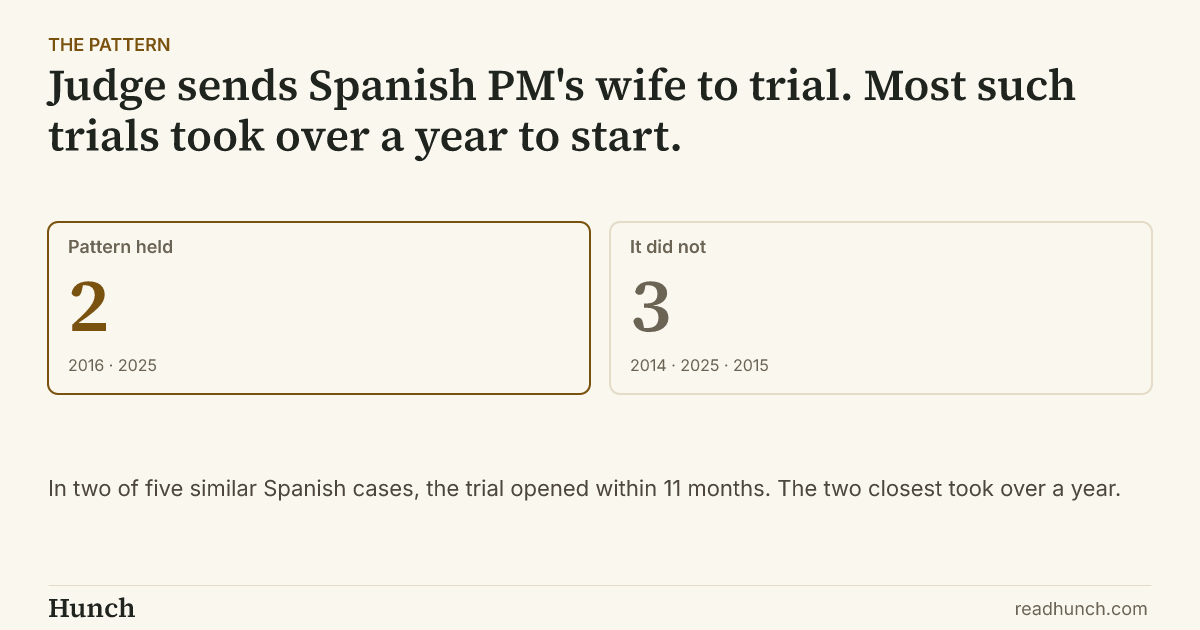
In Spain the wait for a trial depends mostly on the court. We looked at high-profile political cases in which a judge sent the case to trial, and counted the days until the trial opened. Our sources give both dates for eight cases, and five are close enough to compare. The two closest, heard by provincial courts like this one, both took just over a year. The two fast ones were tried by national courts: the Supreme Court, which has no queue, and the National Court. This trial will be the only one of them heard by a jury, and jury rules let the defence appeal the order itself, a step none of the five cases had.
Show the other 3 cases
The Read
A judge’s order is not the start of the trial. In Spain the time from the order to the first day in court runs from weeks to years, and it depends mostly on which court hears the case. The Supreme Court tried the attorney general within two months. The National Court took from eight months for Rodrigo Rato to 19 months for Gürtel. The two provincial court cases, closest to this one, both took just over a year.
This case adds two things the record lacks. It will be heard by a jury, and under jury rules the defence can appeal the order itself. Both usually slow a case down, which is why the estimate sits below the record.
The reading fails if the Madrid court moves fast to settle the case before the general election, or if the appeal is thrown out quickly. It also fails the other way if the trial is suspended or the case is closed on appeal.
Disclaimer
Hunch works only from sources that are publicly available, and publishes on the basis of analysis of that material. We do not form an editorial opinion or take sides, we give a simpler and wider view of news that already exists. If information in a source we used was inaccurate, distorted, or later disputed but had already entered our analysis, Hunch accepts no liability for that. Predictions are not advice. Phase 1 markets use Hunch Points, not money.
Published by Hunch under the Editorial Code. Complaints and corrections: /contact/.