Spain's rent decree goes to a vote. The party it needs has said no.
Spain's government wants Congress to approve two housing decrees on 2 October. It has no majority, and the Catalan party Junts rejects one of them.
What happened
Spain’s coalition government approved two housing decrees on after the eviction of an 87-year-old woman in Madrid, and both need the approval of Congress, where the coalition has no majority.
Spain’s coalition government approved two housing decrees on , a week after an 87-year-old woman was evicted from her flat in Madrid. A decree takes effect at once in Spain, but it falls unless Congress approves it within 30 days of publication. The coalition has no majority in Congress and asked for a special sitting on Friday.
The first decree was published on . It extends limits on evicting vulnerable tenants to 2030 and bars speculative buyers from buying homes at below 70% of their value until the end of 2028.
The second decree extends rental contracts automatically. The government put it in a separate text because Junts, the Catalan party whose seven votes it needs, does not back it. It is due in the official gazette on , one day before the vote.
Junts said on that it was still far from a deal and wanted protection for small landlords. On its spokeswoman in Congress, Míriam Nogueras, said the party was disappointed and asked for changes on funds and on inheritance. Decrees cannot be amended at the vote, so any change needs a new decree.
Reports on Junts differ. Infobae wrote on that the conservative People’s Party (PP), the far-right Vox and Junts had announced votes against the rent decree, which together make a majority. The EFE agency reported the same day that Junts had not yet said how it would vote. Congress revoked an earlier decree extending rental contracts on .
Sources: The Guardian, BOE (2), Infobae (2, 3), dpa via Yahoo News, elDiario.es
The Pattern
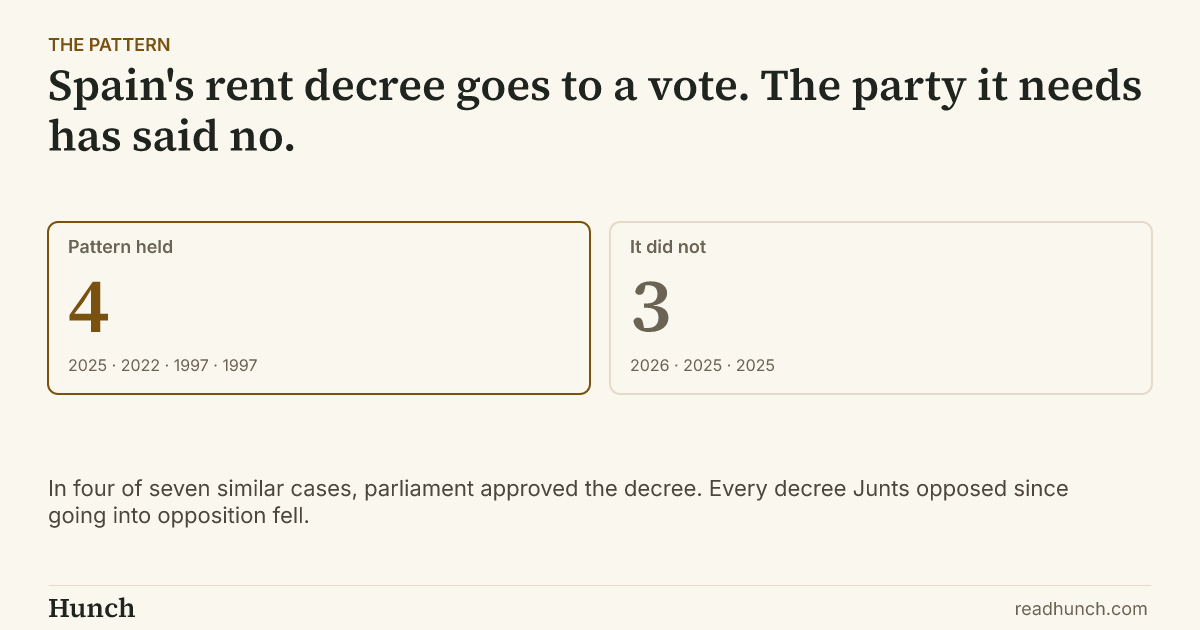
We looked for cases where a government without its own majority issued a decree that lapses unless parliament approves it in time, and the party whose votes it needed said no in public before the vote. We kept only governments that had already lost such votes, as this one has lost eleven since 2023. We count decrees settled by one vote, or by one party decision, as one case. We found seven since 1997, five in Spain and two in Italy.
Show the other 5 cases
The Read
History gives a narrow edge to approval. In four of the seven cases parliament approved the decree despite the public no. The detail points the other way for this one. Since Junts went into opposition in , Congress has revoked all seven decrees it opposed, and a rent extension decree already fell once, in April. Without the rule on earlier defeats, our search finds 15 cases, and 5 of them were approved.
Approval came in two ways. In Italy in 1997 the party that said no got a deal or promised amendments, twice. In Spain in 2022 and 2025 the decree passed with no deal, once on other votes and a deputy’s mistake, once when Podemos changed its mind on the day. The vote on comes a day after the rent decree is published, sooner than in any case we found.
If the decree falls, the cases suggest the government tries again. After two of the three defeats it brought the same measure back in a new decree, and after the third we could not tell. The seven cases come from two countries, and four of them from the present Spanish parliament.
Disclaimer
Hunch works only from sources that are publicly available, and publishes on the basis of analysis of that material. We do not form an editorial opinion or take sides, we give a simpler and wider view of news that already exists. If information in a source we used was inaccurate, distorted, or later disputed but had already entered our analysis, Hunch accepts no liability for that. Predictions are not advice. Phase 1 markets use Hunch Points, not money.
Published by Hunch under the Editorial Code. Complaints and corrections: /contact/.