Britain moves to nationalise steel again. Both past takeovers were later undone.
A bill letting ministers take a steel company into public ownership passed a House of Lords stage unchanged on 1 July. The next stage opens on 8 July.
What happened
The Steel Industry (Nationalisation) Bill clears committee stage in the House of Lords without amendment, as peers warn against running the industry on a blank cheque.
The bill would let ministers take a steel company into state hands when that is in the public interest, by moving the company’s shares or property into public ownership.
It is the last step of a rescue that began in . Ministers then used the Steel Industry (Special Measures) Act to direct how British Steel runs and keep the Scunthorpe blast furnaces burning. About £484 million in support has followed. In the government said it planned to nationalise the company fully.
The bill finished its House of Commons stages on . The House of Lords held its first main debate on it, the second reading, on .
The cost came up at committee stage, when peers go through the bill line by line, on and . Lord Sharpe of Epsom proposed a limit of £2.5 billion on support until . He said the government’s own aim “is not permanent public subsidy”.
Lord Fox, for the Liberal Democrats, wanted both Houses to approve any money, with a 90-day pause after select committees, which check the government’s work, receive the details. Business minister Lord Leong rejected both ideas. He said fixed limits would “risk constraining the Government’s ability to respond effectively”. The bill left committee unchanged.
Report stage, the next round of Lords votes, opens on Wednesday . This time peers will push their changes to votes. They want a statement of the costs the state could face later on the environment, pensions and running the plants. They also want a report on how nationalisation affects investment from abroad, and equal rules for public and private steel firms.
If any change is voted through, the bill goes back to the House of Commons, and the summer break is close.
Sources: The Irish News, House of Lords Library, UK Parliament
The Pattern
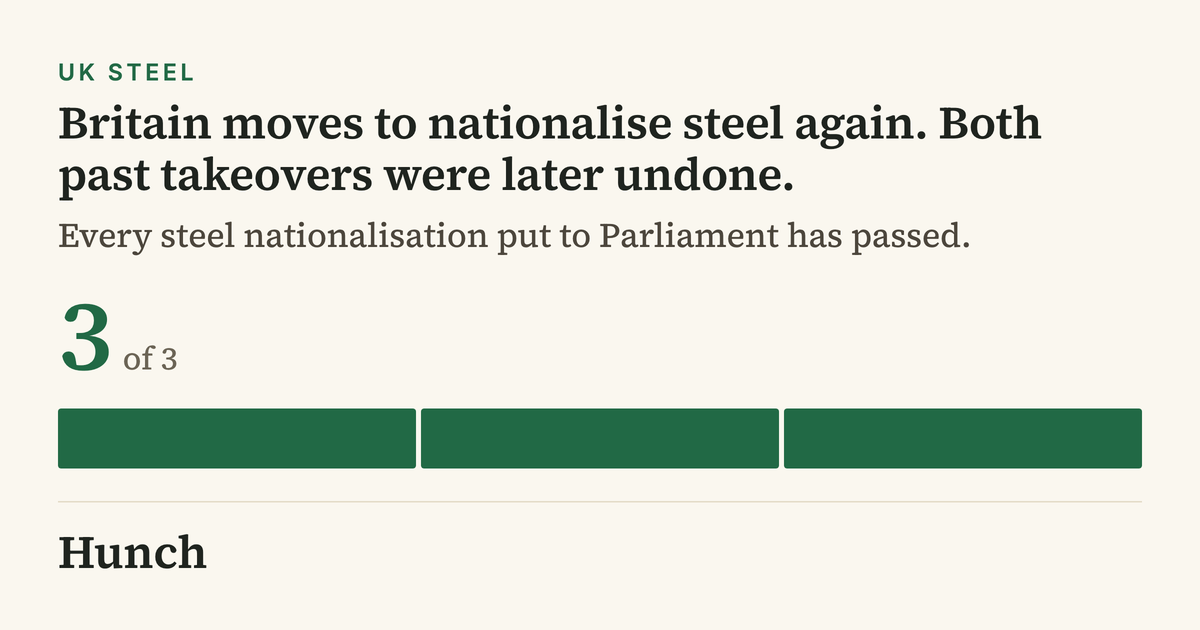
Three identified steel public-ownership or intervention bills passed. Their legal effects differed; operational control in 2025 is not identical to an ownership transfer.
Show the other 3 cases
The Read
History points to the bill becoming law before the summer break. Steel laws have passed three times out of three, and this one meets less resistance than any before it. The rescue has run since , and Parliament accepted the principle when it sat on a Saturday to keep the Scunthorpe furnaces burning. The opposition’s changes in committee were about the cost and did not challenge public ownership.
The risk is the calendar. A defeat on would start ping-pong, when a bill passes back and forth between the two Houses, with perhaps eight sitting days left. The government is going through a Labour leadership change and has little time for a fight with the Lords. The Sharpe limit and the Fox approval plan appeal to peers outside the parties, because refusing a blank cheque is not a party position. Peers who withdrew changes in committee did so to fight at report stage, where the custom of restraint is weaker.
By custom the Lords changes government bills and does not block them, and a single defeat can be accepted or reversed in one Commons sitting, with two full sitting weeks left. If two or more changes pass, the government must choose between accepting limits on its own spending and letting the bill slip to September. A bill delayed past the summer is likely to be reopened for talks.
Disclaimer
Hunch works only from sources that are publicly available, and publishes on the basis of analysis of that material. We do not form an editorial opinion or take sides, we give a simpler and wider view of news that already exists. If information in a source we used was inaccurate, distorted, or later disputed but had already entered our analysis, Hunch accepts no liability for that. Predictions are not advice. Phase 1 markets use Hunch Points, not money.
Published by Hunch under the Editorial Code. Complaints and corrections: /contact/.