Trump made Stephen Miller his White House chief of staff. Will he go before 2027?
Stephen Miller became Donald Trump's White House chief of staff on 9 November, days after Republicans lost both houses of Congress.
What happened
Stephen Miller, the architect of Donald Trump’s mass deportation policy and hardline crackdown on immigration, took up his new role as White House chief of staff on Monday.
Stephen Miller became White House chief of staff on . The Guardian calls the job one of the most powerful unelected posts in Washington. Miller, 41, had been a deputy chief of staff since and is known as the architect of Donald Trump’s mass deportation policy. He replaced Susie Wiles, who ran Trump’s 2024 campaign. Miller is the sixth chief of staff to serve Trump, who went through four in his first term.
Stephen’s been with me from the beginning. He gets it. Very good politically and he’s a very good man. He’ll do a great job. Great manager.
Donald Trump to reporters at the White House, 6 November 2026
Trump made the change three days after the midterm elections. He announced it on , and by the next day Republicans had lost seven Senate seats and 42 House seats. In October Trump had said there was “zero chance” he would replace Wiles.
Democratic leaders want Miller gone. Hakeem Jeffries, likely the next Speaker of the House, wrote “Fire him today”, and on said he had “zero interest” in working with Miller. Some Republicans object too. Congressman Marlin Stutzman called the move a “horrible decision”, and Don Bacon said Miller “cost us seats in Texas and Arizona”.
Democrats take control of Congress in January. Then their House committees can open investigations and order officials to appear. Trump himself said in a 60 Minutes interview shown on that his deportation policy, which Miller led, might be “too tough”.
Sources: The Guardian (2, 3, 4), NBC News (2)
The Pattern
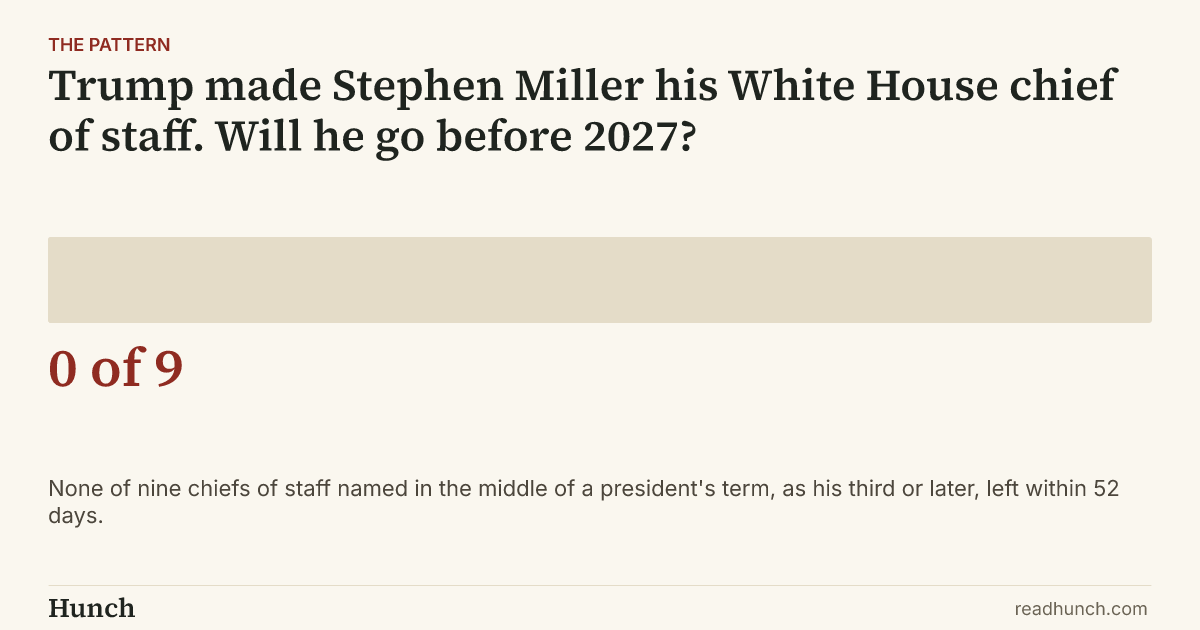
We looked for cases where a US president named a new White House chief of staff in the middle of a term, as at least the third chief under that president. We found nine since 1975, under six presidents from Gerald Ford to Donald Trump. For each we checked whether the new chief left, or said he would leave, within 52 days, the time from to .
Show the other 7 cases
The Read
Where an exit is known, it came after more than a year. Four of the nine left or said they would: Jack Lew after 367 days, William Daley after 368, Mick Mulvaney after 448 and Howard Baker after 473. Two moved to other government jobs and two left for their own reasons. Reince Priebus, Trump’s first chief, left after 189 days in 2017.
There are reasons for doubt. Miller is Trump’s sixth chief of staff, and none of the nine was more than a president’s fourth. None of them started just after the other party won both houses of Congress. Each time the president decided alone, and Trump made two of the nine choices. His words on staff can change fast: in October he said there was “zero chance” of replacing Wiles.
Sources: The American Presidency Project (2, 3, 4, 5), The Guardian (2)
Disclaimer
Hunch works only from sources that are publicly available, and publishes on the basis of analysis of that material. We do not form an editorial opinion or take sides, we give a simpler and wider view of news that already exists. If information in a source we used was inaccurate, distorted, or later disputed but had already entered our analysis, Hunch accepts no liability for that. Predictions are not advice. Phase 1 markets use Hunch Points, not money.
Published by Hunch under the Editorial Code. Complaints and corrections: /contact/.