Sweden's Ulf Kristersson trails by 3 points. Can his small partner clear 4%?
Ulf Kristersson's right-wing government is about 3 points behind Magdalena Andersson's opposition, 10 days before Sweden votes on 13 September.
What happened
A poll published ten days before Sweden’s election showed a close race between Kristersson’s government bloc and the centre-left opposition; Bloomberg put the opposition’s lead at a little over three points, its narrowest of the year.
Sweden votes on Sunday , electing all 349 seats in the Riksdag, the national parliament, along with regional and local councils. Early voting has been open since .
The race is between two groups of parties. One is the four-party opposition led by the Social Democrats under former prime minister Magdalena Andersson. The other is the three-party government of Ulf Kristersson, in power since 2022 with the support of the anti-immigration Sweden Democrats.
The polls have tightened in the last two weeks. A poll published on showed a close race with ten days to go. The Guardian wrote on that the polls pointed to a new centre-left coalition.
On Bloomberg reported that the opposition’s lead had narrowed to a little over three points, with Kristersson’s Liberal partner below the 4% a party needs to enter parliament.
The 4% line may decide the result. If the Liberals fall short, their votes win no seats. That is why a three-point gap in votes can become a gap of more than twenty seats. In 2022 the Liberals cleared the line with 4.61%, and the right-wing parties won 176 seats to 173 with a lead of less than one point in votes.
Sources: Reuters, Swedish Election Authority (2), Bloomberg 2 Sep 2026, context, Guardian
The Pattern
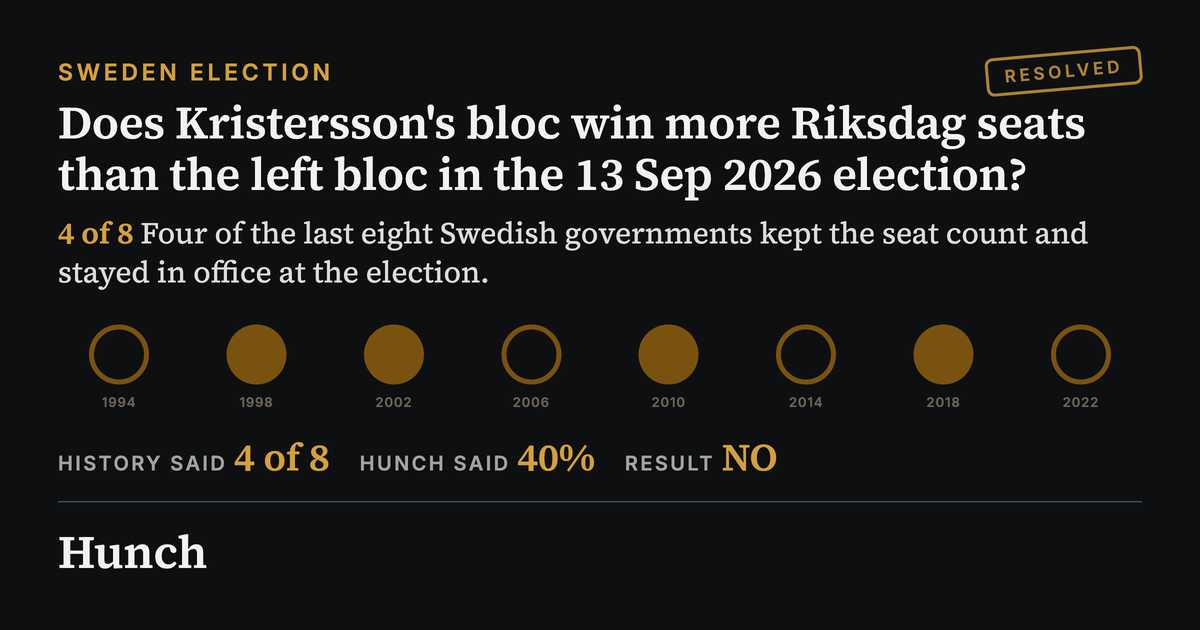
In four of the last eight elections the government stayed in power. We looked at every Swedish election since 1991, nine in all, and show the last eight. In four, the government’s side won more seats than its rivals and stayed in office, and in four it lost. In every close race, the seat count turned on which small parties cleared the 4% line.
Show the other 6 cases
The Read
History leans towards the opposition, though by less than the summer polls suggested. Four of the last eight governments won more seats than their rivals. The two recent survivals, 2010 and 2018, came from a near-tie in votes. Today’s three-point gap sits between those and the clear defeats of 2006, 2014 and 2022.
The Liberals decide the seat count. Below 4% their votes count for nothing, and the poll Bloomberg reported on turned a three-point gap in votes into more than twenty seats between the two sides. That is why the market puts the government side’s chance of winning more seats at 40% and not closer to even.
The trend runs the government’s way. Every poll of the last two weeks has moved in the same direction, and in 2022 the Liberals cleared the line with 4.61% after polling below it for most of the campaign. The reading fails if tactical voting, when supporters of other parties vote Liberal to keep them in, lifts the Liberals over 4%. Then three points in votes becomes close to a coin-flip in seats. It also fails if the Sweden Democrats’ vote is understated, as it was in 2018 and 2022.
Disclaimer
Hunch works only from sources that are publicly available, and publishes on the basis of analysis of that material. We do not form an editorial opinion or take sides, we give a simpler and wider view of news that already exists. If information in a source we used was inaccurate, distorted, or later disputed but had already entered our analysis, Hunch accepts no liability for that. Predictions are not advice. Phase 1 markets use Hunch Points, not money.
Published by Hunch under the Editorial Code. Complaints and corrections: /contact/.