Sweden voted out its prime minister. Will the new one be in office by 5 October?
Speaker Andreas Norlen gave Magdalena Andersson until 28 September to put a government together. Her bloc holds 176 of the Riksdag's 349 seats.
What happened
Speaker Andreas Norlen asked Magdalena Andersson on Friday to explore forming a government. She has until ; if she fails, Ulf Kristersson gets the task.
Ulf Kristersson resigned as Sweden’s prime minister on Thursday , four days after his side lost the election by about 50,000 votes. The left bloc led by Magdalena Andersson won 176 of the 349 seats in the Riksdag, the Swedish parliament. Kristersson’s side won 173.
In his statement Kristersson asked to leave office so that work on a new government could start at once.
In Sweden a prime minister who resigns stays on as caretaker until a new one takes over, and the speaker of the Riksdag runs the process of finding one.
Andersson has until . The speaker, Andreas Norlen, acted the next day. After talks with every party and with his deputies, he asked Andersson to find out whether she can form a government. If she misses the deadline, the task passes to Kristersson.
Her majority is thin. Andersson needs the Greens, the Centre Party and the Left Party to reach a majority of three seats, and two of them are already pulling apart. The Left Party wants places in the cabinet in return for its support. The Centre Party says it will not back a government built that way.
One more date is fixed. The Riksdag has told the press that the new session opens on Tuesday .
Sources: Al Jazeera, BBC, Riksdag
The Pattern
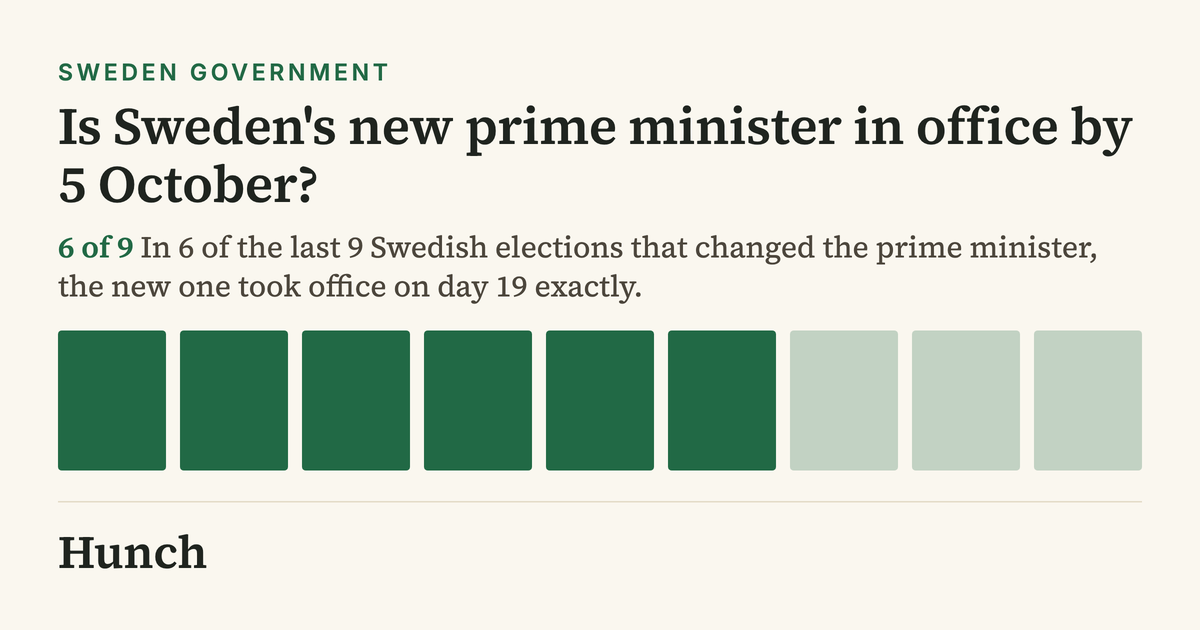
Six of the last nine new prime ministers took office on day 19. We looked at every Swedish general election since 1976 after which the prime minister left office and the Riksdag chose a new one. We counted the days from polling day to the day the new prime minister took office. Elections where the prime minister stayed on are left out.
Show the other 7 cases
The Read
History points to speed, and the reason is the timetable more than the politics. After six of the last nine elections that removed a prime minister, the new one took office on day 19 exactly. The new Riksdag opens about two weeks after polling day, elects a speaker, and votes on a prime minister in its first working week. Sweden also makes that vote easier than most countries. A candidate wins unless more than half of all members vote against, so Andersson does not need every party on her side to say yes. She only needs them not to say no.
The risk is what happened in 2022, when it took 37 days, and in 2018, when it took 134. Both times four parties had to make a deal from nothing. Andersson is doing that now, with a margin of three seats, a Left Party asking for cabinet places and a Centre Party refusing to support that. In this record there is almost nothing in between. It is day 19, or it is weeks.
The two questions on this page use two different clocks. The first starts on polling day and ends when someone is in the job, which is what the nine elections measure. The second starts with Kristersson’s resignation on and ends with the Riksdag’s vote. That shorter chain has its own six cases, which took 5, 9, 14, 17, 32 and 115 days. Two of the six came in under 12 days, and both were changes in the middle of a term, when parliament was already sitting and the votes were already counted. That is why the second question starts at 10 per cent and carries a warning. The new Riksdag does not meet until , and no Swedish government after an election has ever been voted in on the opening day.
Disclaimer
Hunch works only from sources that are publicly available, and publishes on the basis of analysis of that material. We do not form an editorial opinion or take sides, we give a simpler and wider view of news that already exists. If information in a source we used was inaccurate, distorted, or later disputed but had already entered our analysis, Hunch accepts no liability for that. Predictions are not advice. Phase 1 markets use Hunch Points, not money.
Published by Hunch under the Editorial Code. Complaints and corrections: /contact/.