Swiss voters decide on strict neutrality. One in five past plans like it passed.
On 27 September Swiss voters decide whether to write a stricter neutrality into the constitution. It would stop most sanctions on countries at war.
What happened
Voters in Switzerland will decide in a referendum on Sunday whether to enshrine a stricter definition of the country’s neutrality into the constitution.
Switzerland votes on on the neutrality initiative. It would write into the constitution that Swiss neutrality is permanent and armed. Switzerland could not join a military alliance or work with one unless it was attacked, and could not impose sanctions on countries at war, except sanctions of the United Nations.
Since Switzerland has largely followed the EU’s sanctions against Russia. Politico reports that the initiative grew out of the backlash to that. It was launched by Pro Schweiz, a national-conservative group close to the Swiss People’s Party (SVP).
The Federal Council, Switzerland’s government, and parliament recommend a No. They say the constitution already gives the room needed and the initiative would narrow it. The lower house voted 124 to 65 against, with 5 abstentions, and the upper house 29 to 10, with 5 abstentions. Politico reports that all major parties except the SVP oppose it.
A change to the constitution needs two majorities. More than half of voters must say yes, and so must more than half of the cantons. The result in each canton counts as that canton’s vote, and six cantons count as half a vote each, so there are 23 votes in total.
The SRG, the Swiss public broadcaster, asks the gfs.bern institute for two polls before each vote. The first, published on , had 42% for the initiative and 54% against. The second, published on , had 34% for and 63% against. gfs.bern says support fell in the groups it tracks, including SVP supporters, where a majority still backs it.
Sources: Politico Europe, Swiss Federal Council, initiative page, Federal Council voting booklet, ch.ch, Swiss federal authorities, gfs.bern (2)
The Pattern
We looked for cases where Swiss voters were asked to limit the government’s hand abroad, or to reopen or leave international treaties, by a citizens’ initiative that the government and parliament told them to reject. We found five, from 2012 to . In each we compared the result with the last SRG poll and with the vote of the cantons.
Show the other 3 cases
The Read
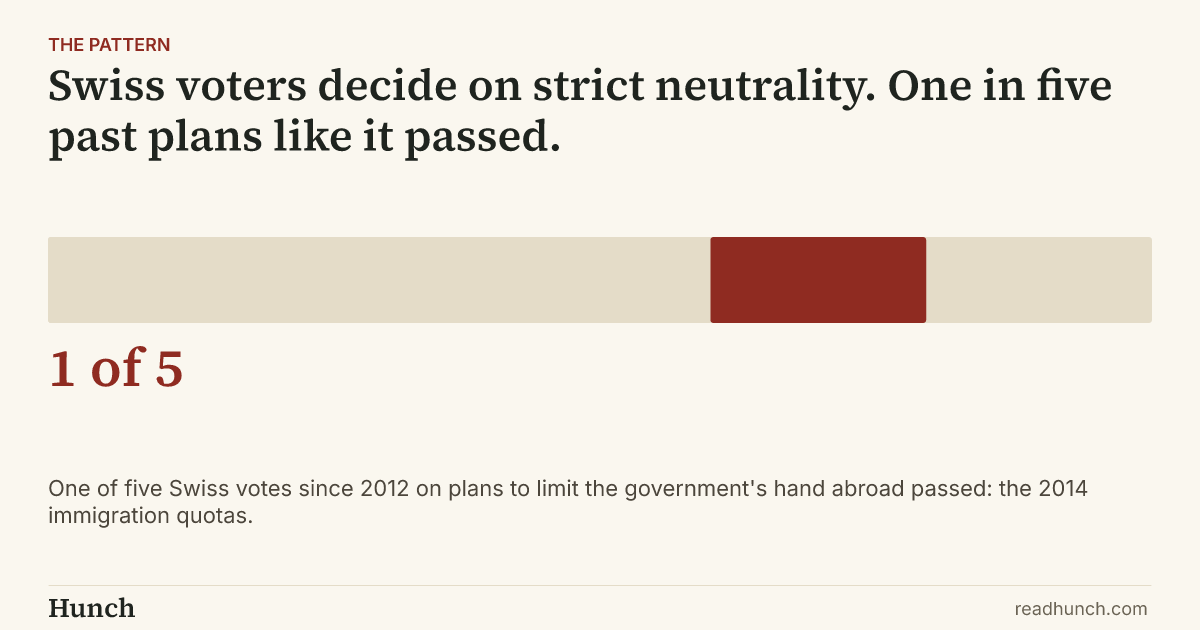
History says the initiative is more likely to fail than pass. In five past votes on plans to limit the government’s hand abroad, one passed. The yes share ran from about a quarter to just over half, and the result was usually a few points from the last SRG poll.
The record is small and comes from the voters of one country. Before the one vote that passed, in 2014, the last SRG poll had No ahead by seven points. This time the last poll has No ahead by 29 points, a wider gap than before any past vote. The Federal Statistical Office will publish the result on the evening of .
Disclaimer
Hunch works only from sources that are publicly available, and publishes on the basis of analysis of that material. We do not form an editorial opinion or take sides, we give a simpler and wider view of news that already exists. If information in a source we used was inaccurate, distorted, or later disputed but had already entered our analysis, Hunch accepts no liability for that. Predictions are not advice. Phase 1 markets use Hunch Points, not money.
Published by Hunch under the Editorial Code. Complaints and corrections: /contact/.