Swiss polls lean Yes on easier arms exports. In similar votes, the lead faded.
Swiss voters decide on 29 November if arms can go to 36 partner countries in a war. The first poll for broadcaster SRG had 49% for, 41% against.
What happened
The Swiss arms industry and its opponents set out their case before the vote on easing arms exports.
Switzerland votes on on a change to its War Materiel Act. This law decides when Swiss weapons may be sold abroad. Today a sale is refused if the buyer is fighting an armed conflict. Parliament eased these rules in , and opponents forced a vote with more than 75,000 signatures. A simple majority of voters decides, and the cantons, the Swiss regions, do not need to agree.
The change would let Switzerland sell arms to 36 partner countries even during a war, if this fits Swiss neutrality and Swiss interests. The list includes all 27 European Union members, the United States, the United Kingdom, Japan and Argentina. Buyers would no longer always have to promise not to pass the arms on. Sales to Ukraine, directly or through another country, would stay banned.
It will become possible for war materiel to be supplied to a partner state involved in an armed conflict provided this is compatible with Switzerland’s neutrality and its foreign and security policy interests.
Swiss Federal Council, page on the vote of 29 November 2026
The government and the arms industry back the change. The Federal Council, Switzerland’s government, says Russia’s war against Ukraine has made Europe much less safe. The Swiss People’s Party also says yes. After Switzerland refused requests from Germany, Denmark and the Netherlands to pass Swiss-made arms on to Ukraine, the Netherlands stopped buying Swiss weapons. Matthias Zoller of the industry group Swiss ASD says exports fell by 30% in 2023 and 2024 as partners lost trust.
About 28 parties and groups are against it. They include the Social Democrats, the Greens, the Evangelical People’s Party, the charity Caritas and the Group for a Switzerland without an Army. At their campaign launch they called the law “immoral” and “anti-Ukraine”. They say it breaks a deal from 2021 that led campaigners to drop a stricter proposal.
Polls point in different directions. The first poll by gfs.bern for SRG, the Swiss public broadcaster, taken from 5 to , had 49% for, 41% against and 10% undecided. A YouGov poll taken from 7 to had 38% for and 33% against, with nearly three in ten undecided. An earlier Leewas poll expected the law to fail.
Sources: swissinfo (2, 3, 4, 5, 6), Swiss Federal Council, Swiss Federal Statistical Office, Fedlex (2), Swiss People's Party, gfs.bern
The Pattern
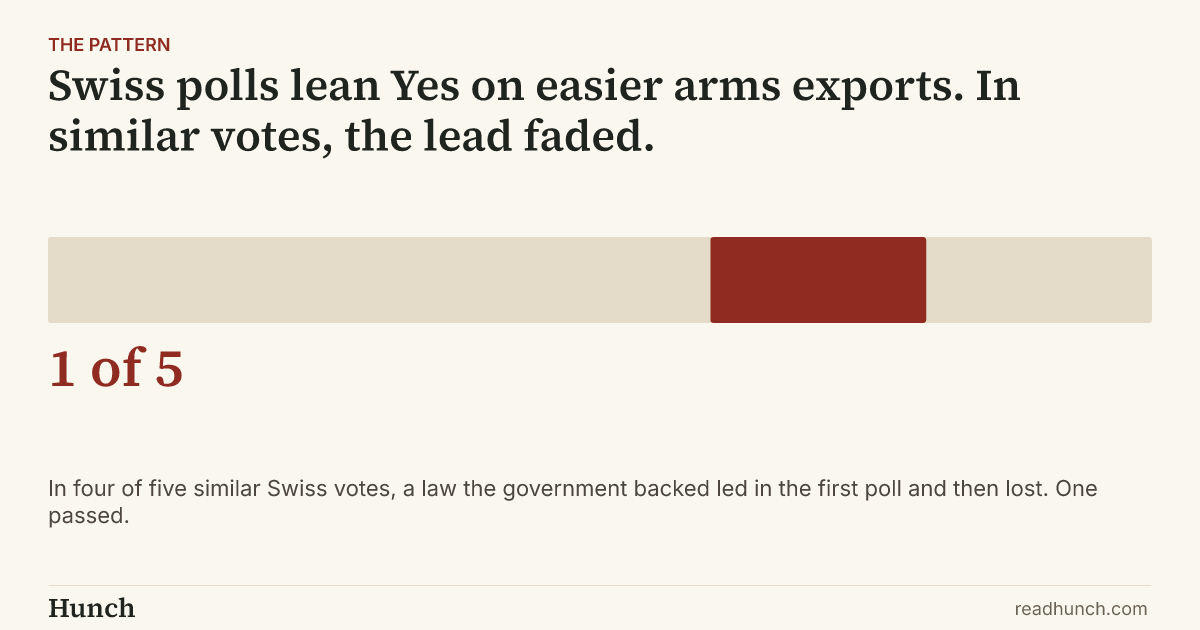
We looked for cases where Swiss voters decided on a law that parliament had passed and opponents had challenged with signatures, while the government backed it, four questions were on the ballot and a neighbour was building up its army during a war in Europe. We found five such votes, on two days in 2022 and 2024. Each time the side for the law led in the first SRG poll. (Swiss Federal Statistical Office; Swiss Federal Statistical Office; gfs.bern; gfs.bern; German Federal Government; swissinfo)
Show the other 3 cases
The Read
The first SRG poll gave the law a lead of eight points. In all five past votes the side for the law also led in the first SRG poll, and the lead shrank by voting day. Four of those laws then failed with 46% to 48% for, and the pension law passed with 50.55%. gfs.bern calls the first result a tie with a Yes lead and says many voters have not made up their minds yet. In 2022 and 2024 a second SRG poll came out before each vote.
There are reasons for doubt. All five past votes fell on just two days, and two were rent laws fought by the same tenants’ groups. None was about arms or neutrality. On only 29.84% of voters backed a proposal for strict neutrality, and the Swiss People’s Party, which backed that proposal, now supports this law. gfs.bern names neutrality as one of the two strongest arguments against it.
Sources: gfs.bern (2, 3, 4, 5), Swiss Federal Statistical Office (2, 3), Swiss People's Party (2)
Disclaimer
Hunch works only from sources that are publicly available, and publishes on the basis of analysis of that material. We do not form an editorial opinion or take sides, we give a simpler and wider view of news that already exists. If information in a source we used was inaccurate, distorted, or later disputed but had already entered our analysis, Hunch accepts no liability for that. Predictions are not advice. Phase 1 markets use Hunch Points, not money.
Published by Hunch under the Editorial Code. Complaints and corrections: /contact/.