Texas elected a Democrat to lead its Senate. Will Republicans take her powers?
On 3 November Democrat Vikki Goodwin beat Dan Patrick for lieutenant governor of Texas. Republicans hold 18 of 31 seats in the Senate she will lead.
What happened
Dan Patrick, who leaves office in January, said Republicans in the Texas Senate should change the rules to protect their conservative majority.
In Texas, the lieutenant governor runs the state Senate. As president of the Senate, the lieutenant governor names the members of every committee, sends each bill to a committee and has strong influence over which bills reach a vote. These powers come from the Senate’s own rules, and senators can change those rules by a vote of a majority of members.
All committees and standing subcommittees shall be appointed by the President of the Senate, unless otherwise directed by the Senate.
Rules of the Texas Senate, Rule 11.01
On Democrat Vikki Goodwin beat Lieutenant Governor Dan Patrick. She is the first Democrat elected to the job since Bob Bullock, who left office in 1999, and she takes over in January. Democrats also won the governor’s office and control of the Texas House, while Republicans kept 18 of the 31 Senate seats.
Before the election, Republican senators discussed rule changes that would limit Goodwin’s power if she won, the Austin journalist Scott Braddock reported. On Patrick told a radio host that Republicans in the Senate should change the rules to protect their conservative majority. Republican Senator Bob Hall said on : “I know of no plan or intention to fight bills based on party.”
The new session opens at noon on . The Senate adopts its rules in the first days: in 2025 it did so on , 31 votes to 0. Goodwin says she wants to talk with each and every senator, and on she presents a transition team from both parties.
Sources: CBS News (2, 3), Texas Senate, PBS NewsHour, The Washington Post, Texas Legislative Council, Texas Senate Journal
The Pattern
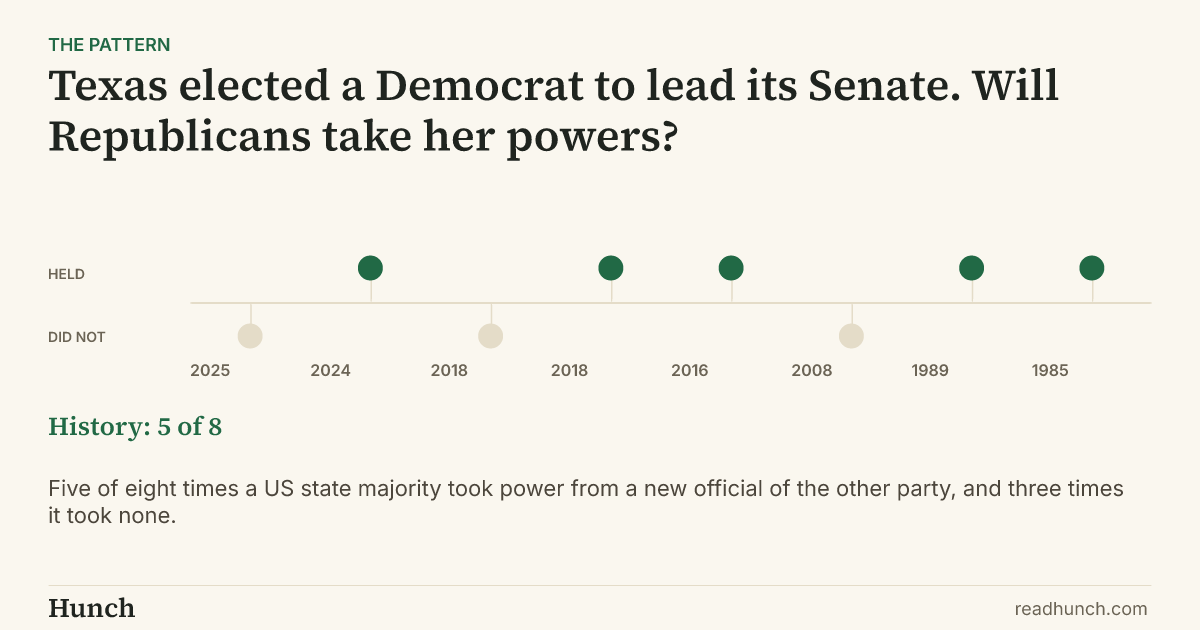
We looked for cases where a US state election gave an important office to one party while the other party kept its majority in the legislature, and that majority then decided whether to take some of the official’s powers before its first regular session ended. We found eight such times since 1985, four of them in North Carolina. Texas has none: every lieutenant governor after Bullock was a Republican. (TIME; CBS News)
Show the other 6 cases
The Read
Five of eight times, the majority took some power away. But three of those five were laws passed in December, before the new official took office, while the outgoing side could still sign them or override a veto. In Texas such a law before January would need a special session of the outgoing Legislature. Only the governor can order one, and Governor Greg Abbott has not done so. After a new law would go through a Democratic House to a Democratic governor, Gina Hinojosa. In the three times when a newly elected lieutenant governor from the other party was to lead a state Senate, power was taken once, in North Carolina in 1989, and left in place in Mississippi in 2008 and Vermont in 2025.
There are reasons for doubt. Four of the eight times come from North Carolina. Patrick, who urged new rules, leaves office in January. Of the 18 Republican senators, Bob Hall spoke to CBS News, and he spoke about bills, not about the rules for the lieutenant governor.
Sources: The Guardian (2, 3), PBS NewsHour, Texas Constitution, Office of the Texas Governor, TIME, Mississippi Legislature, VTDigger, CBS News (2)
Disclaimer
Hunch works only from sources that are publicly available, and publishes on the basis of analysis of that material. We do not form an editorial opinion or take sides, we give a simpler and wider view of news that already exists. If information in a source we used was inaccurate, distorted, or later disputed but had already entered our analysis, Hunch accepts no liability for that. Predictions are not advice. Phase 1 markets use Hunch Points, not money.
Published by Hunch under the Editorial Code. Complaints and corrections: /contact/.