TfL can license 50,000 hire e-bikes. Will it publish a plan by 10 August?
A new devolution law gives Transport for London the power to license dockless e-bike hire firms. Labour Assembly Members want the rules written now.
What happened
Labour Assembly Members urged TfL to use its new licensing powers to curb nuisance e-bike parking. TfL said it is developing a London-wide scheme and will set out details “in due course”.
Labour members of the London Assembly have called on Transport for London (TfL) to use its new legal powers against “nuisance” e-bike parking. They say pavements blocked by hire bikes are now a daily problem for people who need a clear way along the street.
About 10% of London’s 1.5 million cycle trips a day are now made on dockless e-bikes, which riders leave on the street instead of at a docking station. Roughly 50,000 are available for hire at any one time.
The powers became law on . The English Devolution and Community Empowerment Act lets TfL license dockless firms such as Lime, Forest and Voi under one set of rules for all of London. TfL can limit how many bikes each firm runs and decide where they can be parked. It can also fine firms that break parking or safety rules.
TfL welcomed the Act. It said one London-wide scheme would replace today’s separate rules in each borough, and that it is working with the boroughs on proposals it will set out “in due course”. No timetable has been published. The question is whether TfL puts proposals or a consultation in front of Londoners this summer, or leaves it until the autumn or later.
Sources: Evening Standard
The Pattern
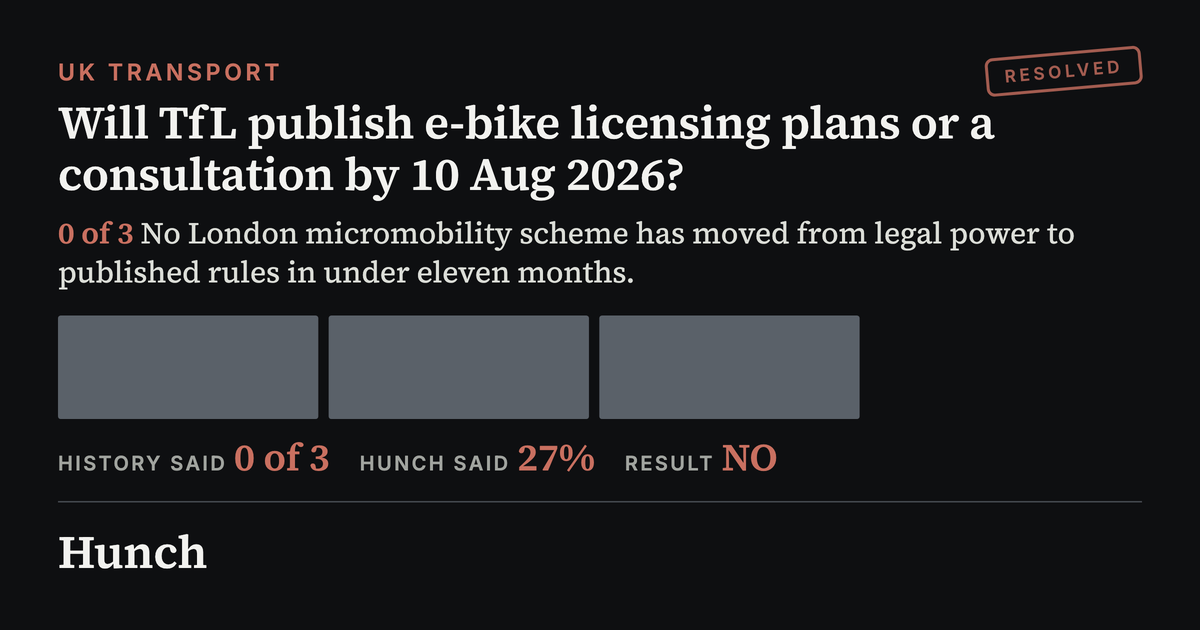
None of three earlier London schemes had rules within 11 months. London has been here before. A new power or a new kind of shared bike or scooter arrives, and then design, consultation and talks with the boroughs take many months. We looked at how long each earlier London scheme took to go from a legal power to working rules. Paris is shown for comparison. It moved faster, but it banned e-scooters instead of licensing them.
Show the other 2 cases
The Read
History says a plan within three months is unlikely. Nothing in TfL’s record suggests a licensing scheme can be ready that fast. The Act is only about eight weeks old, and the scheme needs agreement with 32 boroughs and the City of London. TfL’s own words, “in due course”, are what an organisation says when it has not fixed a date. The e-scooter trial was a much simpler job and still took 11 months from legal power to launch. A 27% chance of a summer plan may still be too high.
Where history is weaker: political pressure. Assembly Members are pushing in public, in local papers across the capital, and blocked pavements annoy voters of every party. TfL has also been preparing for these powers since the law was drafted, so its work may be further on than the public record shows. A short early consultation is cheap to publish. It would show TfL doing something without tying it to details, and it is the easiest way to take the pressure off before the autumn.
Proposals or a consultation from TfL before would answer the question.
Disclaimer
Hunch works only from sources that are publicly available, and publishes on the basis of analysis of that material. We do not form an editorial opinion or take sides, we give a simpler and wider view of news that already exists. If information in a source we used was inaccurate, distorted, or later disputed but had already entered our analysis, Hunch accepts no liability for that. Predictions are not advice. Phase 1 markets use Hunch Points, not money.
Published by Hunch under the Editorial Code. Complaints and corrections: /contact/.