MPs say reject the £10bn Thames Water bid. Will ministers face them?
The Environment Committee told the government to reject the £10bn creditor takeover of Thames Water. Ministers said no to that deal on 16 June.
What happened
The Environment, Food and Rural Affairs Committee published its report on the future of Thames Water on , telling the government to reject the £10bn takeover proposal from the company’s creditors and to consider putting it into special administration instead.
A committee of MPs from several parties told the government on to reject the £10bn offer to take over Thames Water from the company’s creditors, the lenders it owes money to. It said the government should consider special administration instead, a temporary form of public ownership.
The Environment, Food and Rural Affairs Committee said the group behind the offer, London and Valley Water, did not have “the interests of the public, the company or the environment at heart”. It also asked for a change in the law, so that special administration can start because a company performs badly and not only when it cannot pay its debts.
Ministers already rejected that deal on . Emma Reynolds, then environment secretary, wrote to the regulator and told the Commons she had three concerns about the creditors’ plan: the unfair cost to customers, delays to vital investment in infrastructure and delays to environmental improvements. She added that the government “stands ready for all eventualities”, including temporary nationalisation.
Much has changed around the company since then. Andy Burnham replaced Keir Starmer on , so a different government now has to answer the report. The Guardian reported in August that he is looking at changing insolvency law, the rules for companies that cannot pay their debts. The creditors have promised to fight that change in court.
Two days before the report, ministers suggested giving mayors oversight of water companies.
London and Valley Water says its “enhanced proposal will address all feedback from Ofwat and ministers”. The committee’s register gives the government until to reply.
Sources: BBC (2, 3), HC 664, Guardian
The Pattern
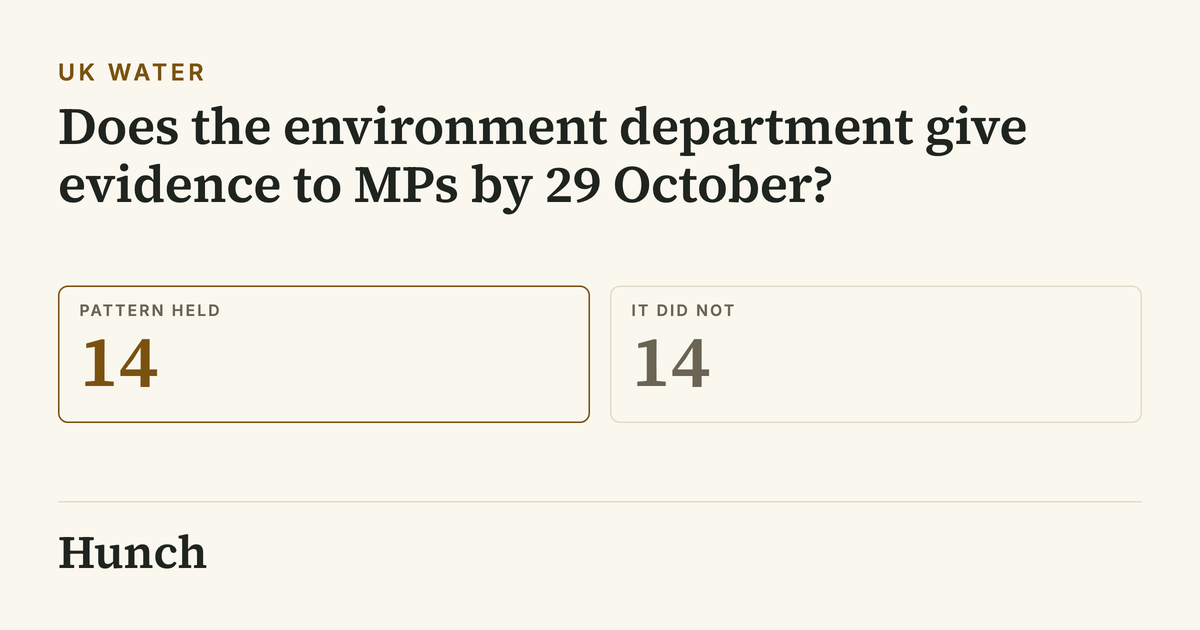
After half of the 28 reports, the department was back within 41 days. We looked at every report this committee has published since , leaving out hearings on appointments and this report itself. For each we counted the days until a minister or an official from the environment department next gave evidence to the committee in person. That session does not have to be about the report. One sitting can follow several reports: three of the eight shown here led to the same sitting on , and two to one on .
Show the other 6 cases
The Read
The committee is asking for a decision the government took 94 days before the report. That is why both questions here are about Westminster and not about the company. Nothing formal has followed the June rejection in either direction. Thames Water is not in special administration, the law has not changed, and the creditors are still funding it, which also keeps it outside the legal reasons for administration. The other side of this story has a short record, and it is nearly used up. In nine cases since 2001 where ministers publicly ended a private rescue of an essential service, eight handovers into public hands came within 64 days of the statement, and the middle one took 19 days. Thames Water is on day 95, so only one of those cases still looks like it.
So the thing to watch in the next six weeks is the department’s diary, and history is split evenly. Two things point against a quick return. The Commons is on its conference break until , which removes the first 24 days of the window, and the committee had nothing planned after . Two things point the other way. This committee holds regular sessions on the department’s work, in March and again in July this year. Its chair has also called the department back twice on water, in after the water sector report and in after South East Water.
The written reply runs on a longer and steadier clock. The register asks for it by , but no reply in this record has ever come within 61 days. The closest case, this committee’s own water report of , is still unanswered after 460 days.
Disclaimer
Hunch works only from sources that are publicly available, and publishes on the basis of analysis of that material. We do not form an editorial opinion or take sides, we give a simpler and wider view of news that already exists. If information in a source we used was inaccurate, distorted, or later disputed but had already entered our analysis, Hunch accepts no liability for that. Predictions are not advice. Phase 1 markets use Hunch Points, not money.
Published by Hunch under the Editorial Code. Complaints and corrections: /contact/.