Trump blames Ukraine's strikes for $6 diesel. Will he tie US aid to them by 14 Oct?
Donald Trump said in Ireland on 13 September that Ukraine must stop hitting Russian diesel plants. He blamed Ukraine, not the Iran war, for $6 diesel.
What happened
Donald Trump, speaking to reporters at his Doonbeg golf course in County Clare on Sunday , said his administration had asked Volodymyr Zelensky to stop drone and missile strikes on Russian sites that produce diesel, and blamed those strikes rather than the US war with Iran for the record price of diesel worldwide.
Donald Trump told Ukraine on Sunday to leave Russian diesel alone. He was speaking during a walk round his Doonbeg golf course in Ireland. Asked about US diesel reaching a record $6.06 a gallon on Friday, he said Volodymyr Zelensky could go after other targets but must stop hitting Russian diesel production, because the strikes were causing a world shortage.
He said his government had already told Zelensky this. He rejected the idea that the six-month-old war with Iran, which has cut oil shipments from the Gulf, was to blame.
His ministers have said the same for two weeks. Treasury Secretary Scott Bessent said on that the US energy shock was partly the result of Ukraine choosing to blow up Russian refineries. Energy Secretary Chris Wright told CBS last week that damage to Russian refineries explained the diesel shortage.
A senior European official close to the US-led talks told Politico that the US government was looking for someone to blame before the midterm elections, and that any pause in energy strikes would have to come from both sides. Russia’s foreign minister, Sergei Lavrov, said on Saturday that Russia would not pause its attacks while talks go on.
The International Energy Agency’s report of gives Trump part of his case. It said damage to Russian refining after Ukrainian attacks, and an almost complete stop to Russia’s exports of fuels, had added to the diesel lost from the Gulf.
Britain has a fuel squeeze of its own. Heating oil has gone from about 60p a litre before the Iran war to about 97p, and the government has put £53m into help with heating-oil bills. Saudi Arabia shut its East-West pipeline on Friday after drones from Iraq hit it, and the price of Brent crude oil went above $100.
Ukraine’s campaign against refineries is the other side of the picture. Its General Staff, the top command of the army, claimed a strike on the Orsk refinery on and on the Afipsky refinery on . Russia has started importing petrol from India.
Sources: Politico, Reuters, Al Jazeera (2), NYT, BBC, Guardian (2)
The Pattern
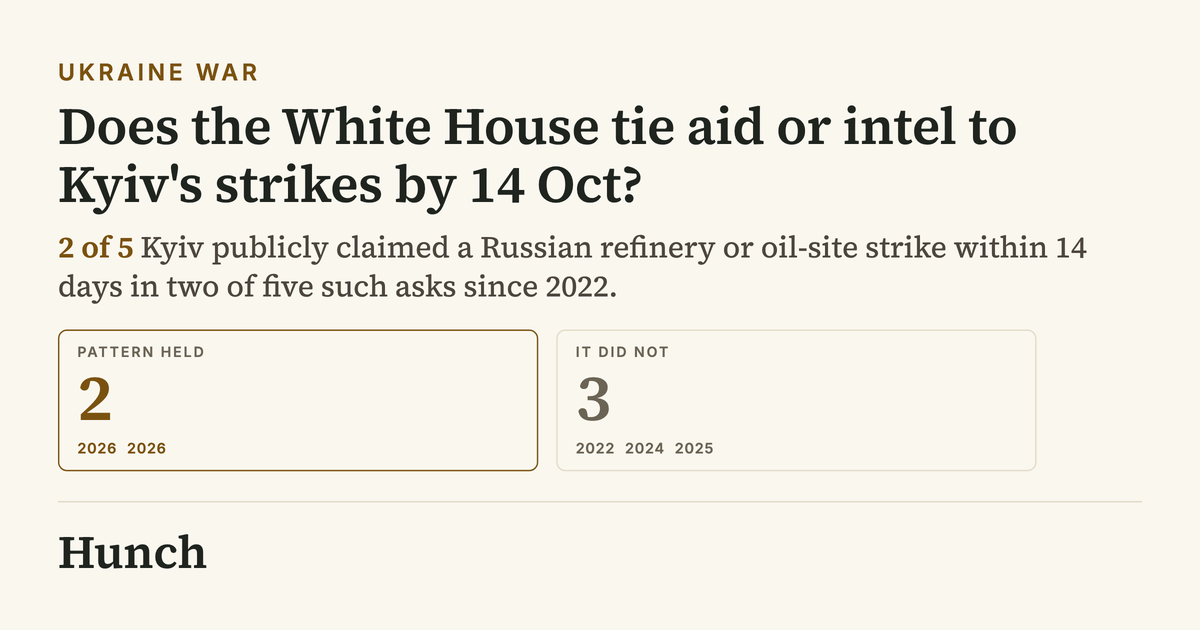
We looked for every public request since 2022 that Ukraine limit its strikes on Russian territory or on Russian energy. We found five. Four came from Washington, and one came from unnamed partners, as Zelensky reported it. For each we checked whether Ukraine’s president, the General Staff or a named commander publicly claimed a strike on a Russian refinery, oil depot, pipeline station or oil terminal within 14 days of the request becoming public. Claims made through unnamed sources do not count.
Show the other 3 cases
The Read
Trump needs a lower price. US diesel set a record above $6 a gallon on Friday. He has promised every adult American $5,000 if Republicans keep control of both chambers of Congress on , and he has told his supporters that oil will not come down until after that vote. Blaming Kyiv moves the cause away from the Iran war. Kyiv needs reach. Refinery strikes are the one tool it has against Russia’s income, Russia is now importing petrol, and Zelensky said on Saturday that Moscow is trying to kill Ukraine’s economy. Moscow moved first, when Lavrov ruled out any pause during talks. In the coming weeks Zelensky and the General Staff choose the targets and whether to claim them. The White House holds a lever on aid and intelligence, which it used in . British ministers can speak too, and Powell was in Kyiv on Sunday telling Europe to accept a hard winter to keep the pressure on.
History leans towards a claimed strike within two weeks. The two 2026 requests were the only ones made since Kyiv began naming its strikes inside Russia, and each was followed within a day by a claim from the General Staff: Orsk after the Vance call in August, Ust-Luga after the partners’ message in March. August also shows how Kyiv follows such requests. It stopped hitting the tankers carrying Kazakh oil that Vance named, and it kept hitting refineries. Trump’s own words on Sunday also left other targets open. Kyiv claims a hit on a refinery or depot every few days, so the strike question, since withdrawn, opened at 74%, well above two in five. The three requests with no claim came in 2022 and 2024, when Kyiv claimed nothing inside Russia, and in .
Where history is weak: . That US request came with a pause in energy strikes by both sides and a live US-led peace effort. Kyiv stopped claiming oil strikes and spent two weeks denying Russian accusations instead. A pause by both sides is exactly the price the European official named to Politico, and Steve Witkoff and Jared Kushner were discussing next steps with Putin a week ago. The forecast fails if Washington offers Kyiv that trade within the fortnight, or if Kyiv goes back to its 2024 habit of hitting refineries without claiming them. The White House question fails if the lever stays in speeches. The UK question fails if ministers keep to general words about self-defence and never name energy.
Sources: Politico, BBC (2), Guardian (2, 3, 4, 5, 6), BBC (2), Al Jazeera
Disclaimer
Hunch works only from sources that are publicly available, and publishes on the basis of analysis of that material. We do not form an editorial opinion or take sides, we give a simpler and wider view of news that already exists. If information in a source we used was inaccurate, distorted, or later disputed but had already entered our analysis, Hunch accepts no liability for that. Predictions are not advice. Phase 1 markets use Hunch Points, not money.
Published by Hunch under the Editorial Code. Complaints and corrections: /contact/.