Donald Trump shows a cap saying Veto. Will he veto a Democratic bill by 1 March?
Democrats won control of both chambers of the US Congress on 3 November. President Donald Trump says he will veto bills that hurt America.
What happened
Democrats plan to send Donald Trump new bills every week from January. Trump has posted a red cap with the word Veto on it.
Democrats will run both chambers of the new Congress. It first meets on . With 33 of 35 Senate races decided, Democrats had won 54 seats and Republicans 44. Hakeem Jeffries, the Democratic leader in the House of Representatives, will become its speaker. His first goals include money to help people pay for health insurance, undoing cuts to Medicaid, the public health insurance for people on low incomes, and a law to make Trump undo his tariffs.
Democrats say they want Trump to veto their bills. Greg Casar, who leads the progressive group of Democrats in the House, promised to pass bills “every single week” and send them to Trump. If Trump vetoes them, he said, that becomes the Democrats’ plan for the 2028 election. Trump posted a picture of a red cap with the word Veto and told supporters “I will VETO anything that hurts America”. On he also said “I don’t want to just be sitting there for two years vetoing everything”.
Most bills need 60 of the 100 Senate votes before they can pass. This rule, called the filibuster, lets the Republican minority stop any Democratic bill without 60 votes. A few fast-track resolutions skip it and pass with a simple majority: those that end US military action, end a national emergency, or cancel a new government rule. The tariff law Jeffries wants is an ordinary bill, because since the summer Trump’s tariffs rest on trade laws, not on an emergency.
Only some of these resolutions reach the president. In June both chambers passed a resolution to stop the war with Iran, but it was of a kind the president cannot veto, and Trump has ignored it. A joint resolution does go to the president, as one on the war in Yemen did in 2019, when Trump vetoed it. A president has 10 days, not counting Sundays, to veto a bill. Two-thirds of both chambers can then override the veto, which means pass the bill into law anyway.
The Congress shall assemble at least once in every year, and such meeting shall begin at noon on the 3d day of January, unless they shall by law appoint a different day.
US Constitution, 20th Amendment, Section 2
Sources: The Guardian (2, 3, 4, 5, 6), PBS NewsHour, CBS News, Congressional Research Service (2, 3), BBC, BBC, American Presidency Project
The Pattern
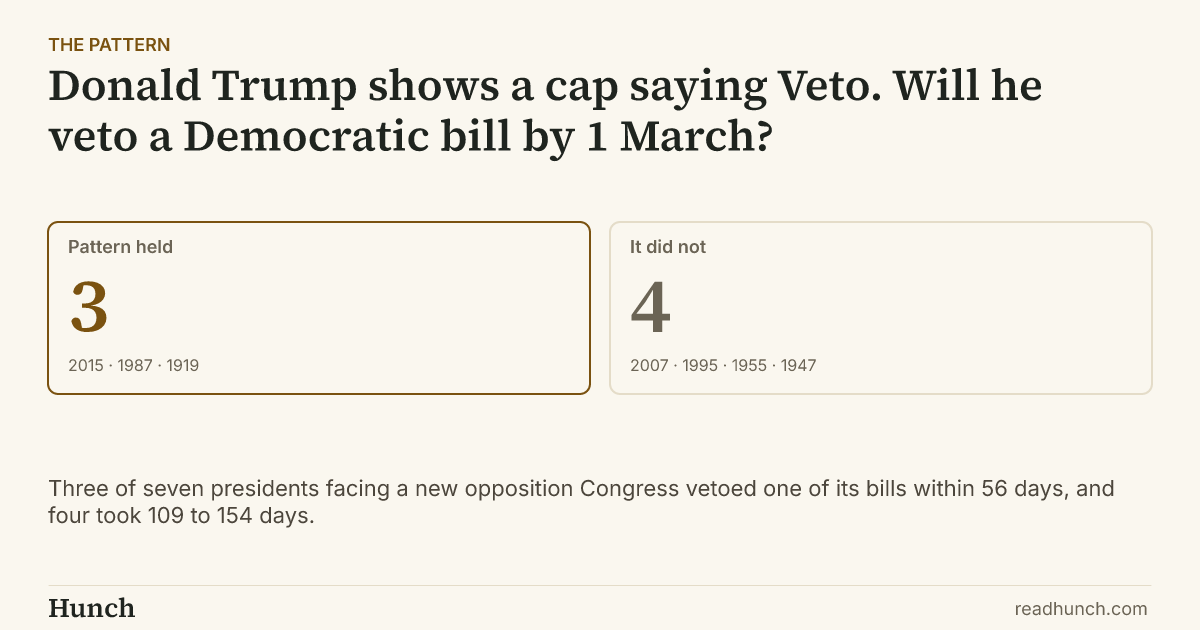
We looked for cases where the party opposed to the president had just won both chambers of the US Congress, and counted the days from the first sitting of that new Congress to the president’s first veto of one of its bills. Since 1919 this has happened seven times. Each of those presidents used a veto in the first year. (US House of Representatives; US House of Representatives; American Presidency Project)
Show the other 5 cases
The Read
Each of the seven presidents vetoed a bill in the first year, but four of them did it after the end of February. Each time the first veto came on an ordinary bill or resolution. Today the Democrats’ first bills, on health insurance and tariffs, are ordinary bills that need 60 Senate votes. The faster road is a resolution to end the war with Iran, but none of this year’s resolutions on the war reached Trump’s desk. On Senator Andy Kim said Democrats had come to the Senate 11 times in 208 days to try to end the war, and that day they lost by 49 to 50, with four Republicans on their side.
There are reasons for doubt. It has happened only seven times since 1919, and each time the choice was a US president’s. The resolutions that skip the 60-vote rule exist only since 1973, so the three oldest Congresses here never had them. Trump also says “We won Venezuela, we won Iran”, and if he ends the war, the readiest road to his desk may close. A resolution against a new government rule can reach him only weeks after Congress starts, close to .
Sources: US Senate (2), The Guardian (2, 3), Congressional Research Service (2, 3), BBC
Disclaimer
Hunch works only from sources that are publicly available, and publishes on the basis of analysis of that material. We do not form an editorial opinion or take sides, we give a simpler and wider view of news that already exists. If information in a source we used was inaccurate, distorted, or later disputed but had already entered our analysis, Hunch accepts no liability for that. Predictions are not advice. Phase 1 markets use Hunch Points, not money.
Published by Hunch under the Editorial Code. Complaints and corrections: /contact/.