Trump cut US drills in Korea. Within a year of most past cuts, the North escalated.
Donald Trump told the Pentagon to cut short the Ulchi Freedom Shield drills with South Korea. A day later North Korea fired about 10 missiles.
What happened
Trump ordered a substantial reduction of the joint Ulchi Freedom Shield exercise via social media hours before it was due to begin, calling the drills costly and a hostile signal to North Korea, while President Lee Jae Myung used the moment to press for wartime operational control and a nuclear-submarine programme.
Donald Trump said on social media that Ulchi Freedom Shield, the joint US military drills with South Korea, would be sharply reduced. He posted it hours before the drills were due to begin. He called them costly and the wrong signal to North Korea’s leader, whom he says he gets on well with.
South Korea split along familiar lines. President Lee Jae Myung had himself suggested cutting the drills to open a door to the North. He used Trump’s decision to push for South Korea to take control of its own forces in wartime, and for progress on a nuclear-powered submarine programme.
The conservative opposition called the cut a security disaster and said again that Seoul was being left out, while the ruling party said nothing in public. Analysts told the Guardian the episode is likely to add to public support for a South Korean deterrent of its own.
North Korea answered first in words. Kim Yo-jong, the sister of the North Korean leader, said through state media on that she knew nothing at all about the secret contacts Trump has hinted at, and that American hostility towards the North has not changed. She agreed that the two leaders’ personal relationship is good.
Trump has said he wants to meet Kim Jong-un later this year, possibly around the APEC summit of Asia-Pacific leaders in Shenzhen in November. He put the North’s arsenal at 57 nuclear weapons.
The missiles came the next afternoon. South Korea’s joint chiefs said about ten short-range ballistic missiles were fired from the Pyongyang area towards the sea east of North Korea at around 5pm local time on . Japan’s prime minister’s office said it had detected a suspected launch. Seoul’s national security council met in emergency session and called on Pyongyang to stop launches banned by UN Security Council resolutions.
Sources: The Guardian (2, 3)
The Pattern
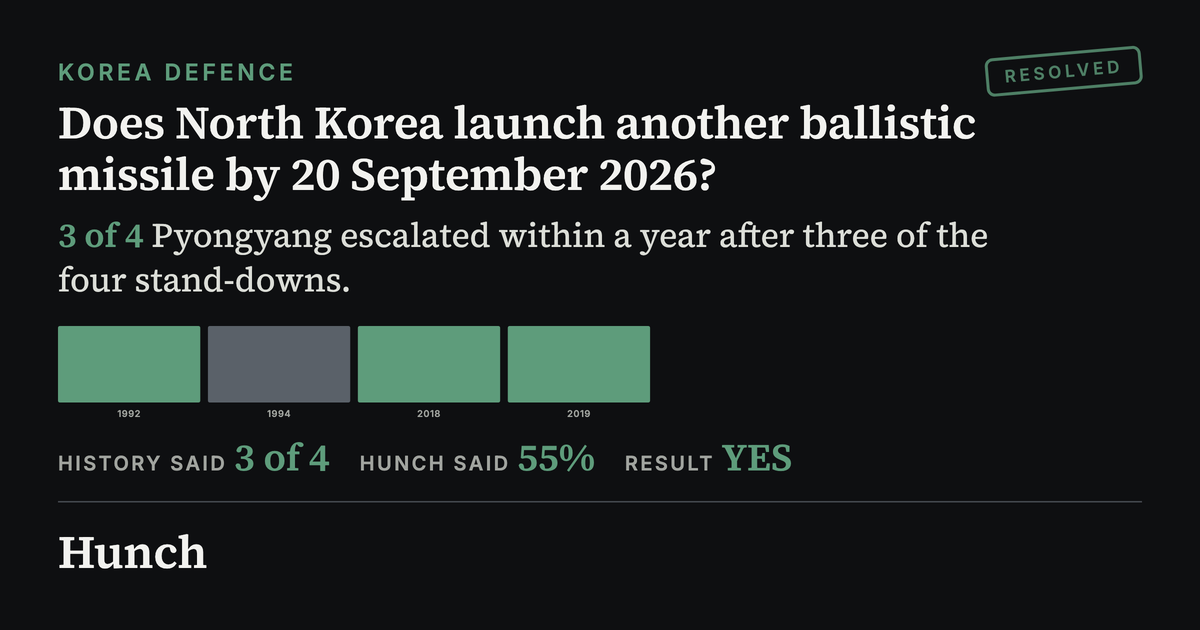
After three of four past cuts, North Korea escalated within a year. We looked at every time since 1992 that Washington cancelled, paused or sharply cut a big joint exercise with South Korea to draw North Korea into talks. There are four. For each we checked whether the North escalated within twelve months, with a missile launch, a step in its nuclear programme or by leaving an arms-control agreement. Only the 1994 deal bought a freeze that lasted, and it ended in 2002.
Show the other 2 cases
The Read
History points to more launches. In 1993 North Korea answered the return of the Team Spirit drills by announcing it would leave the Non-Proliferation Treaty, the global agreement against the spread of nuclear weapons, and it kept going. In 2019 it answered the dropped spring drills with 13 rounds of missile launches and ended its own pause on testing that December. A short-range salvo is also the cheapest signal Kim can send while he waits for a bigger offer. That is why the launch question opened above even odds, though below three in four.
Where history is weaker: the courtship. Kim Yo-jong dismissed the cut as not enough but said her brother’s relationship with Trump had not changed. In the last round of summit talks the North stopped ballistic tests completely while a meeting was in view, with no launches at all between and . Trump says he will meet Kim this year, possibly around the APEC summit in November, and an early announcement would give Pyongyang a reason to stay quiet.
The launch forecast turns on a single decision in Pyongyang. The meeting forecast fails if Kim decides that waiting gets him more than meeting, as the record since 1992 suggests he tends to.
Disclaimer
Hunch works only from sources that are publicly available, and publishes on the basis of analysis of that material. We do not form an editorial opinion or take sides, we give a simpler and wider view of news that already exists. If information in a source we used was inaccurate, distorted, or later disputed but had already entered our analysis, Hunch accepts no liability for that. Predictions are not advice. Phase 1 markets use Hunch Points, not money.
Published by Hunch under the Editorial Code. Complaints and corrections: /contact/.