Trump backs a united Ireland. UK leaders replied in person when face to face.
Donald Trump told reporters in Dublin on 12 September he would love to see Ireland united, then said it again at Doonbeg on 13 September.
What happened
Donald Trump, on the second day of a visit to Ireland on , repeated at his Doonbeg resort that putting Northern Ireland and Ireland together would be natural, a day after telling a Dublin press conference beside Micheál Martin that he would love to see a united Ireland and that it may as well happen now.
A serving US president has backed Irish unity. Sitting beside the Taoiseach, Ireland’s prime minister Micheál Martin, in Dublin on Saturday, Donald Trump said he would love to see the island united. He said it will happen in the end and may as well happen now, and that the UK would have something to say about it.
He opened with the same line at the US ambassador’s home hours later, and said he knew there was no good answer to the question. Earlier presidents kept Washington neutral on whether Northern Ireland stays in the UK, and the unplanned way he said it suggested no change in US policy.
On the second day he went further instead of stepping back. At the Irish Open in Doonbeg on Sunday he called Saturday’s answer a fairly routine comment, said many people agreed, and described joining north and south as one of the naturals of all time.
He was asked about Andy Burnham’s position that there will be no vote on unity until a majority in Northern Ireland is likely to vote for it. He said everybody says that and then things happen. He called the Prime Minister a very nice guy on the liberal side, and would not discuss Scotland.
So far the UK reply has come from below the top. A Downing Street spokesperson said the Prime Minister still believed the support needed to call a referendum under the Good Friday Agreement was not there. Angela Rayner told Sky that Trump is Trump and the government would keep to the Agreement. Kemi Badenoch called it loose talk of the Greenland kind.
Gavin Robinson, leader of the Democratic Unionist Party (DUP), said Northern Ireland’s future would be settled by its people, not by comments from London, Dublin or Washington. Sinn Féin’s Mary Lou McDonald said it was now up to the Taoiseach to start planning. Neither Burnham nor the Northern Ireland Secretary, Chris Bryant, has spoken in his own name.
Sources: BBC, Guardian (2), BBC (2), Politico, Sky, Independent (2)
The Pattern
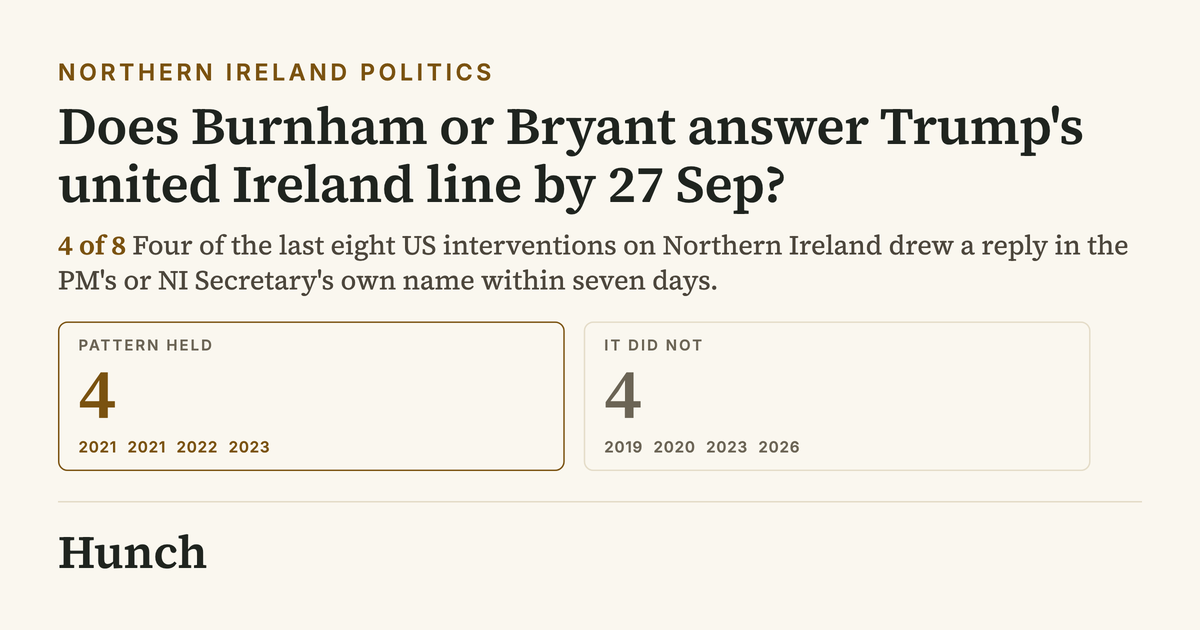
All four replies came when the UK leader was in the room. We looked for public comments since 1998 on Northern Ireland’s border, its peace settlement or whether it stays in the UK, made by a US president, a candidate for president, the Speaker of the US Congress or the leader of a visiting group from Congress. We found eleven and show the last eight. For each we checked whether the Prime Minister or the Northern Ireland Secretary answered in their own name within seven days, in Parliament, in a government statement or on the record to reporters. A spokesperson’s words do not count.
Show the other 6 cases
The Read
The reason for the remarks sits across the Atlantic. The midterm elections are in November, the Republicans are under pressure, and about a tenth of Americans say they have Irish roots. Clinton built his Irish-American support on the peace process, and Trump led with the unity line again at the ambassador’s home, in a speech that drifted into US politics. He also raised unity in private with Catherine Connolly and Martin, which steered the visit away from Gaza and Iran, and he repeated his complaint about UK support for his Iran operation. His former envoy Mick Mulvaney and the Democrat Brendan Boyle both said US policy had not changed. In the coming days the UK government sits in the Commons on 14 and , and Labour’s conference opens in Liverpool on . The DUP now has to square its ties to Trump with his words. Sinn Féin called the remarks a reason for Dublin to start planning, and meets the SNP and Plaid Cymru in Cardiff on Monday.
History leans slightly towards a reply in the Prime Minister’s own name. Four of the last eight comments drew one, and each of those four came with the Prime Minister or the Secretary already in the room. The four made from a distance, including Trump’s own border remark in 2019 and his merger joke in March, were left to spokespeople. On the other side, this remark is the most direct a president has made, and Burnham has already said a vote is off the table. The Commons also sits for two days, in which the DUP can ask for an urgent question that Bryant would have to answer. The Sunday political interviews at the start of conference fall on the last day of the window. The first question opens at 45%. The Sinn Féin question opens at 35% because the party lost its unity planning bill by 79 votes to 69 in July and has a second route through the Assembly. The DUP question opens at 25% because Robinson has said comments from Washington do not decide the matter, which is a reason not to write.
Where history is weak: it measures how close the leaders were, not how strong the words were. No 10 has already answered through a spokesperson and a cabinet minister, which is exactly how the four remote cases ended, and a Prime Minister who wants the story to die has every reason to leave it there. The forecast fails if Burnham is not asked on the record before , or if he only repeats the Agreement’s rule on consent without being asked about Trump, which counts as NO. The Sinn Féin question fails if the party keeps attacking the Taoiseach instead of tabling a motion. The DUP question fails if the party settles for posts on X, which do not count. Martin called the reaction an overreaction, and Trump said he will read about it tomorrow. Both point to the story cooling before anyone at the top has to speak.
Sources: BBC (2, 3, 4), Politico, Guardian (2), Parliament, LabourList, Independent
Disclaimer
Hunch works only from sources that are publicly available, and publishes on the basis of analysis of that material. We do not form an editorial opinion or take sides, we give a simpler and wider view of news that already exists. If information in a source we used was inaccurate, distorted, or later disputed but had already entered our analysis, Hunch accepts no liability for that. Predictions are not advice. Phase 1 markets use Hunch Points, not money.
Published by Hunch under the Editorial Code. Complaints and corrections: /contact/.