Tube workers struck twice over a four-day week trial. Will their union call more?
RMT union members shut large parts of the Underground on 2 and 4 June over TfL's four-day compressed week trial for Tube drivers.
What happened
RMT members completed a second 24-hour walkout over TfL’s four-day compressed week trial. The union says the dispute is unresolved and further action remains possible.
Members of the RMT, a transport workers’ union, held two 24-hour strikes on the London Underground on Tuesday and Thursday . They were protesting against a trial of a four-day week for Tube drivers on the Bakerloo line, in which drivers fit their working week into four days instead of five.
There was no service on the Circle and Piccadilly lines, or on the central parts of the Metropolitan and Central lines. Delays spread across the whole network.
The union says fitting five days of driving into four means longer shifts, more tiredness and less flexibility, in a job where safety depends on the driver. TfL, which runs the Tube, says the trial is optional, does not add to contracted hours and is meant to modernise working patterns.
Talks at ACAS, the official service that helps settle work disputes, took place before the strikes. They did not give the RMT the promises it wanted.
The June strikes were already the second round. Strikes set for 19 and and for 16 and were called off on after late talks. The union then went ahead with the strikes on 2 and .
No new dates have been announced. The RMT has not settled, and TfL’s own strike page still lists the dispute as open.
Sources: The Guardian, RMT, TfL
The Pattern
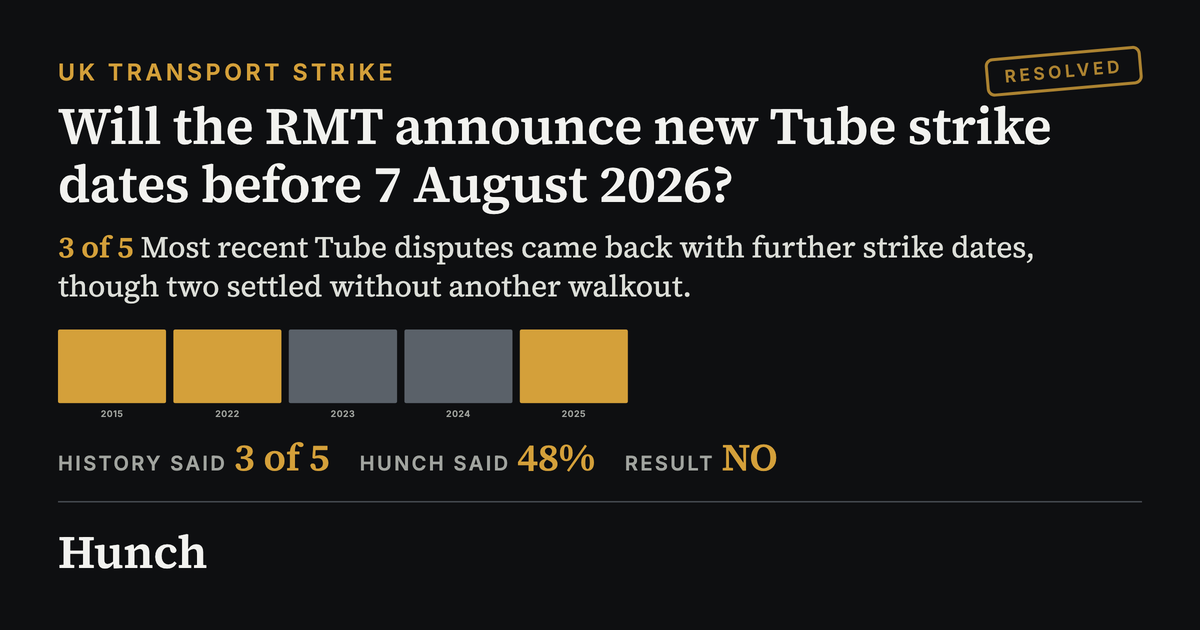
We looked at the five major RMT disputes on the Underground since 2015 and asked whether each came back with new strike dates after its first round or a pause. They fall into two groups. Some ended after one round or a late offer. Others kept producing new strike dates until a deal was reached. Two of the five, in 2022 and 2023, were rounds of the same dispute over pensions and jobs.
Show the other 3 cases
The Read
History leans towards more strike dates, though not by much. Three of the five disputes came back with new dates. The RMT has already called and cancelled two rounds of strikes and carried out a third, which looks like a union keeping its right to strike alive. TfL calls the trial optional and says it costs nothing extra, so it has little room to give way on the main point. The union’s main worry is tiredness in a job where safety depends on the driver, and a small extra payment is unlikely to answer it. In , when neither side moved, rolling strikes followed.
shows the other path. When TfL wants a dispute to end, it can move late and fast, and a trial is easier to soften than a pay deal. It could add checks on tiredness or make it clearer that drivers choose to join. The RMT could then claim a win without another strike. Two of the five disputes ended this way, and the record is small, since two of the five were rounds of one dispute.
Summer can also hide what is going on. Strikes hurt more in term time, which gives the union a reason to wait, so a quiet July would not mean the dispute is over. A formal RMT strike notice naming Tube dates before would settle the first question.
Disclaimer
Hunch works only from sources that are publicly available, and publishes on the basis of analysis of that material. We do not form an editorial opinion or take sides, we give a simpler and wider view of news that already exists. If information in a source we used was inaccurate, distorted, or later disputed but had already entered our analysis, Hunch accepts no liability for that. Predictions are not advice. Phase 1 markets use Hunch Points, not money.
Published by Hunch under the Editorial Code. Complaints and corrections: /contact/.