From 26 Nov London faces eight Tube strikes. The union dropped dates twice in 2026.
The RMT union has named eight London Tube strikes over a four-day week plan, the first at noon on 26 November. It dropped dates in March and May.
What happened
The RMT union said on that London Underground drivers will stage eight 24-hour strikes, starting on , in a long-running dispute over working arrangements.
London Tube drivers in the RMT union plan eight more strikes. The Rail, Maritime and Transport union (RMT) announced them on . Each lasts 24 hours from noon: , 17 and , 4 and , and 17, 23 and . Strikes in April and June caused wide disruption, though trains ran on most lines.
The dispute is over a plan by Transport for London (TfL), which runs the Tube, for a four-day week for drivers with new working arrangements. TfL says the plan is voluntary and that most drivers would go from 36 hours a week to 35. Aslef, the other drivers’ union, backs the plan and says shift timetables would be based on 34 hours. The RMT says drivers would spend more time driving and that hundreds of jobs could go. It wants 32 hours over four days for the same pay.
On TfL said drivers who stay on five days are guaranteed to keep their depot, the place they work from. Nick Dent of London Underground urged the RMT to “put this proposal to their members”. The RMT says it still has no guarantees and that drivers who refuse the new terms could be moved from their depots. RMT leader Eddie Dempsey said London Underground “must withdraw these damaging proposals” and negotiate.
The union will launch a series of rolling 24-hour strikes beginning on November 26, in opposition to management’s plans to introduce a so-called voluntary four-day working week alongside a new Trains Modernisation Framework.
RMT statement on the strikes
The two sides talked through the summer, and the Evening Standard says TfL gave its final proposals a few weeks ago. By the evening of no report named a new meeting.
Only RMT members would strike. The BBC says they are about half of Tube drivers and that Aslef has a slightly higher share. When both unions struck last year, almost all services stopped. TfL said about 60% of drivers came to work during the June strikes, when Tube journeys fell by 41% and 40%.
Sources: BBC (2, 3), The Guardian, RMT, Evening Standard (2)
The Pattern
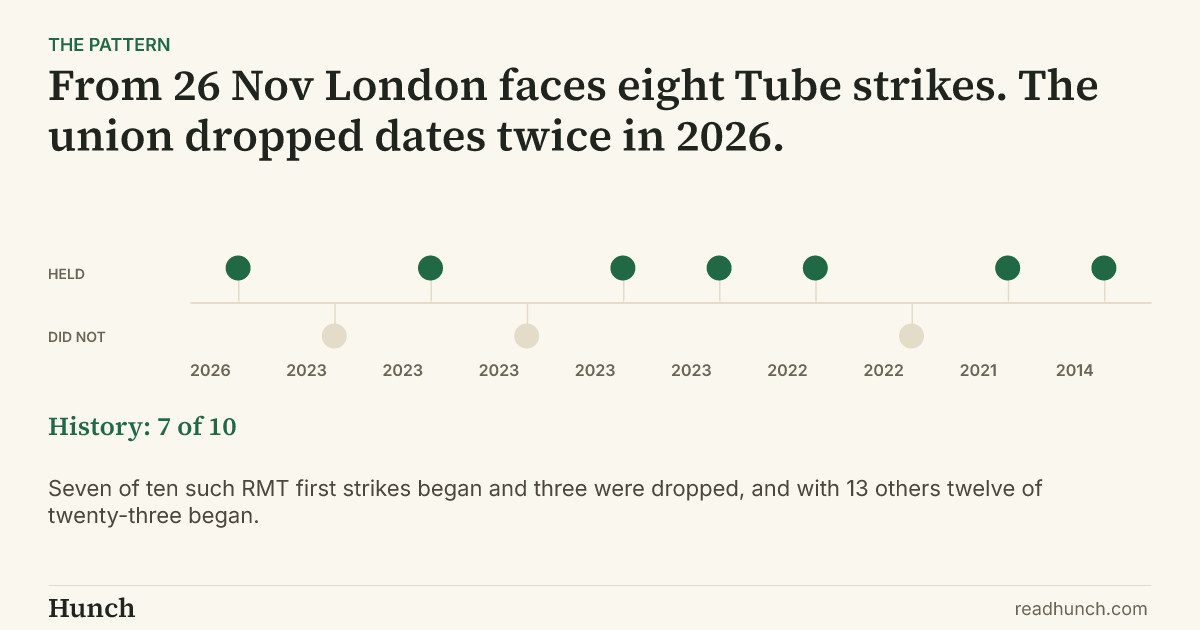
We looked for cases where a British union named strike dates in a dispute in which it had already dropped one strike and gone ahead with another. Ten fit, all of them RMT strikes. Five were on the Tube and five on the railways. Each named two or more dates at least ten days ahead, with no other union for the same staff shown striking with it at that point.
Show the other 8 cases
The Read
The first date went ahead seven of ten times, and the railways lift that number. On the Tube alone it went ahead three of five times, and on the railways four of five, all in one pay dispute. There, the RMT leader at the time, Mick Lynch, said the Department for Transport stopped the train companies offering a deal. In today’s Tube dispute TfL says it added the depot option itself after feedback. Adding the 13 other Tube and rail announcements we found makes it twelve of twenty-three, close to even, because those 13 include the first dropped date in each dispute. That longer list still leaves out some first strikes.
When a first date was dropped among the ten, it came late: one day before in and , two days before in . That would be 24 or , so silence until then says little. This year the RMT dropped dates six days ahead in March and one day ahead in May. In May a TfL letter saying the plan would stay voluntary appears, the Guardian reported, to have given the RMT room to drop strikes, and the depot guarantee could work the same way. But the RMT says it still has no guarantees, and the June strikes went ahead after talks. Its August vote was a little weaker: 937 of 1,050 voters backed strikes, or 89% against 91% in February, and by our count turnout was 61% against 66%.
Among the ten, the RMT dropped dates after talks five times and the dispute stayed open each time. It did settle in , after naming dates only nine days ahead, which puts that strike outside the ten. The longest series with a known end lasted 25 days, and these dates cover 91, so the ten say little about or later.
Sources: The Guardian (2, 3, 4, 5, 6, 7, 8), BBC (2), RMT, Evening Standard
Disclaimer
Hunch works only from sources that are publicly available, and publishes on the basis of analysis of that material. We do not form an editorial opinion or take sides, we give a simpler and wider view of news that already exists. If information in a source we used was inaccurate, distorted, or later disputed but had already entered our analysis, Hunch accepts no liability for that. Predictions are not advice. Phase 1 markets use Hunch Points, not money.
Published by Hunch under the Editorial Code. Complaints and corrections: /contact/.