Andy Burnham rules out an early vote. Will he change his mind before 2027?
Andy Burnham became prime minister on 20 July without a general election. On 25 September he said the next one will be in 2029.
What happened
Andy Burnham said on that he is not tempted to call an early general election and that the next election will be in 2029.
Andy Burnham says the next general election will be in 2029. Asked by ITV Calendar on if the vote would come then, he said: “Yes, that’s when the next election will be.” He told BBC reporters there would be no general election next May. The law says it must be held by .
Burnham replaced Keir Starmer as Labour leader and became prime minister on . He did not face a general election to get the job. Labour won a large majority in on Starmer’s manifesto, and in July Burnham said he would work to that manifesto.
Talk of an early election had grown during the week. The BBC reported that Labour’s head office had started a campaign drive called “operation second term”, while Downing Street said no early election was planned. The Guardian reported that advisers and MPs had discussed one.
Polls have moved towards Labour since July, to around the low or mid twenties. Recent polling suggests Labour would lose its majority but stay the largest party if an election were held now.
Three dates come next. Burnham speaks to the Labour conference in Liverpool on . Voters in Holborn and St Pancras, Starmer’s old seat, elect a new MP on . The Budget is on .
Sources: BBC (2, 3, 4, 5), The Guardian, HM Treasury
The Pattern
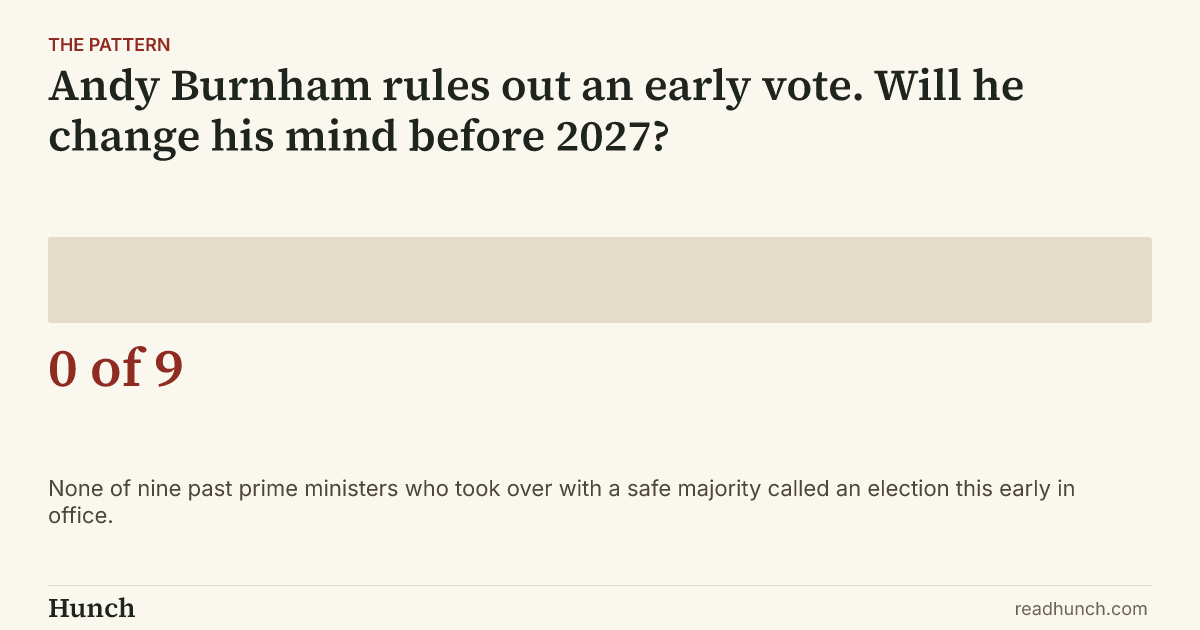
We looked for cases where a UK prime minister took over between elections from a leader of the same party, with a working majority and at least two years before an election was due. We found nine since 1902. None of them called an election in the first five months. Two called one within a year, Stanley Baldwin in 1923 and Theresa May in 2017. Both said they needed support for a new policy, and both lost their majority.
Show the other 7 cases
The Read
History says an election this year is very unlikely. None of the nine prime ministers in Burnham’s position called one within five months. The earliest was Stanley Baldwin in 1923, who asked for an election in November, a few days later in his term than Burnham will be on . The quick elections in the wider record came from leaders who had less than two years left, like Anthony Eden in 1955, or no majority, like Boris Johnson in 2019.
The first year is less certain. Two of the nine called an election within a year, and both said they needed backing for a new policy. What a leader says in public tells us little: Gordon Brown ruled out an election in 2007 and kept to it, while Theresa May said there would be none until 2020 and then called one. The record is all British and goes back to 1902, when the rules on how long a Parliament lasts were different. A new policy that Labour’s 2024 manifesto does not cover, raised at the conference or the Budget, would be the sign to watch.
Disclaimer
Hunch works only from sources that are publicly available, and publishes on the basis of analysis of that material. We do not form an editorial opinion or take sides, we give a simpler and wider view of news that already exists. If information in a source we used was inaccurate, distorted, or later disputed but had already entered our analysis, Hunch accepts no liability for that. Predictions are not advice. Phase 1 markets use Hunch Points, not money.
Published by Hunch under the Editorial Code. Complaints and corrections: /contact/.