Ukraine opened a first set of EU entry talks. Recent bids mostly froze for years.
Ukraine opened its first group of EU membership talks on 15 June. The step was unblocked by Viktor Orbán's election defeat in April.
What happened
The Commission is drawing up enlargement reform plans — including safeguards to keep new members in line after accession — as Ukraine’s negotiating track gathers pace.
The EU opened the first group of talks with Ukraine on . EU countries agreed the step on . The talks are split into groups of subjects, called clusters, and this first one is called ‘fundamentals’. Moldova opened the same group on the same day.
The fundamentals group covers the rule of law, democratic institutions, reform of public administration and economic conditions. It is the first group opened in any bid to join the EU, and by design the last one closed.
Hungary, led by Viktor Orbán, had blocked these talks for two years. The block ended when his government lost the election in . Ukraine took four years to go from official candidate to its first group of talks, the fastest in recent EU expansion.
The EU is already arguing about what comes next. The European Commission is preparing proposals to change how the EU takes in new members. They include safeguards written into future joining treaties, to stop new members sliding back on democracy after they join. The Commission wants to take the lead again before EU leaders discuss expansion in October.
Marta Kos, the EU official in charge of expansion, says the EU is building rules that would ‘bite hard’ if new members go rogue after joining.
Sources: Politico (2), Council of the EU
The Pattern
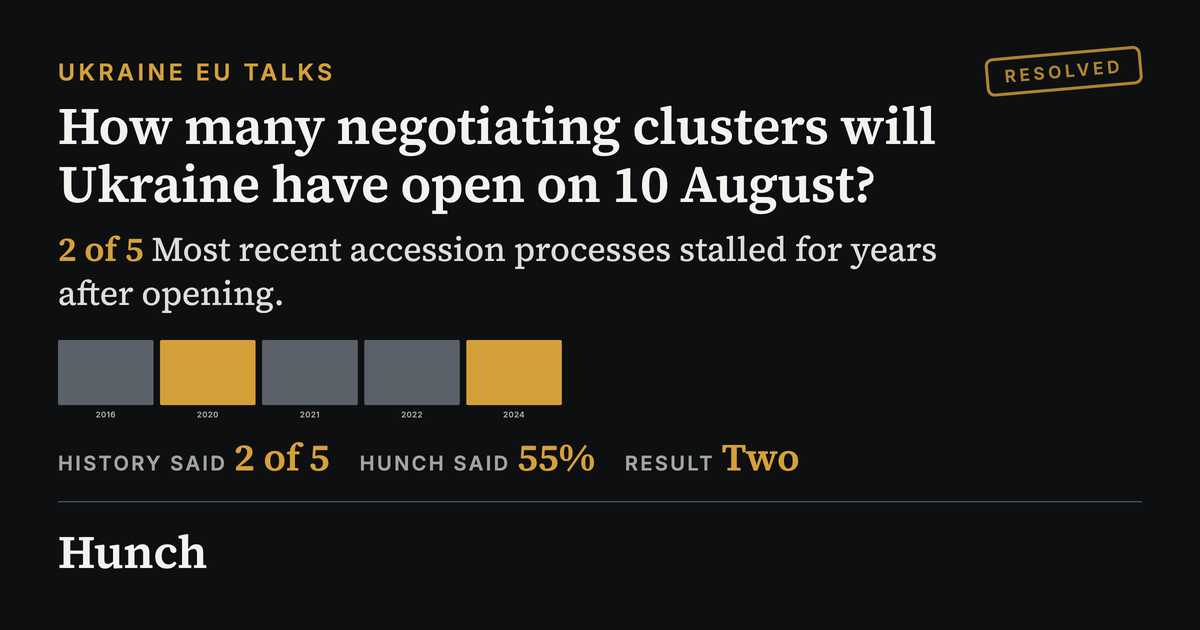
We looked at the last five countries whose EU membership talks passed an opening step, and asked what happened next. They split into two groups. Two kept opening new chapters of talks. Three opened talks and then stalled for years.
Show the other 3 cases
The Read
History points to a quiet summer. The EU process is slow by design, and Brussels largely stops in August. Checking a country’s laws for the remaining groups of talks takes months. Each new opening needs a formal meeting that every EU country must agree to and fit into its diary. The Commission is writing its reform proposals for the October summit of EU leaders, and nothing forces it to finish before autumn. That is why our estimate puts 55% on one group of talks by and 22% on safeguard proposals before August.
The weak point is that the one thing that froze this process, Hungary’s veto, is gone. Kyiv and the Commission both have political reasons to open a second group while they can. Albania showed that two openings two months apart are possible when EU countries want it, and Ukraine’s checks are further along than its four-year wait suggests. A formal meeting in summer would be unusual. Opening talks with a country at war was unusual too.
A Council of the EU press release on a new formal opening before would answer the first question. A formal Commission paper on safeguards by that date would answer the second.
Disclaimer
Hunch works only from sources that are publicly available, and publishes on the basis of analysis of that material. We do not form an editorial opinion or take sides, we give a simpler and wider view of news that already exists. If information in a source we used was inaccurate, distorted, or later disputed but had already entered our analysis, Hunch accepts no liability for that. Predictions are not advice. Phase 1 markets use Hunch Points, not money.
Published by Hunch under the Editorial Code. Complaints and corrections: /contact/.