Rebeca Grynspan leads the race for UN chief. Past leaders mostly won in a month.
Rebeca Grynspan of Costa Rica came first in the UN Security Council's third secret vote on 18 September. Nine of 15 members backed her.
What happened
In the third straw poll of the UN Security Council on Friday , Rebeca Grynspan of Costa Rica regained the lead with nine “encourage” votes, five “discourage” and one “no opinion”. Michelle Bachelet of Chile left the race the next day, leaving seven candidates.
The 15 members of the UN Security Council are choosing the next secretary-general, the head of the UN, in secret test votes called straw polls. António Guterres leaves the job on . The General Assembly then appoints the person the Council recommends.
Rebeca Grynspan is a former vice-president of Costa Rica who now runs UNCTAD, the UN trade body. She led the first vote with ten members for her and one against. In the second vote, on , she fell behind Carolyn Rodrigues-Birkett of Guyana. In the third vote, on Friday , she was first again.
The field is getting smaller. Michelle Bachelet, a former president of Chile, left the race on Saturday after her support collapsed, which leaves seven candidates. Rodrigues-Birkett kept eight votes for her, but the votes against her rose from three to six.
The Guardian reports that some diplomats are discussing late candidates, among them Lana Nusseibeh of the United Arab Emirates and Sigrid Kaag of the Netherlands. None of them has said they want to run.
To win, a candidate needs nine of 15 votes and no veto. Any of the five permanent members can block her: the US, China, Russia, the UK and France. The votes so far do not show who voted against. The Guardian reports that Grynspan fears her five votes against came from Russia and China. That becomes clear only later, when permanent members vote on coloured ballots.
Sources: The Guardian (2, 3)
The Pattern
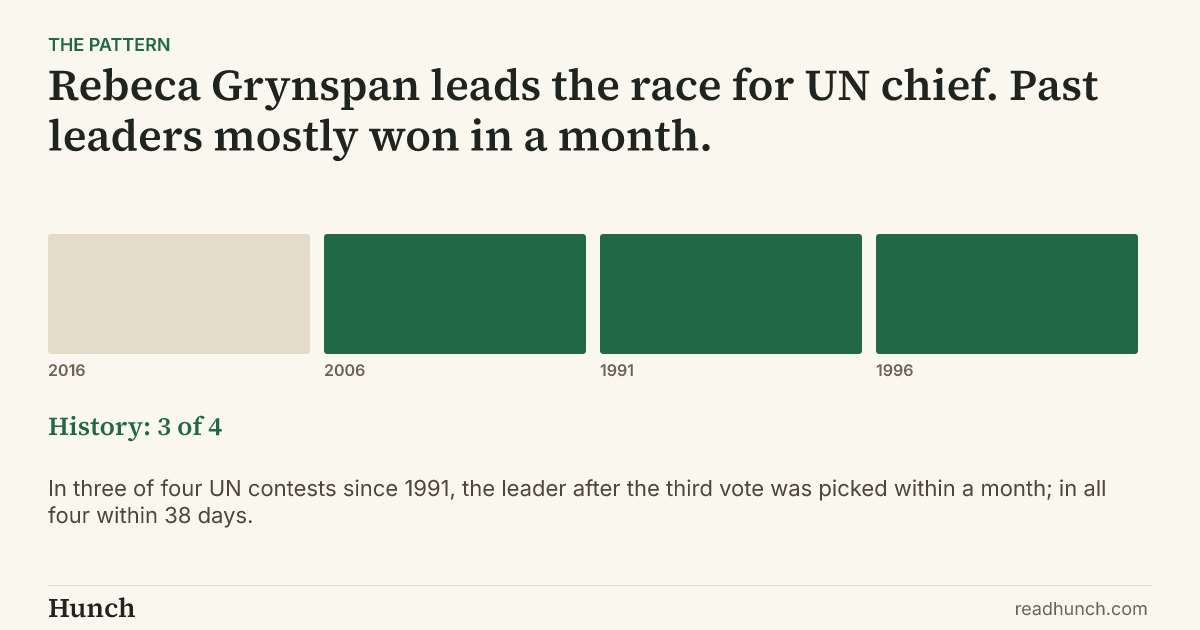
We looked at every race for UN secretary-general since 1991 in which the Security Council had three or more straw polls. There are four. In each we asked whether the person leading after the third poll was then recommended by the Council, and how fast. The same Council, with the same five veto powers, decided all four. Only the 2016 race ran under today’s open rules, with public candidates and hearings. For 1991 and 1996 our sources name the leader only in New York Times headlines, without the vote counts.
Show the other 2 cases
The Read
History says the leader at this stage wins, and usually fast. In each of the four races the person ahead after the third poll became secretary-general. Three times the Council acted within 11 days, and in 2016 it took 38. Even in 1996, when the US and France were split over the choice, the Council acted two days after the third open vote.
This year’s lead is the thinnest in our sources. Ban Ki-moon had 13 votes for him at this point, and Guterres had 11 with three against. Grynspan has nine with five against. The Guardian says three polls have produced no clear frontrunner and that late candidates are being discussed. That is why our estimate sits well below what history alone would suggest.
The estimate would rise if the next poll, and especially a vote with coloured ballots for the permanent members, shows no veto against Grynspan. It would fall if a new candidate is nominated, or if the lead passes to Rodrigues-Birkett or someone else.
Disclaimer
Hunch works only from sources that are publicly available, and publishes on the basis of analysis of that material. We do not form an editorial opinion or take sides, we give a simpler and wider view of news that already exists. If information in a source we used was inaccurate, distorted, or later disputed but had already entered our analysis, Hunch accepts no liability for that. Predictions are not advice. Phase 1 markets use Hunch Points, not money.
Published by Hunch under the Editorial Code. Complaints and corrections: /contact/.