Trump and Xi will talk AI in China. Rival leaders often issued no joint text on it.
Donald Trump and Xi Jinping are due to meet in Shenzhen, China, on 18 and 19 November. The US says they will move new talks on AI risks forward.
What happened
So, at President Trump’s direction, we have begun that important work by establishing a new dialogue with China on SI, designed to guard against shared risks and prevent a misunderstanding between our two systems.
The US says AI talks with China will move forward in Shenzhen. On US Treasury Secretary Scott Bessent said the two countries have started a dialogue on what the Trump administration calls superintelligence, the most powerful AI. He said they expect to share ways of testing advanced AI models before release. They are also setting up a direct line to warn each other of serious incidents. He promised no limit on how fast AI is built, and said the two countries’ interests “will not always coincide”.
The two countries established the U.S.-China Super Intelligence (SI) Dialogue to exchange views on risks and benefits related to SI. The next exchange will occur by . The United States and China also agreed to establish a bilateral communication channel for SI incidents.
White House fact sheet, 25 September 2026
Trump and Xi set up the talks in Washington in September. Each side then put out its own list of what was agreed: the White House on and China’s foreign ministry the next day. Both lists had the same point on AI talks, and no text was issued in the name of both leaders. China’s list calls it the China-US AI Dialogue.
The two leaders meet again on 18 and . They will meet at the Asia-Pacific Economic Cooperation (APEC) leaders’ summit in Shenzhen. In a CBS 60 Minutes interview shown on , Trump said he does not mind safety limits on AI, but “I don’t wanna put us in a deep second position”. The same day he told reporters he expects one meeting with Xi and Russian President Vladimir Putin together. On China’s foreign ministry said only that the two sides are “in communication” about the leaders’ meetings this year.
Sources: US Treasury, The Straits Times (2), White House, Chinese foreign ministry (2), CBS News
The Pattern
We looked for cases where two rival powers announced talks on the risks of a dangerous weapon or technology, with no joint text at the start, and their leaders met next. We found seven such meetings from 1967 to 2024, five between the US and Moscow and two between the US and China. Meetings announced without the subject on the agenda were left out. Each time, we asked whether the leaders put out a joint text on the subject.
Show the other 5 cases
The Read
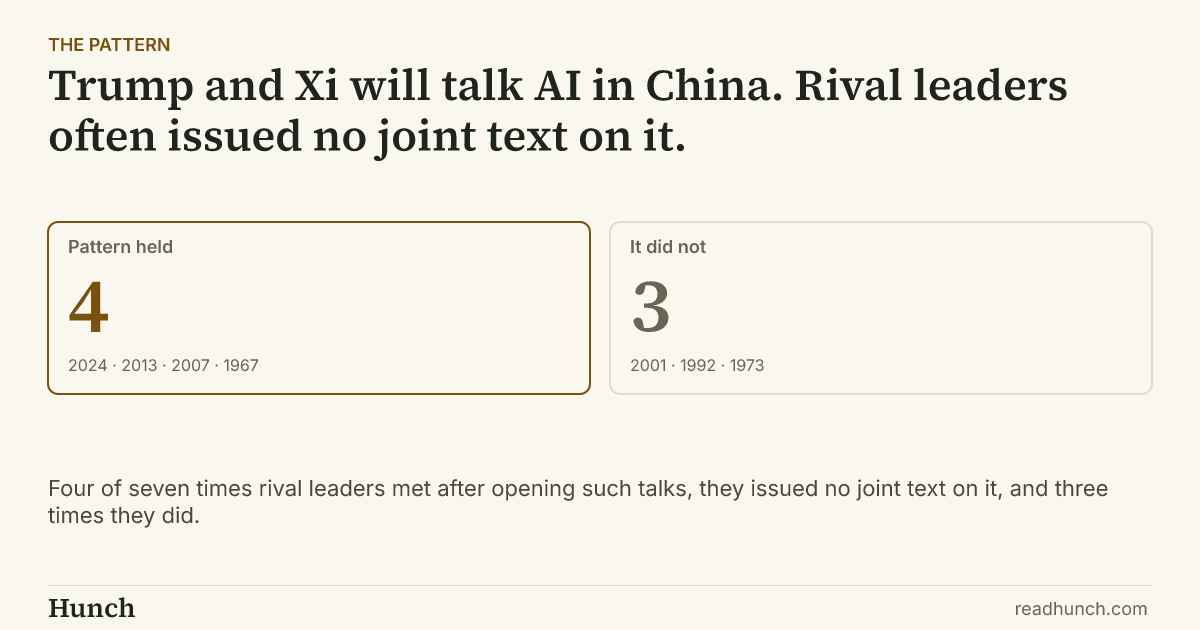
Four of the seven meetings ended with each side speaking for itself. Both meetings between the US and China, in 2013 and 2024, went this way. Since 2013 the two countries have opened such talks before a leaders’ meeting four times, and never put out a joint text on the subject. The three joint texts came from US and Soviet or Russian leaders. The two signed ones, in 1973 and 1992, came after talks by diplomats on nuclear weapons had opened or been announced. This time the Treasury Secretary leads for the US, and neither September list mentions talks on a treaty.
There are reasons for doubt. The US is one side every time, and most of what is known comes from US papers. China’s own account is on an open page only for 2024, and it came out the day after the meeting. Counting every such talk between the US and Moscow or Beijing before a leaders’ meeting since 1945, 30 in all, a joint text came out 10 times.
Sources: American Presidency Project (2, 3, 4, 5, 6), White House archive, Chinese foreign ministry (2), US Treasury, White House, US State Department (2)
Disclaimer
Hunch works only from sources that are publicly available, and publishes on the basis of analysis of that material. We do not form an editorial opinion or take sides, we give a simpler and wider view of news that already exists. If information in a source we used was inaccurate, distorted, or later disputed but had already entered our analysis, Hunch accepts no liability for that. Predictions are not advice. Phase 1 markets use Hunch Points, not money.
Published by Hunch under the Editorial Code. Complaints and corrections: /contact/.