The US flew an accused embassy worker out of London. Will the UK ask for him back?
American officials took a US embassy worker from his London flat in August and flew him to the United States. British police had not questioned him.
What happened
US officials detained a US embassy staff member accused of possessing indecent images of children at his south London flat in August and flew him to the United States on a commercial flight before the Metropolitan Police had questioned him; the embassy says it informed UK law enforcement and reassigned him while its own investigation continues.
The man worked at the US embassy in Vauxhall, London, and is accused of having indecent images of children. He was not a diplomat, but the embassy’s diplomatic protection covered him. In August American officials detained him at his south London flat and put him on a commercial flight to the United States, before British police had questioned him.
The embassy says it told UK police quickly and acted fast. It has moved him to the United States while an investigation continues.
The Metropolitan Police, London’s police force, says US authorities told it on Tuesday about an American investigation into suspected crimes in London. It says the two sides are still in contact. American officials have no power to arrest anyone in Britain, and no extradition request was made.
A UK government spokesperson would not comment on the US investigation and said Britain expects foreign diplomats to obey its laws. On the shadow justice secretary Nick Timothy wrote to Alex Norris, the justice secretary. He called the removal a cover-up and asked for the man to be tried in an English court.
Britain has a written procedure for cases like this. When police report a serious alleged crime by someone with immunity, the Foreign Office asks the other country to waive it, which means lifting the protection. If no waiver comes, it asks for the person to be withdrawn.
The latest yearly count listed nine such cases in 2023, one of them for indecent images of children.
The procedure was last tested in June. The Guardian revealed that a US fighter pilot who strangled a woman in Cambridge had been tried by a US military court, a court martial, at RAF Lakenheath. David Lammy told MPs he was raising that case with Washington to establish the facts.
Sources: BBC, Guardian (2, 3), GOV.UK
The Pattern
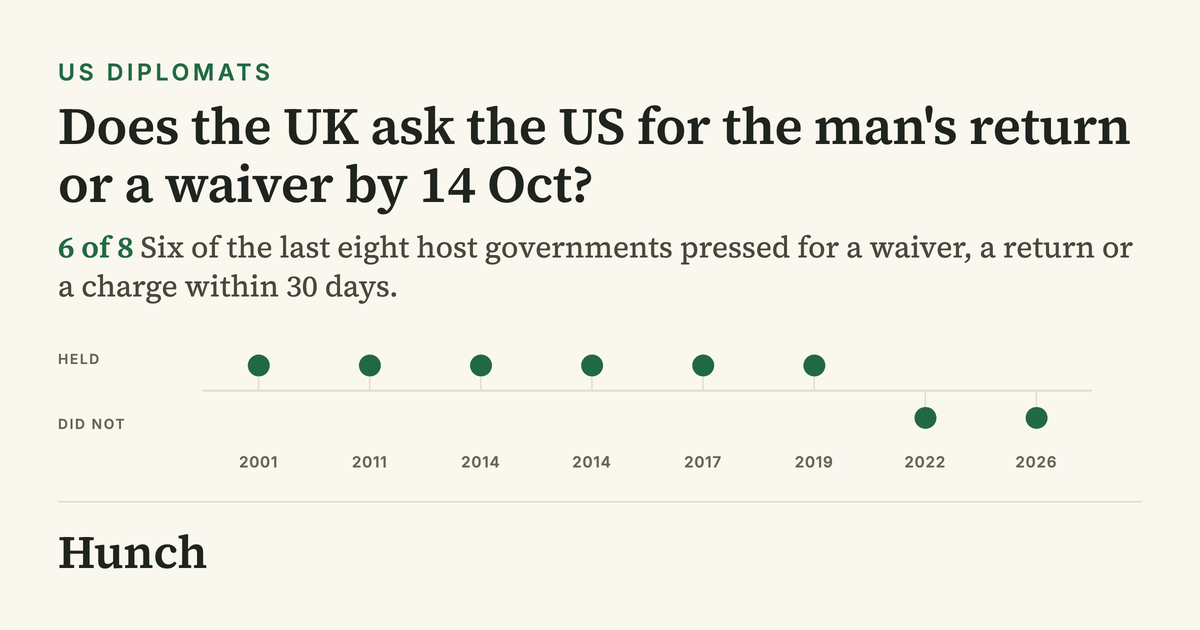
We looked for cases where a foreign country used immunity, its own courts or a flight home to keep one of its people away from the host country’s police after a serious alleged crime. We counted a case if, within 30 days of it becoming public, the host government said in public that it had asked for the protection to be lifted or the person returned, or brought its own charge. Below are the last eight, since 2001: Britain first, then other countries.
Show the other 6 cases
The Read
History from abroad points to a quick request, but Britain’s own record points the other way. In the last eight cases every foreign government pressed within days: New Zealand twice, the United States, Pakistan and Japan. Britain did so in 2019, when public anger over the death of Harry Dunn took Dominic Raab to Mike Pompeo within 48 hours. In 2022 and 2026 the Foreign Office waited for the police, and the justice secretary spoke of establishing the facts. The first week here looks like 2022, with a spokesperson’s statement and contact with the embassy. That is why our estimate starts at 30%, well below the record.
Washington’s move keeps the case inside its own system. The embassy detained the man itself, flew him out, told the Met afterwards on , and calls the transfer a reassignment during an investigation. That order of events avoids a second standoff like the Sacoolas case. Britain wants to look firm without a fight with the White House. Before the Foreign Office and Home Office can ask for a waiver and then for his withdrawal, as their procedure says. The Met can open its own London investigation, and the US Justice Department can charge him at home. Nick Timothy can push for an urgent question in the Commons when it sits on or returns from its conference break on .
The request could still come faster. This kind of crime moves ministers quickly, and the man is not a diplomat. The Conservative letter has already called the removal a cover-up. A Home Office statement that it has asked for his return, or a US charge, would each end the argument. Our estimate is wrong if a minister answers a Commons question with a formal request before the break starts on . A trial in either country would take years, so there is no long market. We will come back to this on .
Sources: BBC, Guardian (2, 3), BBC, UK Parliament recess dates
Disclaimer
Hunch works only from sources that are publicly available, and publishes on the basis of analysis of that material. We do not form an editorial opinion or take sides, we give a simpler and wider view of news that already exists. If information in a source we used was inaccurate, distorted, or later disputed but had already entered our analysis, Hunch accepts no liability for that. Predictions are not advice. Phase 1 markets use Hunch Points, not money.
Published by Hunch under the Editorial Code. Complaints and corrections: /contact/.