The US is reviewing its troops in Europe. Will it announce a cut by 31 December?
NATO diplomats told Politico on 1 November that Donald Trump could pull thousands more US troops out of Europe. A US review is due by December.
What happened
At the heart of the concerns is an upcoming review of U.S. forces in Europe, expected by December.
A US decision on its troops in Europe is due within weeks. On , US Defense Secretary Pete Hegseth announced a six-month review of American forces in Europe, including troop numbers and the right to use bases. Pentagon papers say Hegseth gets at least four options by , and the review officially ends in December.
On , five NATO diplomats told Politico they fear Donald Trump will turn harder on the alliance if his party loses the midterm elections. Three of them said he could pull thousands more US troops out of Europe. On the Democrats won both chambers of Congress.
The new Congress meets only on . Until then the old one sits, and its armed services committees are led by two Republicans, Senator Roger Wicker and Representative Mike Rogers, who opposed the cut in Germany in May. A US law sets a floor of 76,000 US troops in Europe. Reports put the number there now at about 68,000 or about 80,000.
The last cut came on , when the Pentagon said 5,000 troops would leave Germany after German Chancellor Friedrich Merz criticised the US war with Iran. The next day Trump said “we’re cutting a lot further than 5,000”. On the review was still going on, and no new cut had been named.
…thorough review of the Department’s force posture in Europe and is in recognition of theater requirements and conditions on the ground
Pentagon spokesman on the cut of 5,000 troops in Germany, 1 May 2026, as quoted by The Guardian
Sources: Politico Europe (2), The Independent (2), Al Jazeera (2), NPR, The Guardian (2), BBC
The Pattern
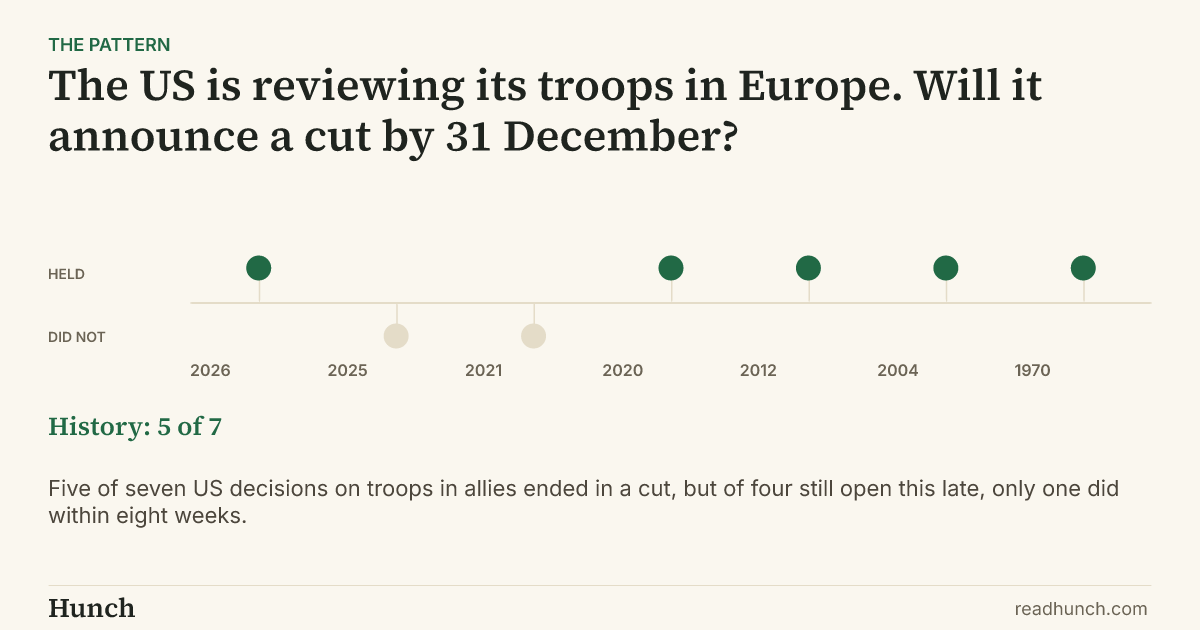
We looked for cases where the US government reached a decision on whether to cut its troops in an allied country, outside a war, whatever the result. We found seven such decisions since 1970, from South Korea under Richard Nixon to Germany this May. Five ended with a cut announced, and twice no cut was named.
Show the other 5 cases
The Read
Most of these decisions ended in a cut, but few came fast. Four of the seven decisions were still open after four and a half months, as this one is now. Only one of them, South Korea in 2004, ended in a cut in the next eight weeks. The current review began on , so is its 196th day. Both times a review had a set deadline, in 1969 and in 2025, the decision came after it, once by 323 days and once by about a month. Trump’s own team has also slowed him twice this year: in May, US media say, Secretary of State Marco Rubio stopped a pullout of up to 25,000 troops from Germany, and in June Rubio and other officials stopped a new announcement by Hegseth.
There are reasons for doubt. Every one of these decisions was made by the US, so this is the story of one country. When a plan for a cut is dropped before it is announced, as Hegseth’s was in June, the government makes no announcement at all. In an army brigade went home from Romania and three nearby countries without replacement, which took US troops in Romania from about 1,700 to about 1,000. The US Army said “This is not an American withdrawal from Europe”, so a step like that does not count as a cut here unless the US government names it one. Today there is also a US law with a floor of 76,000 troops in Europe.
Sources: US State Department, Office of the Historian (2), Politico Europe (2), CBS News, CNN, NBC News, Al Jazeera, The Independent, The Guardian, BBC
Disclaimer
Hunch works only from sources that are publicly available, and publishes on the basis of analysis of that material. We do not form an editorial opinion or take sides, we give a simpler and wider view of news that already exists. If information in a source we used was inaccurate, distorted, or later disputed but had already entered our analysis, Hunch accepts no liability for that. Predictions are not advice. Phase 1 markets use Hunch Points, not money.
Published by Hunch under the Editorial Code. Complaints and corrections: /contact/.