Why the nuclear talks promised by the US, Russia and China may take months to start
The US, Russia and China promised on 19 November to start talks on nuclear risks. They named no date and no place.
What happened
The US, Russia and China said in a joint declaration that they will conduct a dialogue on reducing nuclear risks.
Three presidents signed a joint declaration on . Donald Trump of the US, Vladimir Putin of Russia and Xi Jinping of China met as three for the first time in Shenzhen, China. The last of the declaration’s four points promises talks.
The three countries will conduct a dialogue on reducing nuclear risks and preventing the proliferation of nuclear weapons.
US, Russia and China declaration, 19 November 2026
The text names no date and no place for these talks. The Independent reported that “no time frame was given for the talks”. By none of the three governments had named a date or a place on its news pages.
China has about 600 nuclear warheads. The US and Russia each have more than 5,000. China turned down such talks before. The Guardian wrote that Beijing “has previously rebuffed Trump’s advances to join such talks, pointing to the larger US and Russian stockpiles”. Patricia Kim, an analyst at Brookings, said: “The real test will be whether the three countries follow through on their stated commitment”.
A US-Russian treaty limiting nuclear weapons ran out in , and Trump wants a new agreement that includes China.
Each of the three governments names a different subject. Trump spoke of “how to reduce the number of nuclear weapons on Earth”. China’s account says Xi asked to “establish crisis communication and prevention mechanisms”. Putin spoke of stopping the spread of nuclear weapons and said deals could be prepared “in the same or in a different format”.
Sources: US government (2), BBC, The Independent, US State Department, Kremlin (2, 3), Chinese foreign ministry (2), NBC News, The Guardian (2)
The Pattern
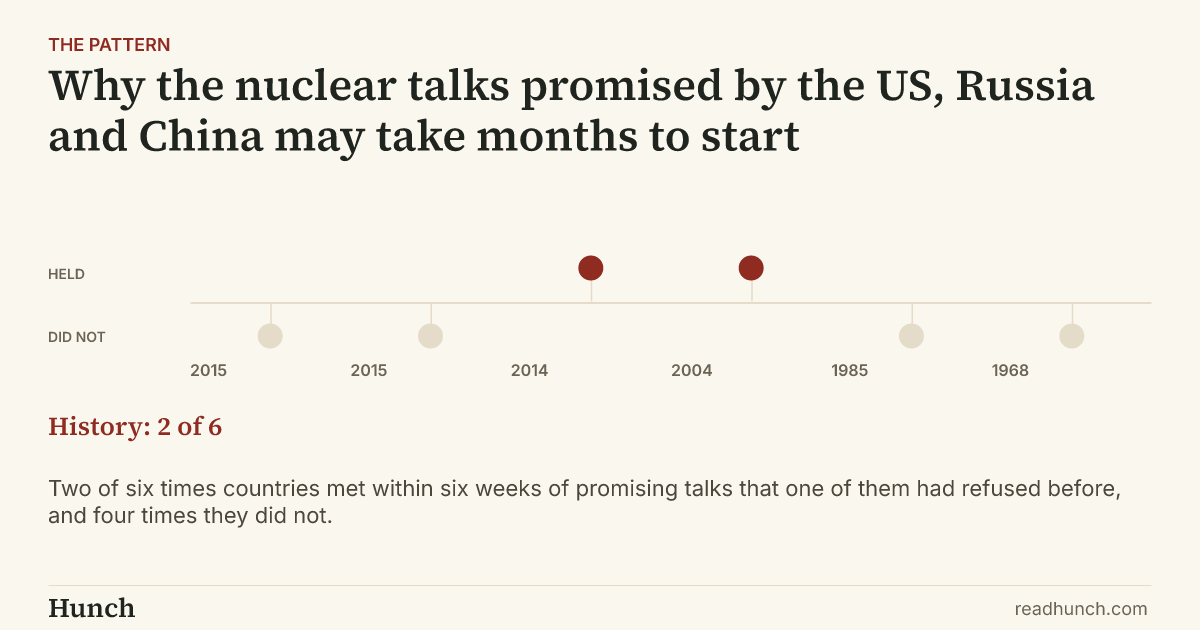
We looked for cases where countries publicly promised to start talks with each other, and one of them had until then refused or put off such talks. We checked six such promises from 1968 to 2015. Two led to a first meeting within six weeks. Four did not: two meetings came later in the first year, one came after 504 days, and one never took place.
Show the other 4 cases
The Read
Two of the six promises led to a first meeting within six weeks: the US and Cuba after 35 days, and India and Pakistan in 2004 after 41 days. Both times the month of the first meeting was named on the day of the promise. The US and the Soviet Union met 63 days after their promise of . In five of the six a date or a place for the first meeting was public within six weeks. A named date did not always bring a meeting. India and Pakistan cancelled their meeting one day before it, and the date they set for was dropped.
Each of the six promises was between two countries, and this one is between three. India and Pakistan made three of the six, two of them in 2015, and the US was a party to the other three. In three of the six the month or the place of the first meeting was named on the day of the promise, and the declaration of names neither. Putin said on of meetings of the three: “we did not agree to meet regularly in this format”. In 1968 the Soviet Union proposed a date and a place itself, and the start was then put off after the invasion of Czechoslovakia in August of that year.
Sources: The Guardian (2, 3, 4), US government archive, US State Department (2), Reagan Library, BBC (2, 3), US government, Kremlin
Disclaimer
Hunch works only from sources that are publicly available, and publishes on the basis of analysis of that material. We do not form an editorial opinion or take sides, we give a simpler and wider view of news that already exists. If information in a source we used was inaccurate, distorted, or later disputed but had already entered our analysis, Hunch accepts no liability for that. Predictions are not advice. Phase 1 markets use Hunch Points, not money.
Published by Hunch under the Editorial Code. Complaints and corrections: /contact/.