US plans tariffs up to 12.5% on 60 economies. What replaces the old ones in July?
The US Trade Representative proposed duties of 10% to 12.5% on 60 economies under Section 301 trade law, over forced labour. Hearings open on 7 July.
What happened
USTR proposed additional duties of 10% to 12.5% on 60 economies after Section 301 forced-labour investigations, with written comments due and a public hearing on .
On the US Supreme Court struck down Trump’s tariffs. It ruled 6-3 that an emergency powers law, the International Emergency Economic Powers Act, does not let the president set tariffs. Chief Justice Roberts wrote the opinion.
The ruling confirmed that two sets of tariffs were unlawful: the duties on Canada, Mexico and China linked to the drug fentanyl, and the worldwide ‘reciprocal’ tariffs. It left open whether more than $200bn already collected must be paid back. Overnight, the government lost the main legal tool of its trade policy.
The government rebuilt the tariffs using older laws. A temporary layer of tariffs under Section 122, a law on the balance of payments that allows tariffs for no more than 150 days, ends on .
The longer-term replacement came on . The US Trade Representative, the office in charge of US trade policy, announced findings in 60 separate investigations under Section 301 into forced labour. It proposed extra tariffs of 10% for economies that ban imports made with forced labour and 12.5% for the rest. China is among the 46 economies facing the higher rate.
Written comments closed on and a public hearing follows on .
China’s position makes the timetable harder. China has said it wants to extend the one-year trade truce agreed last autumn. It has also signalled that it would accept tariffs coming back through Section 301, as long as rates go no higher than before. The truce runs to November, but the shape of the new tariffs will decide whether it lasts that long.
Sources: USTR, Supreme Court, Bloomberg
The Pattern
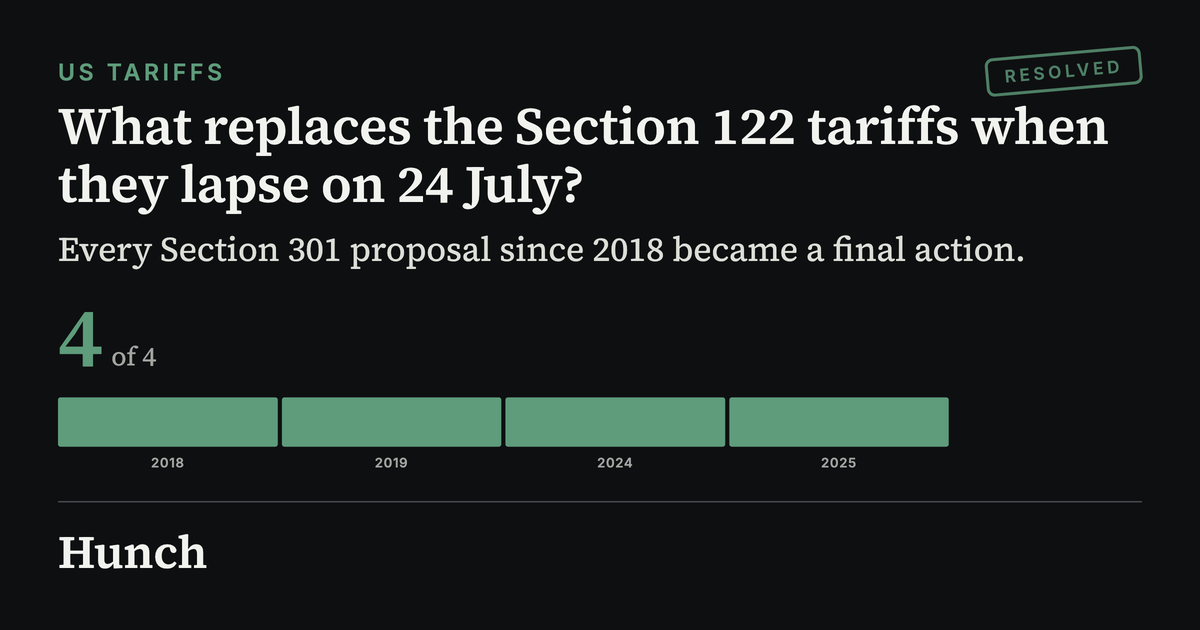
We looked at the four Section 301 cases since 2018 where the US proposed tariffs and then reached a final decision. Section 301 is the trade law behind the new plan. All four proposals went ahead. But in three of them the final tariffs changed after the hearings, in size or in timing.
Show the other 2 cases
The Read
History says the tariffs come back. All four earlier Section 301 proposals became final, and the government has a hard deadline, because the Section 122 tariffs end on . A White House that spent 2025 building pressure on trade partners is unlikely to let its basic tariff fall to zero.
Timing is where history is weak. The usual gap from proposal to final tariffs is about three months, and the hearing only opens on . Running 60 investigations at once has never been tried before. A final decision within five weeks would be the fastest major Section 301 decision on record. Against that, this government likes to move fast and has every reason to here. The gap after could be filled by the new tariffs or by some other temporary step.
History also warns that a proposal can change after its hearing. China has named a limit on rates, and the EU is on the list of 60 three weeks after its trade deal began. Pressures like these trimmed the 2019 and 2025 tariffs. What is legally in force on , as shown in the Federal Register, the US government’s official journal, will settle the question.
Disclaimer
Hunch works only from sources that are publicly available, and publishes on the basis of analysis of that material. We do not form an editorial opinion or take sides, we give a simpler and wider view of news that already exists. If information in a source we used was inaccurate, distorted, or later disputed but had already entered our analysis, Hunch accepts no liability for that. Predictions are not advice. Phase 1 markets use Hunch Points, not money.
Published by Hunch under the Editorial Code. Complaints and corrections: /contact/.